Nvidia’s Ambitious Leap: Pioneering the Future of Generalist Robotics
At CES 2026, Nvidia unveiled a comprehensive suite of robot foundation models, simulation tools, and edge hardware, signaling its intent to become the cornerstone platform for generalist robotics, much like Android’s dominance in the smartphone arena. This strategic move underscores a broader industry trend where artificial intelligence (AI) transitions from cloud-based systems to tangible machines capable of autonomous reasoning and interaction within the physical world. This evolution is facilitated by advancements in sensor technology, sophisticated simulation environments, and AI models that can generalize across diverse tasks.
Nvidia’s Full-Stack Ecosystem for Physical AI
Nvidia’s latest offerings encompass a full-stack ecosystem designed to empower robots with the ability to reason, plan, and adapt across various tasks and environments. These open foundation models are accessible on Hugging Face, a prominent platform for AI model sharing and collaboration. Key components of this ecosystem include:
– Cosmos Transfer 2.5 and Cosmos Predict 2.5: These world models are instrumental in generating synthetic data and evaluating robot policies within simulated environments. By leveraging these models, developers can create robust training datasets and assess robotic behaviors without the constraints of physical testing.
– Cosmos Reason 2: Serving as a reasoning vision language model (VLM), Cosmos Reason 2 enables AI systems to interpret visual data, comprehend contextual information, and execute actions within the physical realm. This model bridges the gap between visual perception and actionable intelligence, allowing robots to make informed decisions based on their surroundings.
– Isaac GR00T N1.6: Tailored specifically for humanoid robots, this next-generation vision language action (VLA) model utilizes Cosmos Reason as its cognitive core. Isaac GR00T N1.6 facilitates whole-body control, enabling humanoid robots to perform complex movements and manipulate objects simultaneously, thereby enhancing their versatility and functionality.
Isaac Lab-Arena: A Virtual Testing Ground
To complement these models, Nvidia introduced Isaac Lab-Arena, an open-source simulation framework available on GitHub. This platform addresses a significant industry challenge: validating complex robotic tasks in physical environments can be prohibitively expensive, time-consuming, and fraught with risk. Isaac Lab-Arena mitigates these issues by providing a consolidated resource that includes task scenarios, training tools, and established benchmarks such as Libero, RoboCasa, and RoboTwin. By offering a unified standard, this framework streamlines the development and testing process, fostering innovation and accelerating deployment.
Nvidia OSMO: Integrating the Workflow
Supporting this ecosystem is Nvidia OSMO, an open-source command center that integrates the entire workflow from data generation through training across both desktop and cloud environments. OSMO serves as the connective infrastructure, ensuring seamless coordination between various components of the development process. This integration enhances efficiency, reduces development time, and facilitates collaboration among developers.
Jetson T4000: Powering the Future
To power these advancements, Nvidia unveiled the Blackwell-powered Jetson T4000 graphics card, the latest addition to the Thor family. Positioned as a cost-effective on-device compute upgrade, the Jetson T4000 delivers 1200 teraflops of AI compute and 64 gigabytes of memory while operating efficiently within a 40 to 70-watt power envelope. This hardware innovation provides the computational muscle necessary to support sophisticated AI models and complex robotic applications.
Collaboration with Hugging Face
Nvidia is also deepening its partnership with Hugging Face to democratize robot training. This collaboration integrates Nvidia’s Isaac and GR00T technologies into Hugging Face’s LeRobot framework, connecting Nvidia’s extensive network of robotics developers with Hugging Face’s vast community of AI builders. The developer platform’s open-source Reachy 2 humanoid now operates directly with Nvidia’s Jetson Thor chip, allowing developers to experiment with various AI models without being confined to proprietary systems. This partnership aims to make robotics development more accessible and foster a collaborative environment for innovation.
Industry Adoption and Impact
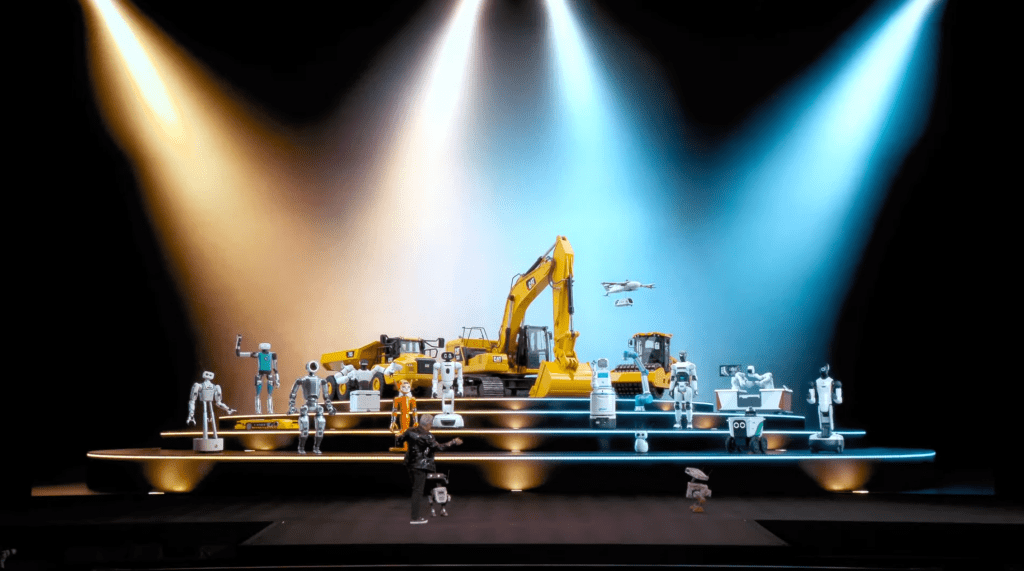
Early indicators suggest that Nvidia’s strategy is gaining traction. Robotics has emerged as the fastest-growing category on Hugging Face, with Nvidia’s models leading in downloads. Prominent robotics companies, including Boston Dynamics, Caterpillar, Franka Robots, and NEURA Robotics, are already integrating Nvidia’s technology into their systems. This widespread adoption underscores Nvidia’s potential to become the default platform for generalist robotics, much like Android’s role in the smartphone industry.
Conclusion
Nvidia’s comprehensive approach to generalist robotics, encompassing advanced AI models, simulation tools, hardware innovations, and strategic partnerships, positions the company at the forefront of this transformative field. By providing a robust and accessible platform, Nvidia is not only accelerating the development and deployment of intelligent robots but also shaping the future of how machines interact with and navigate the physical world. As AI continues to evolve and permeate various aspects of society, Nvidia’s initiatives in generalist robotics are poised to have a profound and lasting impact.