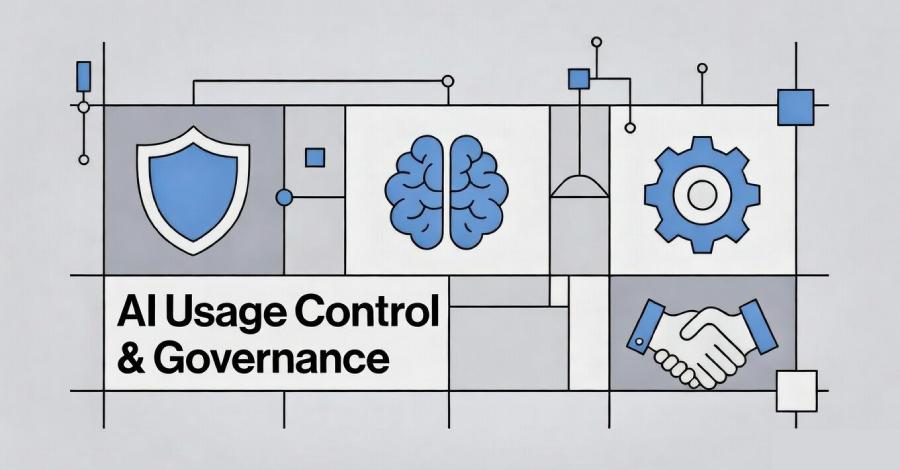
Introducing the Comprehensive RFP Template for AI Usage Control and Governance
As artificial intelligence (AI) becomes integral to enterprise productivity, security leaders are increasingly allocated budgets to secure AI systems. However, many organizations face a significant challenge: they recognize the need for AI governance but lack clarity on specific requirements.
The CISO’s Dilemma: Budget Without Clear Requirements
With AI at the forefront of enterprise operations, Chief Information Security Officers (CISOs) are receiving the necessary funding to implement security measures. Yet, a pressing issue arises: organizations understand the importance of AI governance but are uncertain about the exact solutions they need.
Without a structured approach to evaluate the rapidly expanding market of AI Usage Control (AUC) solutions, teams risk investing in outdated tools ill-suited for modern workflows and emerging technologies.
To address this challenge, a new Request for Proposal (RFP) Guide for Evaluating AI Usage Control and AI Governance Solutions has been introduced. This guide offers a technical framework to help security architects and CISOs transition from broad AI security objectives to specific, measurable project criteria.
Shifting Focus: From Application Proliferation to Interaction Governance
Traditional approaches suggest that securing AI involves cataloging every application employees use. This method is increasingly ineffective. The RFP Guide advocates for a paradigm shift: viewing AI security as an interaction issue rather than an application problem.
Focusing solely on applications means constantly trying to keep up with the hundreds of new AI tools introduced weekly. By concentrating on interactions—such as when a prompt is entered or a file is uploaded—organizations can achieve tool-agnostic control.
The advantage: Utilizing this RFP to demand interaction-level inspection allows organizations to facilitate innovation while safeguarding data, regardless of which new AI tool is adopted by various departments.
Assessing the Limitations of Current Security Stacks
Many vendors claim to offer AI security as an additional feature within their Cloud Access Security Broker (CASB) or Security Service Edge (SSE) solutions. The RFP Guide assists in critically evaluating these claims. Most traditional tools rely on network-layer visibility, which fails to monitor activities within browser-side panels or encrypted Integrated Development Environment (IDE) plugins.
The guide prompts vendors to address critical questions:
– Can AI usage be detected in Incognito mode?
– Is there support for AI-native browsers like Atlas, Dia, or Comet?
– Can the system differentiate between corporate and personal identities within the same session?
The benefit: This structured approach prevents superficial feature claims by requiring vendors to demonstrate their capability to operate at the interaction level without necessitating heavy endpoint agents or disruptive network modifications.
The Eight Pillars of a Robust AI Governance Project
The RFP Template offers a technical evaluation framework across eight essential domains to ensure the selected solution is future-proof:
1. AI Discovery & Coverage: Ensures visibility across browsers, SaaS applications, extensions, and IDEs.
2. Contextual Awareness: Assesses whether the tool comprehends the user and the purpose of their actions.
3. Policy Governance: Evaluates the ability to block Personally Identifiable Information (PII) while permitting benign summaries.
4. Real-Time Enforcement: Determines the capability to prevent data leaks before actions are finalized.
5. Auditability: Provides compliance-ready reports suitable for board presentations.
6. Architecture Fit: Assesses whether the solution can be deployed swiftly without disrupting existing network infrastructure.
7. Deployment & Management: Ensures the tool is manageable and does not overburden IT staff.
8. Vendor Futureproofing: Evaluates readiness for autonomous, agent-driven workflows.
From Policy Documents to Enforceable Controls
The objective of this RFP is not merely to collect information but to evaluate it rigorously. The guide includes a response format that requires vendors to provide detailed explanations and references, moving beyond simple Yes/No answers.
This structured methodology eliminates guesswork in procurement. Instead of relying on subjective impressions of vendors, organizations receive a score-based comparison of how each handles real-world risks, such as prompt injections and unmanaged Bring Your Own Device (BYOD) environments.
Next Steps: Define Requirements Proactively
Utilize the RFP Guide for Evaluating AI Usage Control Solutions to take a proactive stance. This resource will help standardize evaluations, expedite research, and ultimately enable the safe adoption of AI that scales with business needs.