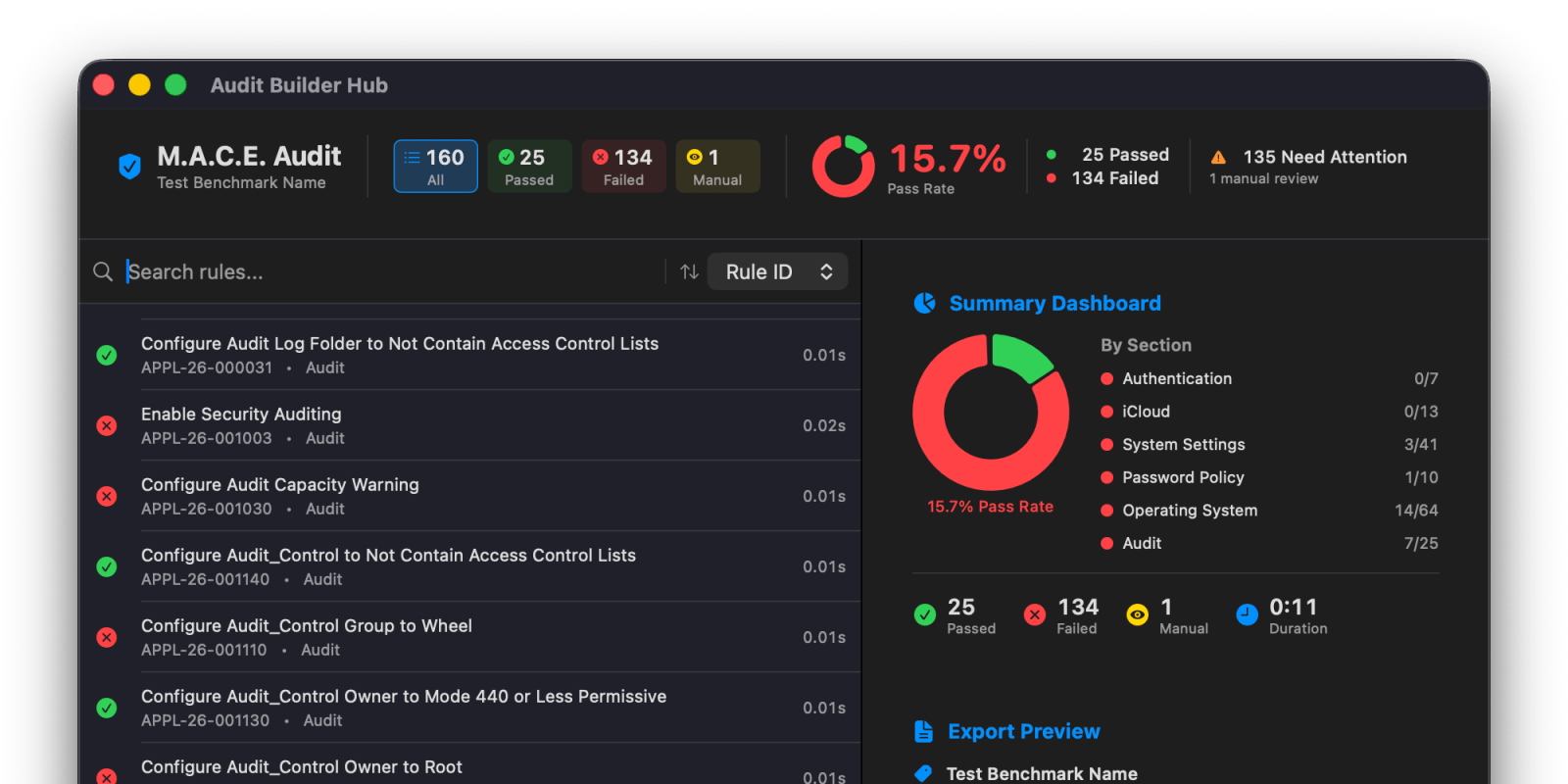
M.A.C.E.: Empowering Mac Admins with Simplified Security Compliance
In the early days of Mac integration into enterprise environments, IT administrators faced significant challenges. Apple devices were often sidelined in favor of Windows systems, leaving Mac admins to develop their own tools and scripts to manage and secure their fleets. Fast forward to today, Apple has become a prominent player in the corporate world, yet the spirit of community-driven innovation among Mac administrators remains strong. A testament to this collaborative effort is the development of M.A.C.E. (macOS Security Compliance Editor), an open-source application designed to streamline the implementation of security compliance benchmarks.
Understanding the macOS Security Compliance Project
The macOS Security Compliance Project (mSCP) is an open-source initiative that provides a structured approach to generating security guidance for macOS systems. Unlike traditional methods that offer static documents, mSCP delivers dynamic resources, including customized documentation, remediation scripts, configuration profiles, and audit checklists tailored to specific organizational requirements. Endorsed by NIST Special Publication 800-219, this project is a collaborative effort involving federal IT security personnel and volunteers from esteemed organizations such as NIST, NASA, the U.S. Navy, and the Center for Internet Security. Apple also acknowledges the project’s significance on its support website.
By leveraging a comprehensive set of tested controls for macOS, mSCP maps them against established security guidelines. This resource enables IT teams to create customized security baselines using a library of validated configuration settings, resulting in actionable content that can be integrated into management tools to achieve compliance.
Introducing M.A.C.E.: A User-Friendly Interface for mSCP
While mSCP offers robust resources, it often requires editing complex YAML files and navigating intricate scripts, which can be daunting for many IT professionals. M.A.C.E. addresses this challenge by providing a graphical user interface (GUI) that simplifies the utilization of mSCP. Instead of sifting through lines of code to implement specific security controls, M.A.C.E. presents these options in an intuitive dashboard.
Users can load standard baselines, such as NIST 800-171 or the CIS Benchmark, and easily toggle specific rules on or off to align with their organization’s policies. Once the baseline is customized, M.A.C.E. generates the necessary output files, including configuration profiles and scripts, which can be directly uploaded to device management services. This functionality empowers even smaller IT teams to deploy robust security standards without the need for dedicated security engineers or external vendors.
The Evolution of M.A.C.E. and Its Roadmap
One concern with open-source tools is the potential for abandonment. However, M.A.C.E. demonstrates a commitment to continuous improvement with an active development roadmap. Future enhancements include:
– Importing Existing Baselines: Facilitating the import of existing mSCP 1.0 and 2.0 baselines to streamline the transition for organizations already utilizing these versions.
– Audit and Remediation Integration: Enabling the execution of official mSCP audits and applying fixes directly from the results, effectively closing the loop between identifying compliance issues and resolving them.
– Automatic Rule Updates: Implementing automatic updates from the mSCP repository to ensure that security controls remain current with evolving standards.
These planned features aim to transform M.A.C.E. into a set it and forget it utility for compliance management, reducing the manual effort required to maintain security standards.
Accessibility and Community Support
M.A.C.E. is available at no cost, reflecting the collaborative ethos of the Mac admins community. As an open-source project, it eliminates subscription fees and procurement processes, allowing organizations to download the latest release directly from GitHub. Users who find value in the tool are encouraged to support the developer through donations, fostering continued development and enhancement.
Conclusion
The development of M.A.C.E. exemplifies the enduring spirit of the Mac admins community, which continues to create innovative solutions to address the evolving challenges of enterprise security compliance. By simplifying the implementation of complex security benchmarks, M.A.C.E. empowers IT teams to effectively secure their macOS environments, regardless of size or resources.