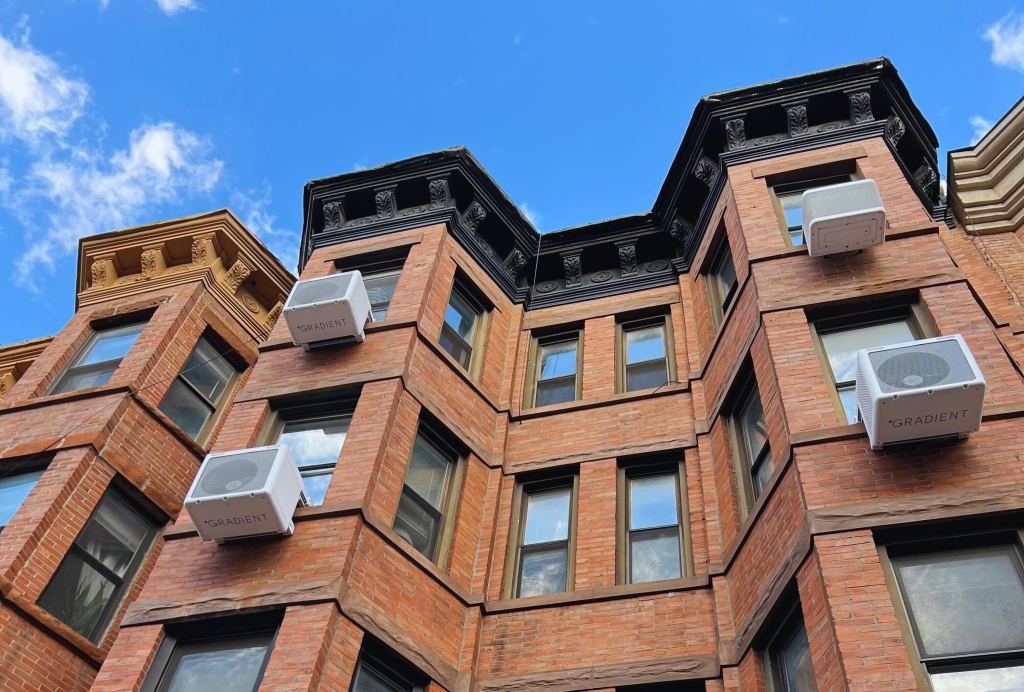
Revolutionizing Comfort: Gradient’s Smart Heat Pumps Transform Aging Buildings
In cities like New York, numerous historic buildings, while architecturally significant, often fall short in providing modern comfort. Constructed during an era when large boilers were considered state-of-the-art, these structures frequently struggle to maintain consistent indoor temperatures, leading to environments that are either excessively hot or uncomfortably cold.
Addressing this challenge, innovative companies have developed advanced, horseshoe-shaped heat pumps. Resembling traditional window air conditioners in appearance, these devices offer the dual functionality of heating and cooling without obstructing views.
Gradient, a leader in this technological advancement, has introduced a groundbreaking feature: the ability to interconnect multiple window units within multifamily residences. This development was exclusively shared with TechCrunch, highlighting the launch of their Nexus software and service.
Multifamily buildings have long been overlooked, stated Vince Romanin, Gradient’s Chief Technology Officer, in an interview with TechCrunch. There’s a significant opportunity to enhance the living experience for residents.
Gradient’s primary focus is on retrofitting older buildings in need of HVAC system upgrades. Collaborations with the New York City Housing Authority have led to the installation of these heat pumps in public housing units. Additionally, a pilot program in Tracy, California, saw the implementation of these systems in a contemporary two-story affordable housing complex. Discussions are also underway with various colleges and universities, many of which have dormitories ill-equipped for the increasingly warm autumn seasons.
A common issue in older buildings is the presence of a single electric meter, which can inadvertently encourage residents to overuse heating or air conditioning. The Nexus system empowers building managers by allowing them to set parameters that prevent excessive energy consumption while ensuring resident comfort. For instance, by capping the heating temperature at 78°F, one building manager observed a 25% reduction in energy usage the following day.
Romanin emphasized that Gradient’s heat pumps represent the most cost-effective solution for aging buildings with outdated boilers, a prevalent scenario in New York City. An added advantage is that units previously reliant solely on steam radiators now benefit from air conditioning, preparing them for intensifying heat waves.
Opting for window units over minisplit systems facilitates rapid retrofitting, often completed within hours, and eliminates the need for electrical system upgrades. In buildings with antiquated wiring incapable of supporting a full 12-amp load on a single outlet, the Nexus system can adjust the power draw accordingly, as explained by Mansi Shah, Gradient’s Senior Vice President of Product and Software.
This adaptive approach extends beyond individual buildings. During periods of peak demand, such as hot summer days, Gradient is developing methods to reduce the operational load of its heat pumps without compromising occupant comfort. By analyzing building data and utilizing sensors within the heat pumps, the company aims to identify units that can decrease air conditioning demand, such as those located on the shaded side of a building. This demand-response strategy enhances grid efficiency, allowing for the integration of more heat pumps without necessitating expensive infrastructure upgrades.
There’s a prevailing notion that electrifying everything will overwhelm the grid, Romanin remarked. However, we believe it’s entirely feasible to electrify systems in a manner that strengthens the grid, simplifies its operation, and reduces the cost of electricity.