Google’s Emergency Location Service Debuts in India, Enhancing Emergency Response
In a significant advancement for emergency response capabilities, Google has launched its Emergency Location Service (ELS) in India, with Uttar Pradesh being the first state to implement this technology. This integration aims to provide precise caller location information to emergency responders, thereby improving the efficiency and effectiveness of emergency services.
Understanding Emergency Location Service (ELS):
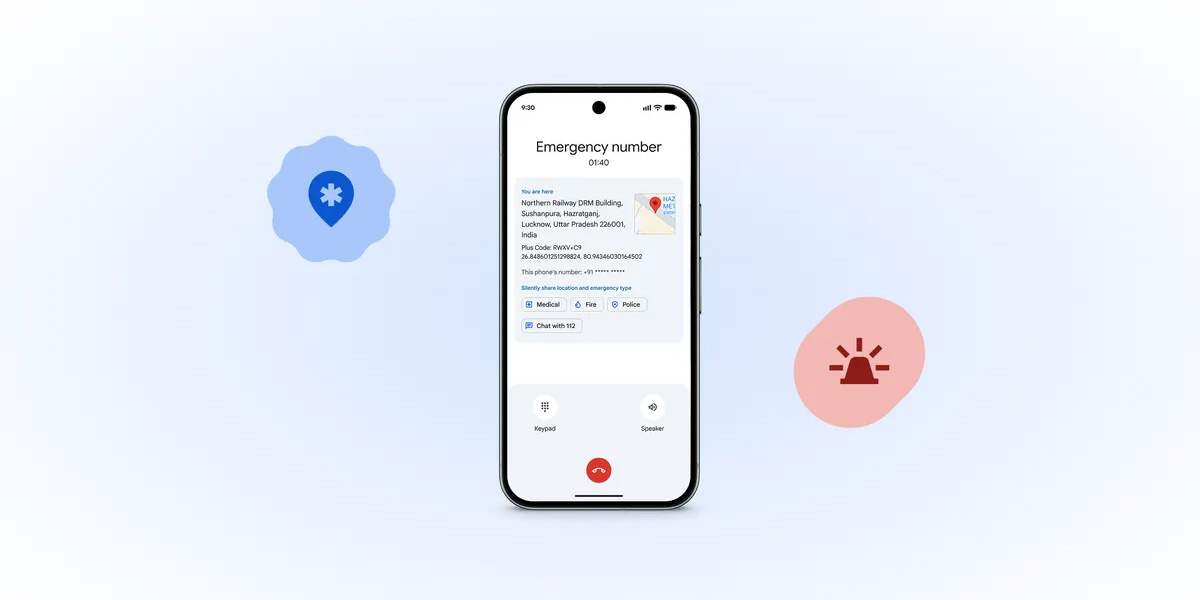
ELS is an in-built feature in Android devices designed to automatically transmit a caller’s exact location to emergency services when an emergency call or SMS is made. This functionality is particularly crucial in situations where the caller is unable to communicate their location due to distress, poor network conditions, or abrupt call disconnections.
How ELS Operates:
Upon initiating an emergency call or sending an SMS to 112, ELS activates and utilizes the Android Fused Location Provider. This system amalgamates data from GPS, Wi-Fi, and cellular networks to determine the caller’s position with remarkable accuracy, often within a 50-meter radius. Additionally, ELS can convey the device’s language settings, facilitating more effective communication between emergency operators and callers.
Implementation in Uttar Pradesh:
Uttar Pradesh has pioneered the adoption of ELS in India through a collaboration between the Uttar Pradesh Police and Pert Telecom Solutions Pvt Ltd (PertSol). The technology is seamlessly integrated into the state’s 112 emergency response system, enabling police, medical, and fire services to instantly access caller locations and dispatch assistance promptly.
Prior to its full-scale deployment, ELS underwent a pilot phase in Uttar Pradesh, during which it supported over 20 million emergency calls and SMS messages. The pilot demonstrated the system’s capability to accurately identify caller locations, even in instances where calls were disconnected shortly after being established.
Privacy Considerations:
Google emphasizes that privacy is a fundamental aspect of ELS. The service activates solely during emergency communications and does not operate in the background. Location data is transmitted directly from the device to emergency services and is neither collected nor stored by Google. This ensures that users’ privacy is maintained while providing critical location information during emergencies.
Technical Requirements and Accessibility:
ELS is compatible with smartphones running Android 6.0 and above and does not necessitate any additional applications or hardware. This broad compatibility ensures that a vast majority of Android users can benefit from this life-saving feature without the need for manual activation or installation.
Broader Implications and Future Prospects:
The activation of ELS in Uttar Pradesh marks a significant milestone in enhancing emergency response services in India. By providing precise location data, ELS has the potential to significantly reduce response times, thereby increasing the likelihood of positive outcomes in emergency situations.
While Uttar Pradesh is the first state to implement ELS, there is potential for expansion to other regions in India. The successful deployment in Uttar Pradesh serves as a model for other states to consider integrating this technology into their emergency response systems.
Conclusion:
The introduction of Google’s Emergency Location Service in India represents a pivotal advancement in the country’s emergency response infrastructure. By leveraging technology to provide accurate and timely location information, ELS enhances the ability of emergency services to respond effectively, ultimately contributing to the safety and well-being of the populace.