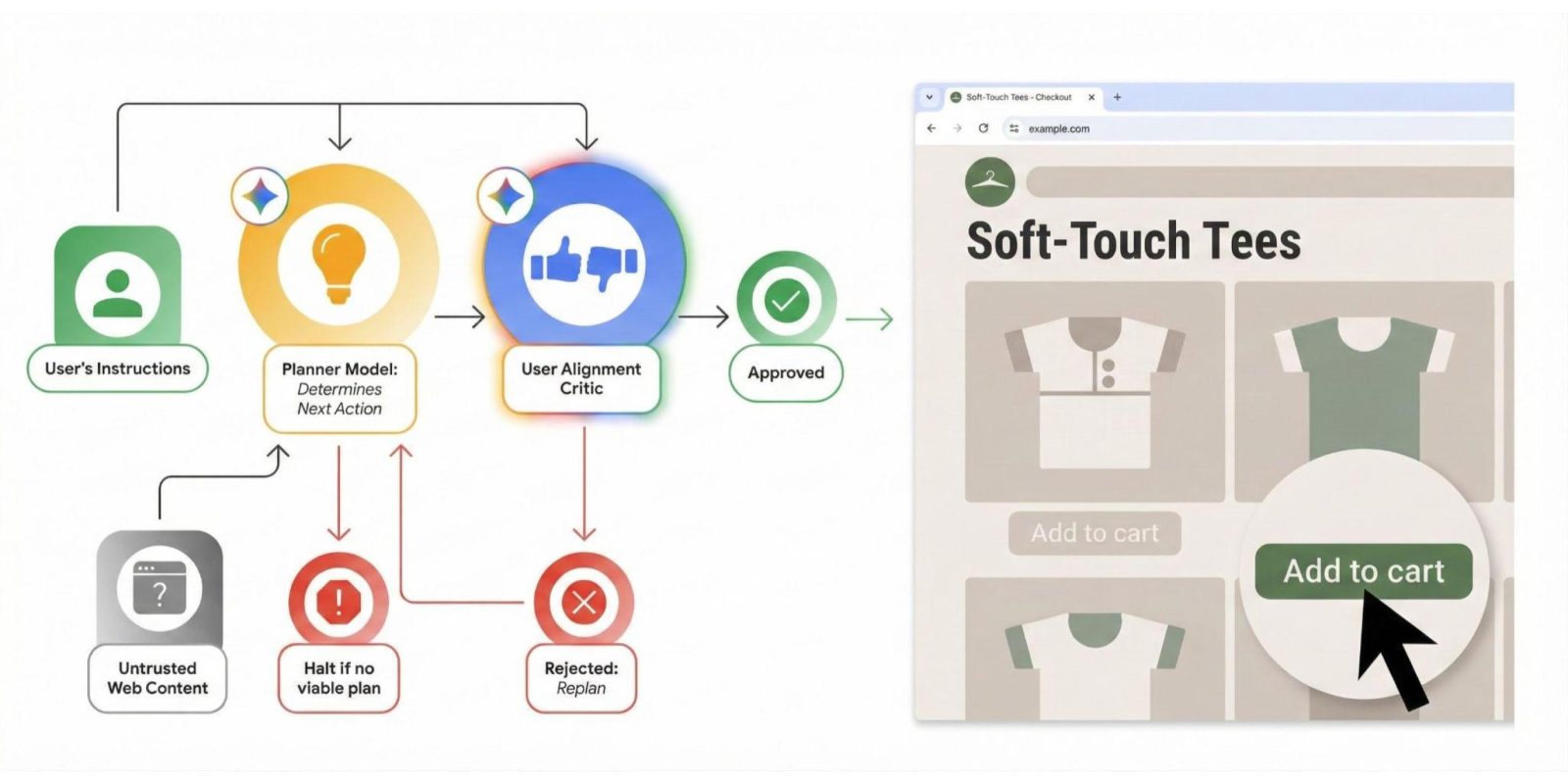
Enhancing Security in Chrome’s Agentic Browsing with Gemini
As Google integrates its advanced AI model, Gemini, into the Chrome browser, it introduces agentic capabilities designed to perform tasks autonomously on behalf of users. This evolution, while enhancing user experience, also brings forth new security challenges, particularly the risk of indirect prompt injection attacks.
Understanding Indirect Prompt Injection
Indirect prompt injection is a sophisticated attack method where malicious entities manipulate the AI agent to execute unintended actions, such as initiating unauthorized financial transactions or extracting sensitive user data. These attacks can originate from various sources, including compromised websites, embedded third-party content, or user-generated inputs like reviews and comments.
Google’s Multi-Layered Defense Strategy
To counteract these threats, Google has implemented a comprehensive, layered defense mechanism within Chrome’s agentic browsing framework:
1. User Alignment Critic Model: This specialized model, developed using Gemini, evaluates each proposed action post-planning to ensure alignment with the user’s intended goals. If an action is deemed misaligned, it is vetoed, prompting the planning model to reformulate its approach. Persistent misalignments result in the system reverting control back to the user. Notably, the Alignment Critic operates solely on metadata about the proposed actions, thereby remaining insulated from potentially malicious web content.
2. Agent Origin Sets: Building upon Chrome’s existing origin-isolation capabilities, this feature restricts the AI agent’s interactions to web origins pertinent to the current task or those explicitly approved by the user. This architectural limitation prevents a compromised agent from accessing unrelated or unauthorized web origins, thereby mitigating potential security breaches.
3. Enhanced User Control and Transparency: Gemini in Chrome maintains a detailed work log, providing users with real-time insights into each step of the agent’s actions. Users retain the ability to intervene and assume control at any point. Additionally, the system incorporates deterministic and model-based checks that necessitate user confirmations before executing significant actions, such as:
– Navigating to sensitive websites, including those related to banking or personal medical information.
– Signing into sites via Google Password Manager, with the model lacking direct access to stored passwords.
– Performing sensitive web actions like completing purchases, sending messages, or other consequential tasks.
Commitment to User Safety
By integrating these robust security measures, Google aims to ensure that the introduction of agentic browsing through Gemini enhances user experience without compromising safety. This proactive approach underscores Google’s dedication to maintaining a secure and trustworthy browsing environment as AI continues to evolve within its platforms.