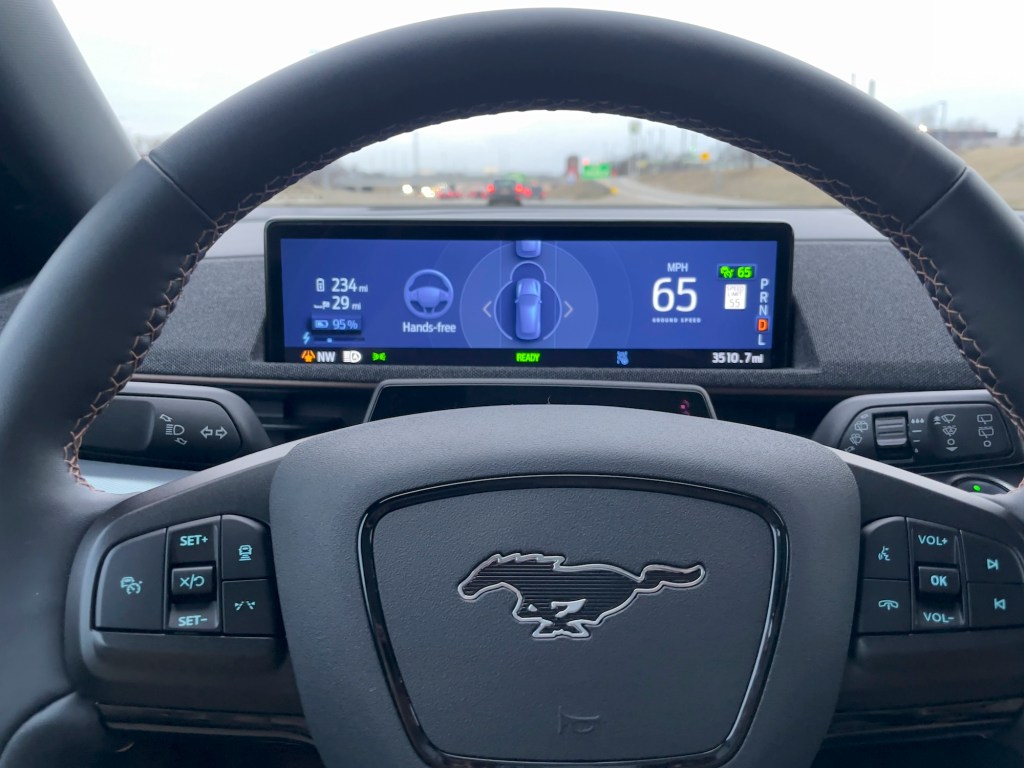
Investigating Fatal Crashes Involving Ford’s BlueCruise: A Closer Look at Driver Distraction and System Limitations
In early 2024, two tragic incidents involving Ford’s BlueCruise hands-free driving system resulted in fatalities, prompting thorough investigations by the National Transportation Safety Board (NTSB) and the National Highway Traffic Safety Administration (NHTSA). Recent findings suggest that driver distraction played a significant role in both crashes, raising critical questions about the efficacy and safety of semi-autonomous driving technologies.
Incident Summaries
San Antonio, Texas Crash
In February 2024, a 2022 Ford Mustang Mach-E, operating under BlueCruise, collided with a stationary 1999 Honda CR-V on Interstate 10. The impact occurred at approximately 74 miles per hour, resulting in the death of the Honda driver and minor injuries to the Ford driver. Data from the vehicle’s driver-monitoring system indicated that the Ford driver was looking at the infotainment screen in the five seconds leading up to the crash. Despite receiving visual and auditory alerts to refocus on the road, the driver did not apply the brakes before the collision. The driver later informed authorities that he was using the navigation system to locate a charging station, which may have contributed to his distraction.
Philadelphia, Pennsylvania Crash
In March 2024, another fatal accident occurred on Interstate 95 involving a 2022 Mustang Mach-E with BlueCruise engaged. The vehicle struck a stationary 2012 Hyundai Elantra, which then collided with a 2006 Toyota Prius. Both the Elantra and Prius drivers were killed, while the Mach-E driver sustained minor injuries. Investigations revealed that the Mach-E driver, a 23-year-old woman named Dimple Patel, was intoxicated at the time of the crash and was later charged with DUI homicide. Although the driver-monitoring system recorded her eyes as being on the road, a photograph taken two seconds before impact showed her holding a phone above the steering wheel, suggesting potential distraction.
Investigations and Findings
The NTSB’s investigations into these incidents have highlighted several critical issues:
1. Driver Distraction: Both crashes involved drivers who were likely distracted before impact. In the San Antonio case, the driver was interacting with the vehicle’s navigation system, while in Philadelphia, the driver was potentially using a mobile phone.
2. System Limitations: The NHTSA identified limitations in BlueCruise’s ability to detect stationary vehicles under certain conditions, particularly at high speeds and in low-visibility environments. This raises concerns about the system’s reliability in preventing collisions with stationary objects.
3. Driver Monitoring Efficacy: The effectiveness of BlueCruise’s driver-monitoring system is under scrutiny. In the Philadelphia crash, the system failed to detect the driver’s potential distraction due to her holding a phone above the steering wheel, outside the system’s monitoring range.
Ford’s Position and System Overview
Ford emphasizes that BlueCruise is a convenience feature and not a substitute for active driver engagement. The company advises drivers to remain attentive and ready to take control at all times, stating that BlueCruise is not a crash warning or avoidance system. The system is available for a one-time fee of $2,495 or a $495 annual subscription.
BlueCruise operates on pre-mapped highways, allowing for hands-free driving while monitoring the driver’s attention through an eye-tracking system. However, the recent incidents have raised questions about the system’s ability to handle real-world driving scenarios, especially those involving stationary vehicles and driver distraction.
Regulatory Actions and Industry Implications
The NTSB has scheduled a public hearing on March 31 in Washington, D.C., to discuss the findings from these investigations and to issue recommendations to Ford. The NHTSA’s ongoing investigation focuses on the limitations of BlueCruise in detecting stationary vehicles and the overall performance of the driver-monitoring system.
These investigations underscore the broader challenges facing the automotive industry as it navigates the integration of semi-autonomous technologies. Ensuring that drivers remain engaged and that systems can reliably detect and respond to various driving conditions is paramount.
Conclusion
The fatal crashes involving Ford’s BlueCruise system serve as a stark reminder of the complexities and responsibilities associated with semi-autonomous driving technologies. As investigations continue, it is crucial for manufacturers, regulators, and drivers to collaborate in enhancing the safety and reliability of these systems. Clear communication about system capabilities, robust driver-monitoring mechanisms, and continuous improvement in detection technologies are essential steps toward preventing future tragedies.