Scaling Early Threat Detection in Your SOC Without Additional Staff
In the rapidly evolving landscape of cybersecurity, early threat detection is not merely a best practice—it is the critical factor that distinguishes a contained incident from a catastrophic breach. Despite this, numerous organizations worldwide face a significant gap between the time an attacker infiltrates their systems and when the breach is detected, often resulting in severe consequences.
The High Cost of Delayed Detection
Recent studies highlight the alarming repercussions of delayed threat detection. Attackers can move laterally across a network in under an hour, yet organizations may take an average of six months to identify a breach. Notably, the fastest recorded lateral movement in 2024 was a mere fifty-one seconds, as reported in CrowdStrike’s 2025 Global Threat Report. This shrinking window for early intervention underscores the urgency for organizations to enhance their detection capabilities.
The expansion of the threat surface further complicates this challenge. Supply chain compromises doubled as a share of breaches from 2024 to 2025, indicating that traditional, manual, or reactive methods are insufficient to keep pace with the growing volume and sophistication of threats. For Security Operations Center (SOC) managers, the ability to detect threats early—before they escalate—is paramount in mitigating the severity and cost of breaches.
The Limitations of Expanding Staff
While increasing the number of analysts might seem like a straightforward solution, it is often unsustainable due to several factors:
– Talent Shortage: The cybersecurity field faces a significant talent gap, with over 750,000 positions unfilled in the U.S. alone. Nearly half of companies take more than six months to fill a cybersecurity vacancy, making it challenging to scale teams quickly enough to address the growing threat landscape.
– Analyst Burnout: The demanding nature of SOC work leads to high burnout rates. More than half of SOC analysts have considered leaving the field, with alert fatigue being a primary driver. Simply adding more staff to an already overwhelmed team can exacerbate burnout rather than alleviate it.
– Experience Constraints: Senior analysts are scarce, and developing the necessary experience takes time. A junior SOC analyst typically requires 2–3 years of supervised experience before handling complex investigations independently. During this period, they may require significant oversight, placing additional burdens on existing senior staff.
– Economic Considerations: Staffing is a significant expense, accounting for 35–45% of an organization’s total cybersecurity budget. Doubling analyst headcount to enhance detection capacity can double costs without guaranteeing proportional improvements in outcomes.
Leveraging Fresh Threat Intelligence
To enhance detection capabilities without expanding staff, SOC teams can integrate high-quality, real-time threat intelligence feeds into their detection pipelines. Fresh threat intelligence is crucial, as threat actors frequently change their infrastructure, including IPs, domains, and behavioral patterns. Traditional methods that rely on static blocklists and retrospective reports often result in defending against outdated threats.
Effective threat intelligence should be:
– Fresh: Reflecting active campaigns and newly observed indicators.
– Actionable: Ready for immediate integration into detection systems.
– Context-Rich: Providing insights into how indicators are used in real attacks.
Automated Threat Intelligence Feeds, such as those provided by ANY.RUN, offer continuously updated indicators derived from real-world malware analyses. These feeds deliver:
– Real-Time IOCs: Including IPs, domains, and URLs collected in near real-time.
– Threat Actor Attribution: Information on who is attacking and their motives.
– Machine-Readable Formats: Compatible with SIEM, SOAR, and EDR platforms.
– Confidence Scoring: Assessments of the reliability of each indicator to reduce noise.
By integrating these feeds, organizations can detect emerging attacks early, reducing the time attackers have to cause damage.
Enhancing Context for Faster Decision-Making
An Indicator of Compromise (IOC) without context is merely a data point. Without understanding how an indicator is used in an attack, analysts may struggle to determine the appropriate response, leading to high false positive rates and wasted time.
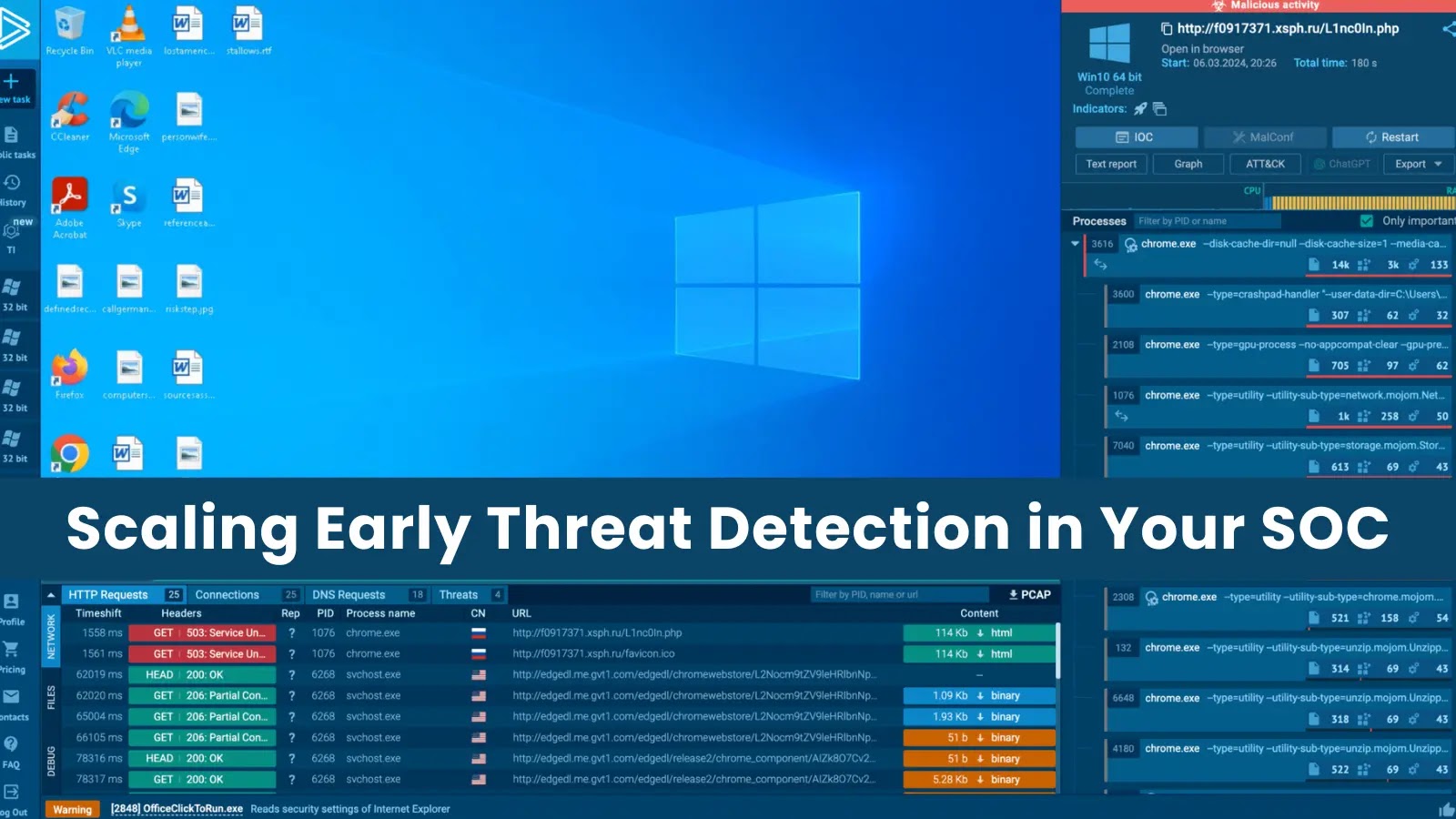
ANY.RUN’s Threat Intelligence Feeds address this by linking indicators directly to comprehensive sandbox analysis reports. Analysts can quickly access information on:
– Malware Behavior: Observations of how the malware operates during execution.
– Infrastructure Contacted: Details on which systems the malware communicates with.
– Processes and Artifacts Created: Information on what the malware generates within the system.
– Tactics and Techniques Used: Insights into the methods employed by the malware.
This contextual information enables analysts to make informed decisions quickly, reducing the time spent on false positives and enhancing overall efficiency.
Accelerating Investigations and Response
Access to detailed behavioral reports tied to indicators allows analysts to streamline their investigative processes. This leads to:
– Reduced Mean Time to Detect (MTTD): Faster identification of threats.
– Improved Mean Time to Respond (MTTR): Quicker containment and remediation of incidents.
– Fewer Manual Steps: Simplified workflows that enhance productivity.
By starting investigations with pre-analyzed threat data, analysts can focus on critical tasks, improving the SOC’s overall performance.
Integrating Threat Intelligence into Security Tools
Incorporating high-quality threat intelligence into existing security tools can significantly enhance detection and response capabilities:
– EDR and XDR Platforms: Enriching endpoint telemetry with fresh indicators helps identify malware activity and suspicious communications before attackers escalate privileges or move laterally.
– SOAR Platforms: Threat intelligence can power automated response workflows. For example, when an endpoint connects to a domain listed in the threat intelligence feed, SOAR playbooks can trigger containment actions or additional investigation steps.
By feeding intelligence directly into these tools, organizations can transform threat data into automated detection and response capabilities, enhancing their security posture without additional staffing.
Strengthening Security Without Expanding the Team
Scaling SOC performance does not necessarily require hiring more analysts. Providing existing teams with better intelligence and greater visibility into emerging threats can be more effective. ANY.RUN’s Threat Intelligence Feeds assist organizations in achieving this by delivering:
– Continuously Updated Indicators: Derived from real malware activity.
– Detailed Behavioral Context: Through comprehensive sandbox reports.
– Community-Generated Intelligence: Sourced from a global network of analysts and SOC teams.
With fresher data and richer context, SOC teams can focus on identifying threats early and stopping attacks before they escalate, thereby reducing the cost and impact of security incidents.