Mitigating Security Risks in Large Language Model Infrastructures
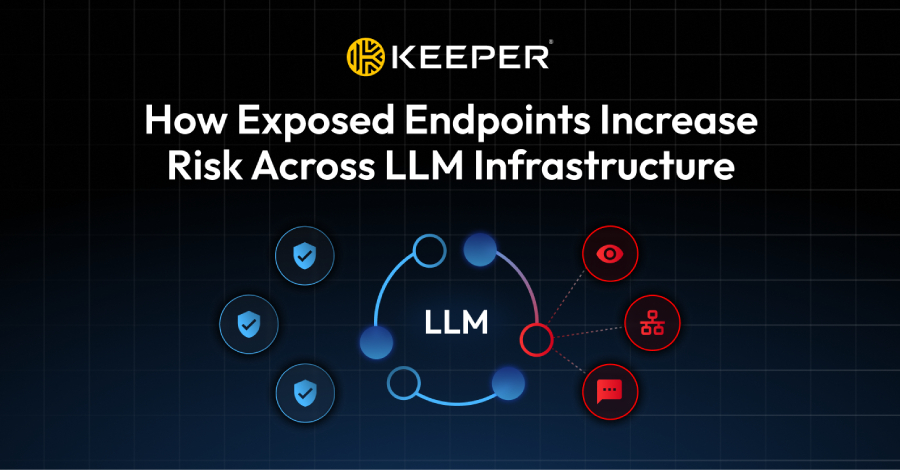
As organizations increasingly deploy their own Large Language Models (LLMs), they introduce a complex web of internal services and Application Programming Interfaces (APIs) to support these models. While the models themselves are often the focus of security measures, the infrastructure that connects and automates these models presents significant vulnerabilities. Each new LLM endpoint broadens the attack surface, sometimes in subtle ways that are overlooked during rapid deployment phases, especially when these endpoints are implicitly trusted. When LLM endpoints accumulate excessive permissions and expose long-lived credentials, they can grant far more access than intended. Therefore, organizations must prioritize endpoint privilege management, as exposed endpoints have become a prevalent attack vector for cybercriminals seeking access to the systems, identities, and secrets that power LLM workloads.
Understanding Endpoints in LLM Infrastructure
In the context of modern LLM infrastructure, an endpoint is any interface through which a user, application, or service can communicate with a model. Essentially, endpoints facilitate the sending of requests to an LLM and the reception of responses. Common examples include inference APIs that handle prompts and generate outputs, model management interfaces used to update models, and administrative dashboards that allow teams to monitor performance. Many LLM deployments also rely on plugin or tool execution endpoints, enabling models to interact with external services such as databases, thereby connecting the LLM to other systems. Collectively, these endpoints define how the LLM integrates with its environment.
The primary challenge is that most LLM endpoints are designed for internal use and speed, rather than long-term security. They are typically created to support experimentation or early deployments and are often left running with minimal oversight. As a result, they tend to be poorly monitored and granted more access than necessary. In practice, the endpoint becomes the security boundary, meaning its identity controls, secrets handling, and privilege scope determine the extent of access a cybercriminal can achieve.
Pathways to Endpoint Exposure
LLMs are seldom exposed through a single failure; more often, exposure occurs gradually through small assumptions and decisions made during development and deployment. Over time, these patterns transform internal services into externally reachable attack surfaces. Some of the most common exposure patterns include:
– Publicly Accessible APIs Without Authentication: Internal APIs are sometimes exposed publicly to expedite testing or integration. Authentication is delayed or skipped entirely, and the endpoint remains accessible long after it was meant to be restricted.
– Weak or Static Tokens: Many LLM endpoints rely on tokens or API keys that are hardcoded and never rotated. If these secrets are leaked through misconfigured systems or repositories, unauthorized users can access an endpoint indefinitely.
– Assumption That Internal Means Safe: Teams often treat internal endpoints as trusted by default, assuming they will never be reached by unauthorized users. However, internal networks are frequently reachable through VPNs or misconfigured controls.
– Temporary Test Endpoints Becoming Permanent: Endpoints designed for debugging or demos are rarely cleaned up. Over time, these endpoints remain active but unmonitored and poorly secured while the surrounding infrastructure evolves.
– Cloud Misconfigurations Exposing Services: Misconfigured API gateways or firewall rules can unintentionally expose internal LLM endpoints to the internet. These misconfigurations often occur gradually and go unnoticed until the endpoint is already exposed.
The Dangers of Exposed Endpoints in LLM Environments
Exposed endpoints are particularly perilous in LLM environments because LLMs are designed to connect multiple systems within a broader technical infrastructure. When cybercriminals compromise a single LLM endpoint, they can often gain access to much more than the model itself. Unlike traditional APIs that perform one function, LLM endpoints are commonly integrated with databases, internal tools, or cloud services to support automated workflows. Therefore, one compromised endpoint can allow cybercriminals to move quickly and laterally across systems that already trust the LLM by default.
The real danger doesn’t derive from the LLM being too powerful but rather from the implicit trust placed in the endpoint from the beginning. Once an LLM endpoint is exposed, it can act as a force multiplier; cybercriminals can use a compromised endpoint for various automated tasks instead of manually exploring systems. Exposed endpoints can jeopardize LLM environments through:
– Prompt-Driven Data Exfiltration: Cybercriminals can create prompts that cause the LLM to summarize sensitive data it has access to, turning the model into an automated data extraction tool.
– Abuse of Tool-Calling Permissions: When LLMs call internal tools or services, exposed endpoints can be used to abuse these tools by modifying resources or performing privileged actions.
– Indirect Prompt Injection: Even when access is limited, cybercriminals can manipulate data sources or LLM inputs, causing the model to execute harmful actions indirectly.
The Unique Threat of Non-Human Identities (NHIs) in LLM Environments
Non-Human Identities (NHIs) are credentials used by systems instead of human users. In LLM environments, service accounts, API keys, and other non-human credentials enable models to access data, interact with cloud services, and perform automated tasks. NHIs pose a significant security risk in LLM environments because models rely on them continuously. Out of convenience, teams often grant NHIs broad permissions but fail to revisit and tighten access controls later. When an LLM endpoint is compromised, cybercriminals inherit the NHI’s access behind that endpoint, allowing them to operate using trusted credentials. Several common problems exacerbate this security risk:
– Secrets Sprawl: API keys and service account credentials are often spread across configuration files and pipelines, making them difficult to track and secure.
– Static Credentials: Many NHIs use long-lived credentials that are rarely, if ever, rotated. Once those credentials are exposed, they remain usable for long periods of time.
– Excessive Permissions: Broad access is often granted to NHIs to avoid delays, but it’s inevitably forgotten about. Over time, NHIs accumulate permissions beyond what is actually necessary for their tasks.
– Identity Sprawl: Growing LLM systems produce large numbers of NHIs across environments. Without proper oversight and management, this expansion of identities reduces visibility and increases the attack surface.
Strategies to Mitigate Risks from Exposed Endpoints
Reducing risk from exposed endpoints starts with assuming that cybercriminals will eventually reach exposed services. Security teams should aim not just to prevent access but to limit what can happen once an endpoint is reached. An effective approach is to apply zero-trust security principles to all endpoints: access should be explicitly verified, continuously evaluated, and tightly monitored in all cases. Security teams should also implement the following measures:
– Enforce Least-Privilege Access for Human and Machine Users: Endpoints should only have access to what is necessary to perform a specific task, regardless of whether the user is human or non-human. Reducing permissions limits how much damage a cybercriminal can do with a compromised endpoint.
– Use Just-in-Time (JIT) Access: Privileged access should not be available all the time on any endpoint. With JIT access, privileges are only granted when necessary and automatically revoked after a task is completed.
– Monitor and Record Privileged Sessions: Monitoring and recording privileged activity helps security teams detect privilege misuse, investigate security incidents, and understand how endpoints are actually being used.
– Rotate Secrets Automatically: Tokens, API keys, and service account credentials must be rotated on a regular basis. Automated secrets rotation reduces the risk of long-term credential abuse if secrets are exposed.
– Remove Long-Lived Credentials When Possible: Static credentials are one of the biggest security risks in LLM environments. Replacing them with short-lived credentials limits how long compromised secrets remain useful in the wrong hands.
These security measures are especially important in LLM environments because LLMs rely heavily on automation. Since models operate continuously without human oversight, organizations must protect access by keeping it time-limited and closely monitored.
Emphasizing Endpoint Privilege Management to Enhance Security
Exposed endpoints significantly amplify risk in LLM environments, where models are deeply integrated with internal tools and sensitive data. Traditional access models are insufficient for systems that act autonomously and at scale, which is why organizations must rethink how they grant and manage access in AI infrastructure. Endpoint privilege management shifts the focus from trying to prevent breaches on endpoints to limiting the impact by eliminating standing access and controlling what both human and non-human users can do after an endpoint is reached. Solutions like Keeper support this zero-trust security model by helping organizations remove unnecessary access and better protect critical LLM systems.