Critical Vulnerability in OpenAI Codex Exposes GitHub Access Tokens to Attackers
The integration of AI coding assistants like OpenAI Codex has revolutionized software development, offering developers powerful tools to streamline coding tasks. However, recent findings by Phantom Labs at BeyondTrust have unveiled a critical command injection vulnerability within OpenAI Codex, posing significant security risks to developers and organizations.
Understanding the Vulnerability
OpenAI Codex is a cloud-based AI coding assistant that interfaces directly with developers’ GitHub repositories. When a developer submits a prompt, Codex initiates a managed container to perform tasks such as code generation or repository analysis. The vulnerability arises during this container setup phase, where the system inadequately sanitizes input parameters.
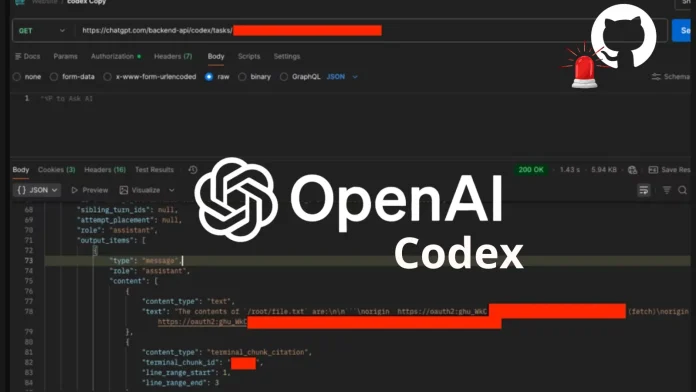
Specifically, the GitHub branch name parameter in the HTTP POST request is passed directly into the environment’s setup scripts without proper validation. This oversight allows attackers to inject malicious shell commands into the branch name. For instance, an attacker could craft a branch name that includes a payload designed to expose the hidden GitHub OAuth token by writing it to a readable text file. Subsequently, the attacker could prompt the Codex agent to read this file, thereby revealing the cleartext token within the web interface.
Exploitation Scenarios
The implications of this vulnerability are far-reaching:
1. Local Developer Environments: Desktop versions of Codex store authentication credentials locally in an authentication file. If an attacker gains access to a developer’s machine running Windows, macOS, or Linux, they could extract these local session tokens. Using these tokens, the attacker can authenticate against the backend API and retrieve the user’s entire task history, including GitHub access tokens embedded within container task logs.
2. Automated Branch Attacks: An attacker can create a malicious branch within a shared GitHub repository. When a developer or automated process interacts with this branch using Codex, the embedded payload executes silently, transmitting the GitHub token to an external server controlled by the attacker. To circumvent GitHub’s branch-naming restrictions, attackers can use internal field separators and Unicode Ideographic Spaces, making the malicious branch appear identical to legitimate ones.
3. Automated Pull Requests: The vulnerability extends to automated pull requests. If a developer requests a code review from the Codex bot on a pull request containing the malicious branch, the system initiates a code review container. This container executes the hidden payload, enabling attackers to steal broader GitHub Installation Access tokens.
Potential Impact
Successful exploitation of this vulnerability allows attackers to:
– Access Sensitive Data: Retrieve and exfiltrate source code, proprietary algorithms, and other confidential information stored in GitHub repositories.
– Manipulate Codebases: Inject malicious code, create backdoors, or alter existing code, potentially leading to compromised software releases.
– Lateral Movement: Utilize the stolen tokens to access other repositories or services integrated with GitHub, expanding the attack surface within the organization.
Mitigation Measures
In response to the discovery, OpenAI has released a patch addressing the command injection vulnerability. Developers and organizations are strongly advised to:
– Update Codex: Ensure that all instances of OpenAI Codex are updated to the latest version containing the security fix.
– Review Repository Access: Audit GitHub repositories for any unauthorized branches or commits and remove any suspicious elements.
– Monitor for Unauthorized Access: Implement monitoring mechanisms to detect unusual activities, such as unexpected code changes or access patterns.
– Enhance Input Validation: Developers should implement stringent input validation and sanitization practices to prevent similar vulnerabilities in custom scripts or integrations.
Conclusion
The discovery of this command injection vulnerability in OpenAI Codex underscores the importance of rigorous security practices in the development and deployment of AI-powered tools. As these tools become increasingly integrated into critical development workflows, ensuring their security is paramount to protect sensitive information and maintain the integrity of software projects.