Critical Vulnerability in vm2 Sandbox Library Exposes Node.js Applications to Remote Code Execution
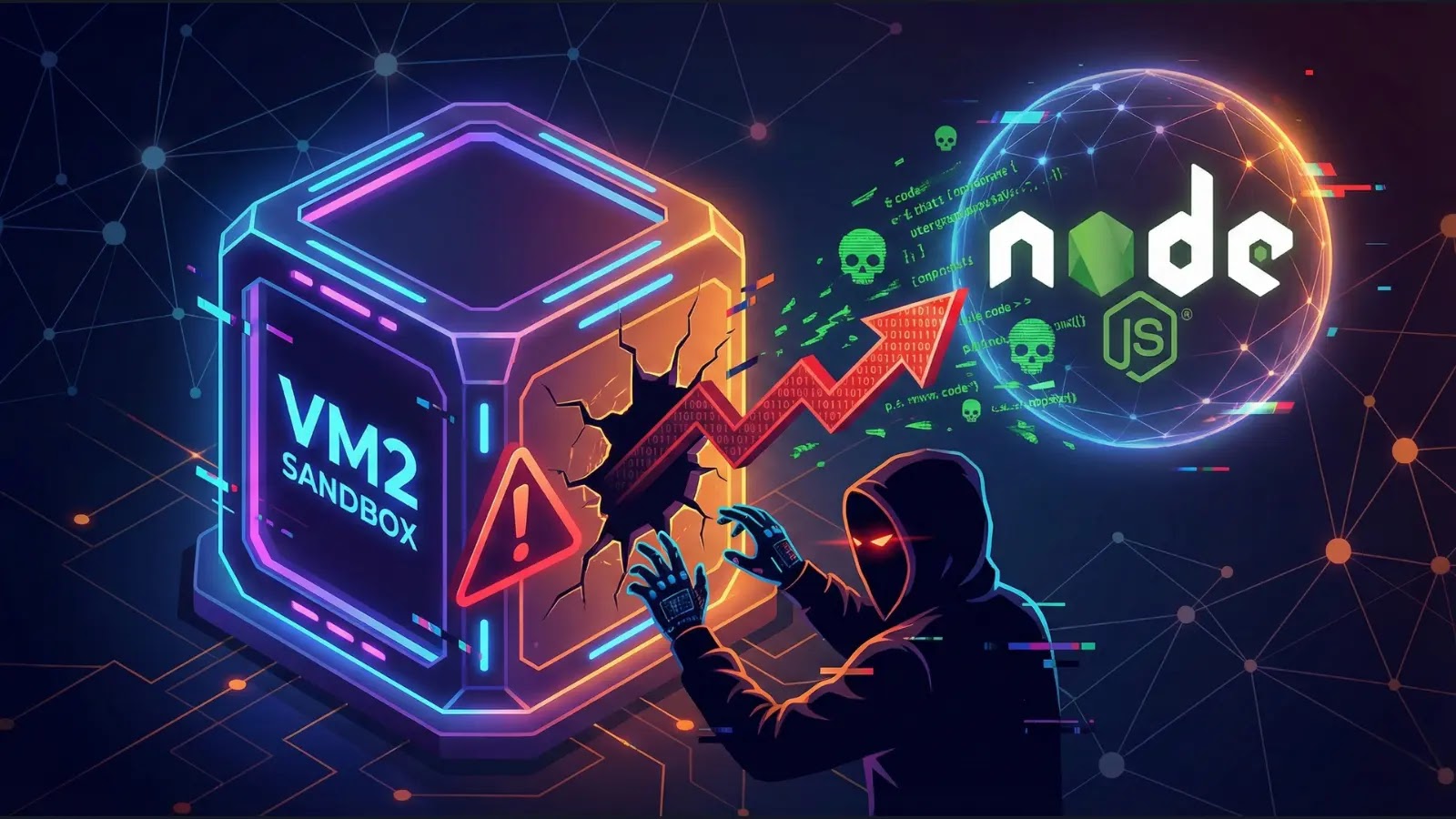
A critical security vulnerability has been identified in vm2, a widely utilized Node.js library designed to execute untrusted code within a secure sandbox environment. This flaw, cataloged as CVE-2026-22709 (GHSA-99p7-6v5w-7xg8), affects all versions up to and including 3.10.0 and has been assigned a maximum severity score of 10.0 on the CVSS v3.1 scale.
Understanding the Vulnerability
The core issue arises from incomplete sanitization of callbacks in the handling of Promise prototypes. While vm2 developers implemented sanitization measures for `localPromise.prototype.then`, these protections did not extend to `globalPromise.prototype.then`. Since asynchronous functions return global Promise objects, this oversight allows attackers to bypass sandbox restrictions and execute arbitrary code on the host system.
Technical Breakdown
The exploit leverages discrepancies in callback sanitization across promise chains. Researchers discovered that by manipulating error stacks, specifically through `Promise.prototype.catch` callbacks, an attacker can gain access to the `Error` constructor. This access facilitates the creation of a `Function` object containing arbitrary code, effectively breaching the sandbox environment.
In proof-of-concept demonstrations, attackers successfully executed system commands such as `execSync()` by accessing the `child_process` module, thereby completely circumventing the intended isolation provided by vm2.
Immediate Mitigation Measures
In response to this critical flaw, vm2 maintainers have released version 3.10.2, which addresses the vulnerability by properly sanitizing Promise callbacks across both local and global prototype chains.
Organizations and developers utilizing vm2 are strongly urged to:
– Upgrade Immediately: Transition to vm2 version 3.10.2 or later to ensure the vulnerability is patched.
– Conduct Comprehensive Audits: Review all development and production environments to identify instances of vm2 and confirm they are updated to secure versions.
– Restrict Execution Contexts: Until the update is applied, limit vm2 execution to trusted code sources to mitigate potential exploitation.
Broader Implications
This vulnerability underscores the inherent risks associated with executing untrusted code, even within environments designed for isolation. It highlights the necessity for continuous vigilance and prompt response to security advisories within the development community.
Conclusion
The discovery of CVE-2026-22709 in the vm2 library serves as a critical reminder of the importance of robust security practices in software development. By promptly updating to the latest version of vm2 and adhering to recommended security protocols, developers can safeguard their applications against potential exploits stemming from this vulnerability.