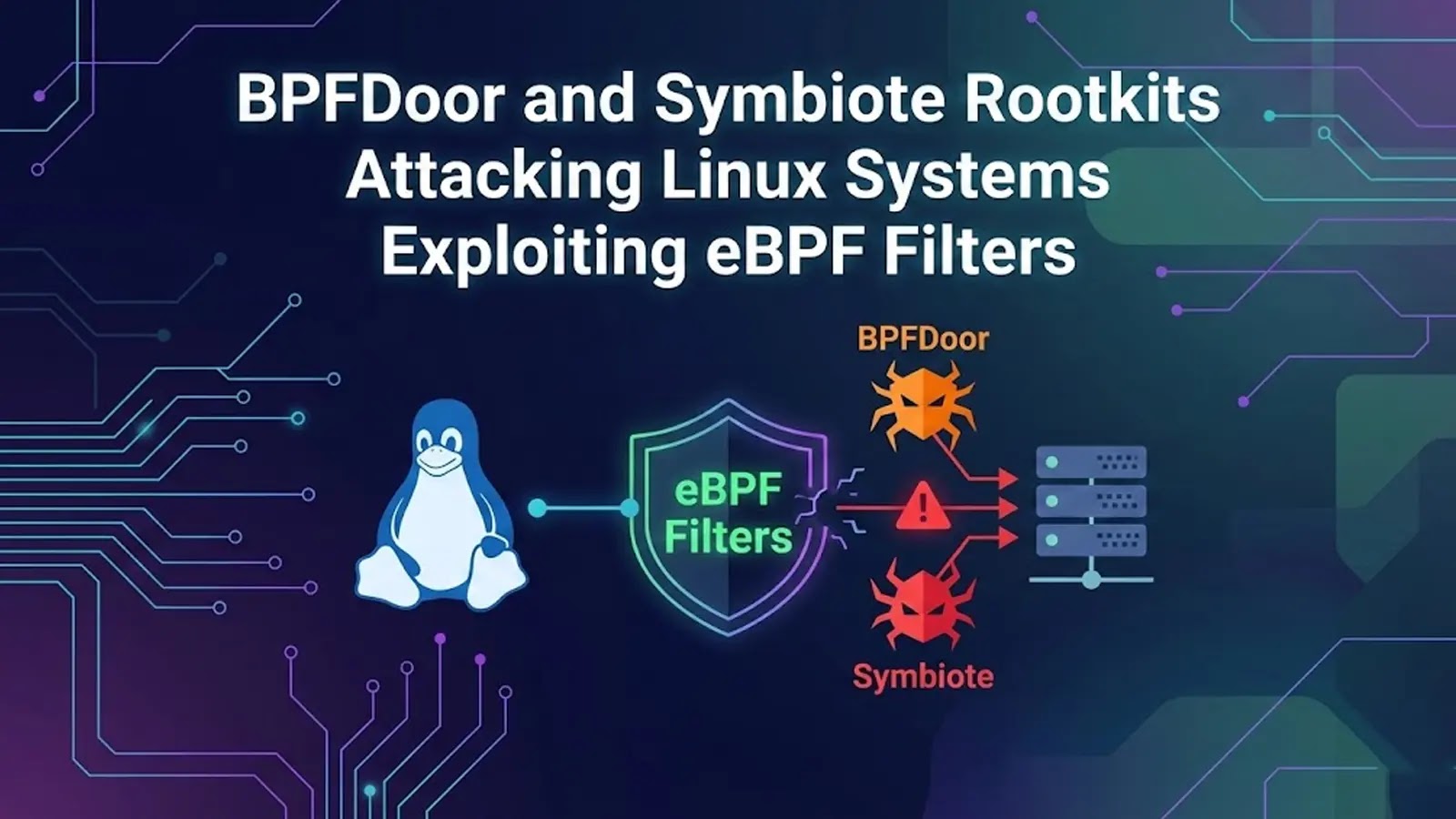
BPFDoor and Symbiote: Advanced Rootkits Exploiting eBPF to Target Linux Systems
In recent years, the cybersecurity landscape has witnessed the emergence of sophisticated Linux rootkits, notably BPFDoor and Symbiote, which exploit the extended Berkeley Packet Filter (eBPF) technology to infiltrate and persist within systems undetected. These advanced malware strains have been actively developed and deployed, posing significant threats to critical infrastructure worldwide.
Understanding eBPF and Its Dual-Edged Nature
Introduced in 2015, eBPF is a powerful Linux kernel feature that allows the execution of sandboxed programs directly within the kernel space. This capability is instrumental for performance monitoring, network traffic analysis, and security enforcement. However, the same features that make eBPF beneficial for legitimate purposes also render it attractive for malicious exploitation. By leveraging eBPF, attackers can execute code at the kernel level, enabling them to monitor, intercept, and manipulate system operations without triggering conventional security mechanisms.
BPFDoor: A Stealthy Backdoor with Persistent Access
BPFDoor is a Linux-specific backdoor that utilizes eBPF to establish a covert channel for persistent access to compromised systems. Its design emphasizes stealth, allowing it to evade detection by traditional security tools. Upon execution, BPFDoor employs eBPF filters to monitor incoming network traffic for specific magic byte sequences. When these sequences are detected, the malware activates, enabling remote command execution and further system compromise.
One of the notable features of BPFDoor is its ability to operate without opening network ports, which are typically monitored by security systems. Instead, it passively listens to network traffic, making it challenging to detect through standard network monitoring practices. Additionally, BPFDoor can manipulate firewall rules and system logs to cover its tracks, further complicating detection efforts.
Symbiote: A Parasitic Malware with Advanced Evasion Techniques
Symbiote represents another class of eBPF-based malware that functions as a parasitic infection, injecting itself into running processes to gain control over the system. It utilizes eBPF to hook into system calls and network operations, allowing it to intercept and modify data seamlessly. This capability enables Symbiote to hide its presence by concealing files, processes, and network connections associated with its activities.
The malware’s latest variants have expanded their capabilities to accept IPv4 and IPv6 packets across multiple protocols, including TCP, UDP, and SCTP. By utilizing non-standard ports and employing port-hopping techniques, Symbiote can maintain communication with command and control (C2) servers while evading detection by network security appliances.
The Evolution of Evasion Tactics
Both BPFDoor and Symbiote have demonstrated a continuous evolution in their evasion tactics. By leveraging eBPF, these rootkits operate at the kernel level, making them invisible to user-space security tools. They can intercept and manipulate network traffic, allowing them to masquerade as legitimate processes and communications. For instance, BPFDoor’s recent variants support IPv6 traffic and can filter DNS traffic over both IPv4 and IPv6 protocols, blending malicious activities with normal network operations.
The technical implementation of these rootkits involves the use of eBPF bytecode attached directly to network sockets, functioning as kernel-level packet filters. This approach allows them to inspect and modify network packets in real-time, enabling the execution of commands and data exfiltration without raising alarms.
Detection and Mitigation Strategies
Detecting and mitigating eBPF-based rootkits like BPFDoor and Symbiote is inherently challenging due to their deep integration into the kernel and sophisticated evasion techniques. However, several strategies can enhance defense mechanisms against such threats:
1. Kernel Integrity Monitoring: Implementing tools that monitor the integrity of the kernel and its modules can help detect unauthorized modifications indicative of rootkit activity.
2. Behavioral Analysis: Utilizing behavioral analysis tools that can identify anomalies in system and network behavior may reveal the presence of stealthy malware.
3. Regular System Audits: Conducting regular audits of system logs, network traffic, and process activities can help identify irregularities that may suggest a compromise.
4. eBPF Activity Monitoring: Developing and deploying monitoring solutions specifically designed to track eBPF activity can provide visibility into potentially malicious use of this technology.
5. Patch Management: Ensuring that all systems are up-to-date with the latest security patches can mitigate vulnerabilities that may be exploited by rootkits.
6. Network Segmentation: Implementing network segmentation can limit the spread of malware within an organization, containing potential damage.
Conclusion
The emergence and evolution of eBPF-based rootkits like BPFDoor and Symbiote underscore the need for advanced security measures capable of detecting and mitigating sophisticated threats. As these malware strains continue to develop, organizations must adopt proactive and comprehensive security strategies to protect their Linux systems from such insidious attacks.