Boston Dynamics and Google DeepMind Collaborate to Advance Humanoid Robotics
In a groundbreaking development at CES 2026, Boston Dynamics announced a strategic partnership with Google’s AI research division, DeepMind, to accelerate the evolution of its humanoid robot, Atlas. This collaboration aims to imbue Atlas with advanced artificial intelligence capabilities, enhancing its ability to interact naturally with humans and perform complex tasks.
Integrating Advanced AI into Robotics
Carolina Parada, Senior Director of Robotics at Google DeepMind, highlighted the partnership’s objective: We’re looking to integrate our cutting-edge AI foundation models with Boston Dynamics’ new Atlas robots, and we’ll aim to develop the world’s most advanced robot foundation model to fulfill the promise of true general-purpose human needs. This initiative builds upon DeepMind’s Gemini Robotics model, designed to enable robots to perceive, reason, utilize tools, and engage with humans effectively.
From Research to Real-World Application
Boston Dynamics, under the majority ownership of Hyundai Motor Group, has a history of transitioning innovative research into practical applications. Their quadruped robot, Spot, is operational in over 40 countries, and the warehouse robot Stretch has unloaded more than 20 million boxes globally since its 2023 launch. The next step involves deploying the humanoid robot Atlas in Hyundai’s Savannah, Georgia factory, marking a significant move toward integrating advanced robotics into industrial settings.
Atlas: A Leap in Humanoid Robotics
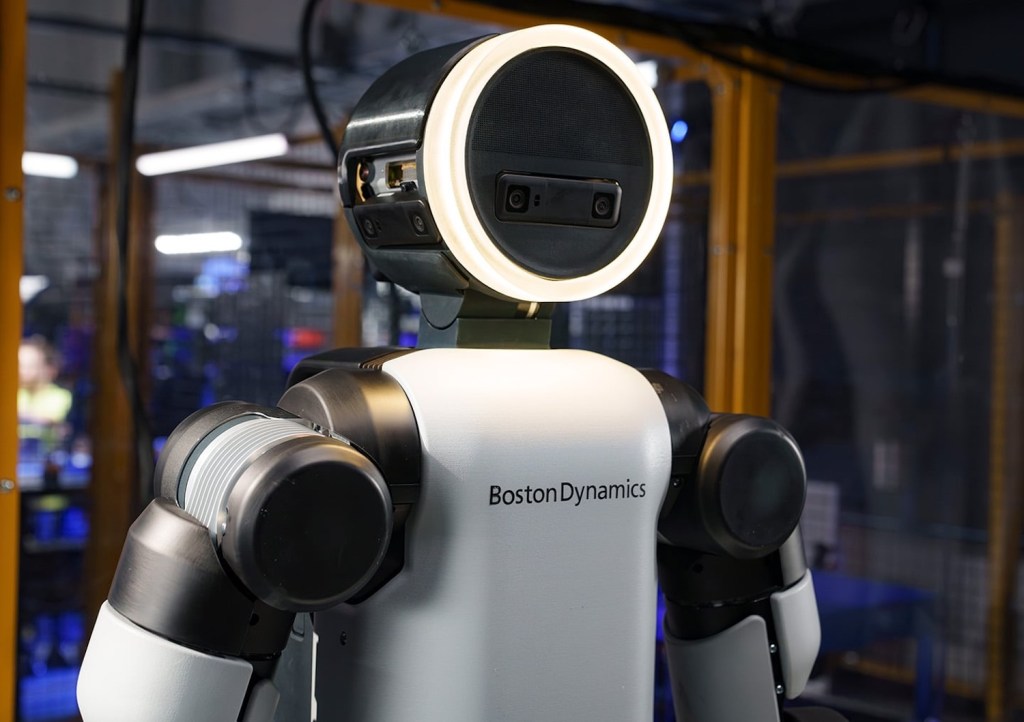
During the CES 2026 press conference, a prototype of Atlas demonstrated its mobility and dexterity. Alberto Rodriguez, Director of Atlas Behavior at Boston Dynamics, emphasized the importance of natural human-robot interaction: Making Atlas into a product requires more than athletic performance for humanoids to really deliver on their promise. They have to be able to interact with people naturally.
The production version of Atlas boasts impressive specifications:
– Degrees of Freedom: 56, with rotational joints for enhanced flexibility.
– Human-Scale Hands: Equipped with tactile sensors in fingers and palms for precise manipulation.
– 360-Degree Vision: Cameras providing comprehensive environmental awareness.
– Strength: Capable of lifting up to 110 pounds.
– Environmental Resilience: Operates effectively in temperatures ranging from -4°F to 104°F and is resistant to water exposure.
Advancing Human-Robot Collaboration
The integration of DeepMind’s AI models aims to enable Atlas to understand and learn from its environment, allowing it to generalize behaviors across various tasks. Parada elaborated: Rather than having a set of predefined, loaded tasks onto the robot, we think robots should understand the physical world the same way we do. They should be able to learn from their experience, generalize new situations, and get better over time.
Safety and Efficiency in Industrial Applications
Hyundai plans to deploy Atlas in its factory for tasks such as parts sequencing by 2028. To ensure safety and efficiency, Hyundai is establishing a U.S. facility called the Robot Metaplant Application Center (RMAC). This center will train robots in movements like lifts and turns, combining training data with real-world data from the Georgia factory to continually enhance robot performance.
Conclusion
The partnership between Boston Dynamics and Google DeepMind represents a significant milestone in the field of humanoid robotics. By combining advanced AI with sophisticated mechanical design, Atlas is poised to revolutionize human-robot interaction and industrial automation, bringing us closer to the realization of general-purpose robots capable of seamlessly integrating into human environments.