Comparing Apple’s 14-inch MacBook Pro: M5 Pro vs. M4 Pro
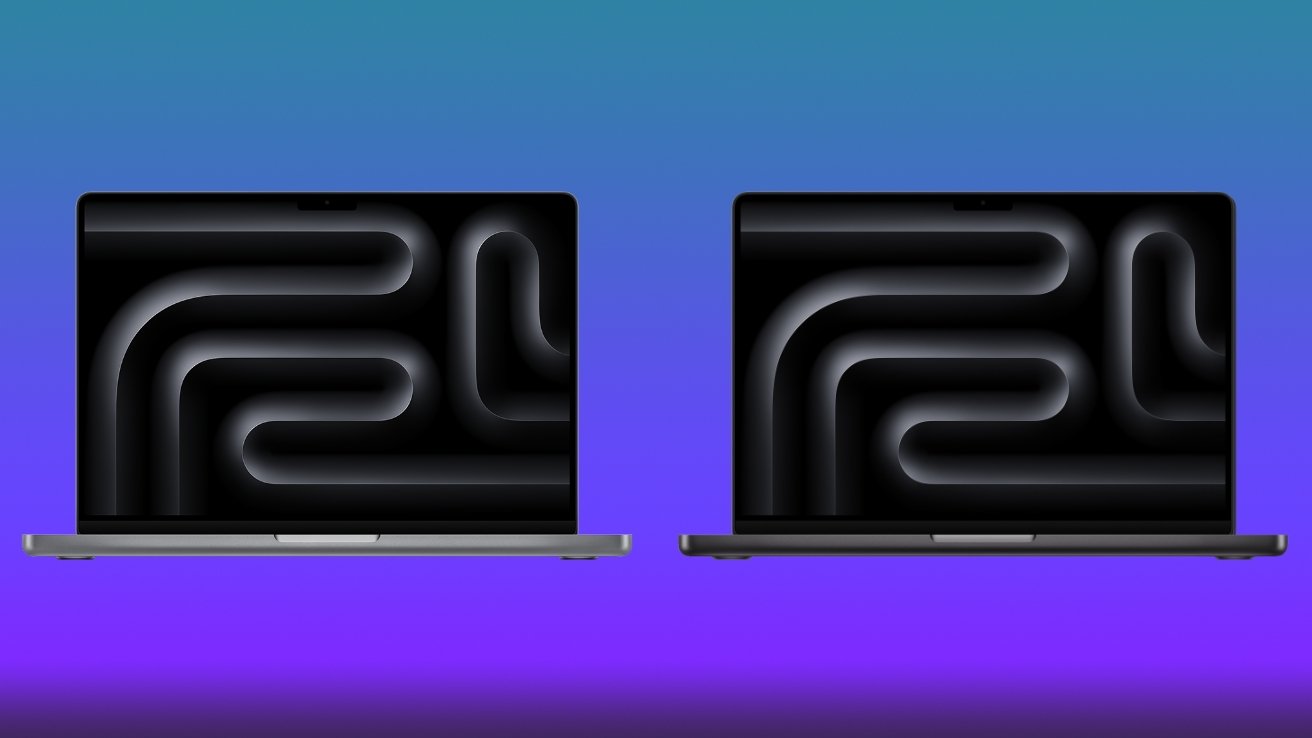
Apple’s 14-inch MacBook Pro has undergone a significant transformation with the introduction of the M5 Pro chip, succeeding the M4 Pro. This comparison delves into the enhancements and differences between these two models, focusing on performance, display capabilities, and overall value.
Display and External Monitor Support
Both the M4 Pro and M5 Pro MacBook Pro models feature a 14.2-inch Liquid Retina XDR display with a resolution of 3,024 by 1,964 pixels, delivering a pixel density of 254 pixels per inch. This display offers Wide Color (P3) support, True Tone technology, and ProMotion adaptive refresh rates up to 120Hz. A notable design element is the notch housing the 12MP Center Stage camera, consistent across both models.
In terms of external display support, the M4 Pro can handle up to two external 6K displays at 60Hz over Thunderbolt. Alternatively, it supports a single external 6K display at 60Hz over Thunderbolt and an external 4K display at 144Hz via HDMI. Other configurations include an external 8K display at 60Hz or a 4K display at 240Hz over HDMI.
The M5 Pro enhances this capability, supporting up to three external 6K displays at 60Hz. It also accommodates configurations such as an 8K display at 60Hz, a 5K display at 120Hz, or a 4K display at 240Hz over HDMI, along with a second display up to 5K at 120Hz or 4K at 200Hz. This expanded support offers greater flexibility for professionals requiring multiple high-resolution displays.
Performance Enhancements
The M4 Pro MacBook Pro was available in two configurations: a 12-core CPU with a 16-core GPU and a 14-core CPU with a 20-core GPU. Both configurations came standard with 24GB of unified memory, with an option to upgrade to 48GB. The 12-core CPU variant included 8 performance cores and 4 efficiency cores, while the 14-core CPU configuration comprised 10 performance cores and 4 efficiency cores.
The M5 Pro MacBook Pro introduces a base variant featuring a 15-core CPU and a 16-core GPU, with options for 24GB or 48GB of unified memory. An upper-tier configuration offers an 18-core CPU and a 20-core GPU, with up to 64GB of unified memory. Notably, the M5 Pro eliminates efficiency cores, utilizing a combination of super cores and performance cores. The 15-core version includes 5 super cores and 10 performance cores, while the 18-core variant comprises 6 super cores and 12 performance cores. This architecture results in two additional performance cores compared to the M4 Pro.
Apple claims the M5 Pro CPU delivers up to 30% faster performance, thanks to its Fusion Architecture, which combines two dies into a single system on a chip. The GPU also maintains hardware-accelerated ray tracing capabilities, offering a 50% increase in graphics performance over the M4 Pro. In gaming scenarios, the M5 Pro provides up to 1.6 times faster performance in titles supporting ray tracing, such as Cyberpunk 2077: Ultimate Edition. For 3D rendering applications like Maxon Redshift, the M5 Pro achieves up to 1.4 times faster performance compared to the M4 Pro.
Memory bandwidth has been increased to 307GB/s, up from 273GB/s in the M4 Pro. Additionally, the M5 Pro is equipped with a dedicated Neural Accelerator in each GPU core and a more power-efficient 16-core Neural Engine. This configuration enhances performance in AI-related tasks, offering up to four times faster large language model prompt processing and up to eight times faster AI image generation compared to the M1 Pro.
Estimated Geekbench 6 benchmarks suggest the M5 Pro achieves a single-core score of approximately 4,300 points and a multi-core score of around 32,400 points. Metal GPU benchmarking is expected to yield a score of about 146,000 points. In comparison, the M4 Pro recorded a single-core score of 3,850 points, a multi-core score of 22,416 points, and a Metal GPU score of 112,160 points.
Pricing and Configurations
At launch, the base 14-inch MacBook Pro with the M4 Pro was priced at $1,599, featuring 16GB of memory and 512GB of storage. Upgrading to 24GB of memory added $200, with an additional $200 for 32GB. Storage upgrades to 1TB and 2TB were priced at $200 and $400, respectively. The Nano-texture display option was available for an extra $150.
The M5 Pro 14-inch MacBook Pro starts at $2,199, equipped with the 15-core CPU, 24GB of memory, and 1TB of storage. Upgrading to the 18-core CPU costs an additional $200. Memory upgrades to 48GB and 64GB are priced at $400 and $600, respectively, with the 64GB option available only with the upper-tier chip. Storage upgrades mirror the M4 Pro’s pricing structure. The Nano-texture display remains a $150 add-on.
Conclusion
The transition from the M4 Pro to the M5 Pro in Apple’s 14-inch MacBook Pro brings substantial performance enhancements, particularly in CPU and GPU capabilities, as well as improved support for external displays. These advancements cater to professionals seeking higher performance and versatility. However, these improvements come with a higher starting price. Potential buyers should assess their specific performance needs and budget considerations when deciding between the M4 Pro and M5 Pro models.