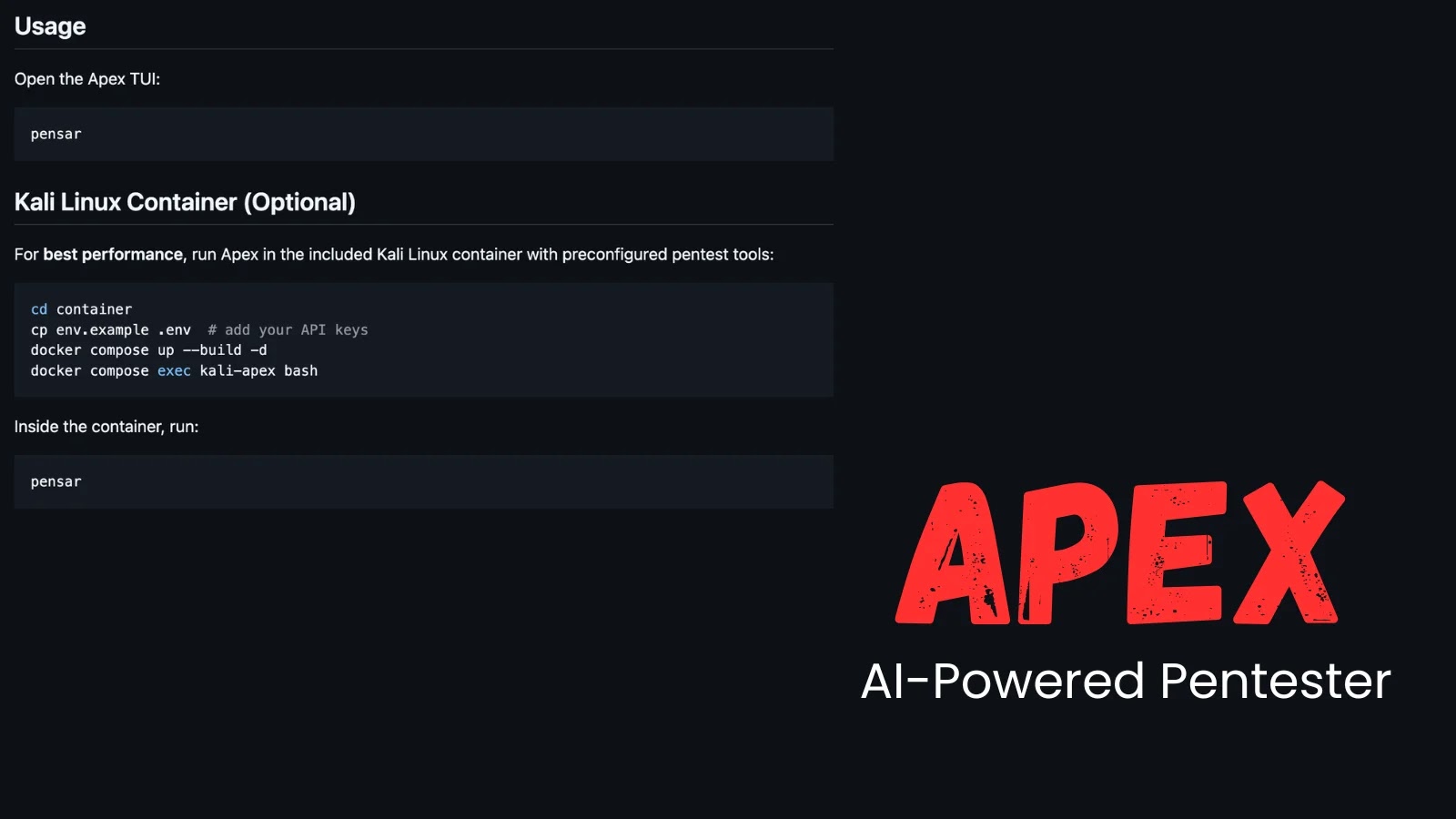
Apex: The AI-Powered Penetration Testing Agent Revolutionizing Application Security
In the rapidly evolving landscape of software development, ensuring robust application security has become a paramount concern. Traditional security measures often struggle to keep pace with the accelerated deployment cycles and the increasing complexity of modern applications. Enter Apex, an autonomous, AI-driven penetration testing agent designed to operate in black-box mode, offering a groundbreaking approach to identifying and mitigating vulnerabilities in live applications.
The Genesis of Apex
The inception of Apex stems from a critical need to address the structural deficiencies in contemporary software security practices. With AI coding agents generating and merging code at unprecedented scales—Stripe’s coding agents alone merge approximately 1,300 pull requests weekly—the traditional methods of vulnerability detection are becoming obsolete. Some engineering teams invest over $1,000 daily in AI tokens per engineer, often without human code review, highlighting the urgency for an advanced security solution.
Apex was conceived as an adversarial verification layer, functioning as an independent agent that attacks running applications in the same manner a real-world attacker would. This proactive approach enables the identification of vulnerabilities before they can be exploited, effectively bridging the gap between rapid development and robust security.
Operational Modes of Apex
Apex offers versatility through its three distinct deployment modes:
1. Continuous Integration (CI) Pipeline Integration: In this mode, Apex validates each deployment against a sandboxed replica of the application. It meticulously maps the attack surface and attempts exploitation before code merges, ensuring that vulnerabilities are identified and addressed early in the development cycle.
2. Production Environment Monitoring: Apex continuously monitors live applications, surfacing exploitable weaknesses in real-time. This ongoing assessment allows for immediate remediation of vulnerabilities, enhancing the overall security posture of the application.
3. On-Demand Testing: Apex supports targeted testing against any specified application, replacing traditional, periodic security assessments with a dynamic feedback loop that operates at the speed of modern threats.
Benchmarking Apex’s Capabilities
To rigorously evaluate Apex’s effectiveness, PensarAI developed Argus, an open-source benchmark comprising 60 self-contained, Dockerized vulnerable web applications. These applications are purpose-built to assess offensive security agents, providing a comprehensive testing ground for Apex.
Existing benchmarks were found lacking in several areas. For instance, XBOW’s widely used 104-challenge set predominantly features PHP applications and lacks coverage of critical vulnerabilities such as GraphQL issues, JWT algorithm confusion, race conditions, prototype pollution chains, WAF bypass techniques, and multi-tenant isolation scenarios. In contrast, Argus encompasses a diverse range of frameworks prevalent in production environments, including Node.js/Express (40%), Python/Flask/Django (20%), multi-service architectures (25%), as well as Go, Java/Spring Boot, and PHP.
Argus introduces categories previously unaddressed by other benchmarks, such as:
– WAF and IDS evasion techniques
– Multi-step exploit chains requiring up to seven chained vulnerabilities
– Multi-tenant isolation failures
– Race conditions and business logic flaws
– Modern authentication bypasses (e.g., JWT, OAuth, SAML, MFA)
– Cloud and Kubernetes infrastructure attacks
The challenges within Argus are calibrated across varying difficulty levels: 2 easy, 27 medium, and 31 hard challenges, providing a robust framework for assessing Apex’s capabilities.
Performance Metrics
Apex was tested against all 60 Argus challenges in full black-box mode using Claude Haiku 4.5, the smallest and most cost-effective model available, to isolate architectural gains over raw model capability. The results were impressive:
– Overall Pass Rate: Apex achieved a 35% pass rate, outperforming competitors such as PentestGPT (30%) and Raptor (27%).
– Top 10 Hardest Challenges: Utilizing Claude Opus 4.6, Apex solved 80% of the top 10 hardest challenges, surpassing PentestGPT’s 70% and Raptor’s 60%.
Throughout the testing, Apex discovered 271 unique vulnerabilities, including:
– SQL Injection
– Server-Side Request Forgery (SSRF)
– NoSQL Injection
– Prototype Pollution
– Server-Side Template Injection (SSTI)
– XML External Entity (XXE) Attacks
– Race Conditions
– Insecure Direct Object References (IDOR)
– Authentication Bypasses
– Cross-Origin Resource Sharing (CORS) Misconfigurations
– Command Injection
– Path Traversal
The average cost per challenge was approximately $8, with the entire 60-challenge run on Haiku costing under $500. Notable achievements included:
– A seven-step race-condition double-spend exploit in a fintech transfer endpoint
– A multi-tenant SSRF chain pivoting through a shared cache to extract API keys from neighboring tenants
– SpEL injection leading to Remote Code Execution (RCE) in a Java Spring Boot application
All these exploits were executed in under 15 minutes, demonstrating Apex’s efficiency and effectiveness.
Identified Challenges and Future Directions
While Apex has showcased remarkable capabilities, certain challenges have been identified:
– Last-Mile Execution: Completing the final credential extraction step after a successful SSRF chain emerged as a dominant gap.
– Decoy Flags: The agent was misled twice by decoy flags, indicating a need for enhanced detection mechanisms.
– Complex Multi-Step Chains: Challenges such as CI/CD pipeline poisoning and Kubernetes cluster takeovers presented difficulties, highlighting areas for further development.
Addressing these challenges is crucial for enhancing Apex’s robustness and reliability. Future iterations will focus on refining these aspects to ensure comprehensive vulnerability detection and mitigation.
Conclusion
Apex represents a significant advancement in the field of application security. By leveraging AI to perform autonomous, black-box penetration testing, it offers a proactive and efficient solution to identify and address vulnerabilities in live applications. As software development continues to accelerate, tools like Apex will be instrumental in bridging the gap between rapid deployment and robust security, ensuring that applications remain secure in the face of evolving threats.