Anthropic’s Claude Code Integrates with Slack: A Game-Changer for Developer Collaboration
Anthropic has unveiled a significant enhancement to its AI-powered coding assistant, Claude Code, by integrating it directly into Slack. This beta feature, available as a research preview starting Monday, enables developers to manage coding tasks seamlessly within their existing Slack conversations. This development marks a pivotal shift in the evolution of coding assistants, emphasizing workflow integration over mere model capabilities.
From Snippets to Full Automation
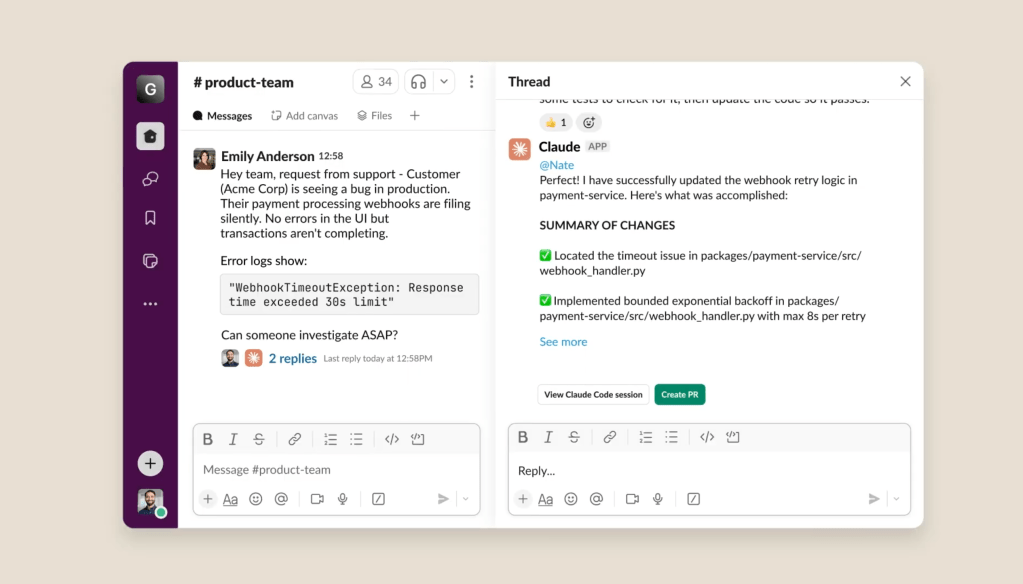
Previously, Claude’s functionality within Slack was limited to providing lightweight coding assistance, such as generating code snippets, debugging, and offering explanations. With this new integration, developers can now invoke @Claude to initiate comprehensive coding sessions directly from Slack threads. Claude intelligently analyzes the context of recent messages, including bug reports and feature requests, to identify the appropriate code repository. It then autonomously manages the coding process, posting progress updates within the thread and providing links for code review and pull request submissions.
The Industry’s Shift Towards Integrated AI Tools
This integration reflects a broader industry trend where AI coding assistants are transitioning from traditional Integrated Development Environments (IDEs) to collaborative platforms where teams naturally interact. For instance, Cursor offers Slack integration for drafting and debugging code within threads, while GitHub Copilot has introduced features that generate pull requests directly from chat interfaces. OpenAI’s Codex is also accessible through custom Slack bots, further illustrating this shift.
Slack’s Strategic Positioning as an AI Hub
By positioning itself as an agentic hub, Slack is strategically aligning with the convergence of AI and workplace collaboration. The platform’s central role in engineering communication means that the AI tool that gains prominence within Slack could significantly influence software development workflows. Integrating AI tools like Claude Code into Slack allows developers to transition seamlessly from discussion to code implementation without the need to switch between applications, heralding a new era of AI-embedded collaboration.
Implications for Developer Workflows
The integration of Claude Code into Slack signifies a fundamental transformation in developer workflows. By embedding AI capabilities directly into collaborative platforms, developers can streamline their processes, reduce context-switching, and enhance productivity. This approach not only simplifies the coding process but also fosters a more cohesive and efficient team environment.
Security and Operational Considerations
While the integration offers numerous benefits, it also raises important considerations regarding code security and intellectual property protection. Introducing another platform into the development workflow necessitates careful management and auditing of repository access to safeguard sensitive information. Additionally, dependencies on Slack or Claude’s API introduce potential risks, such as service outages or rate limits, which could disrupt development processes that were previously managed locally.
Anthropic’s Strategic Timing
Anthropic has not yet announced a timeline for a broader rollout of this feature. However, the timing of this beta release is strategic, as the AI coding assistant market becomes increasingly competitive. Differentiation among these tools is shifting from model capabilities to the depth of integration and distribution channels. By embedding Claude Code into Slack, Anthropic is positioning itself at the forefront of this evolution, offering a solution that aligns with the natural workflows of development teams.
Conclusion
The integration of Claude Code into Slack represents a significant advancement in the realm of AI-assisted software development. By merging coding capabilities with collaborative communication platforms, this development has the potential to redefine how development teams operate, making the process more intuitive, efficient, and aligned with modern workflows. As this integration progresses, it will be crucial for organizations to balance the benefits of enhanced collaboration with the need for robust security measures to protect their code and intellectual property.