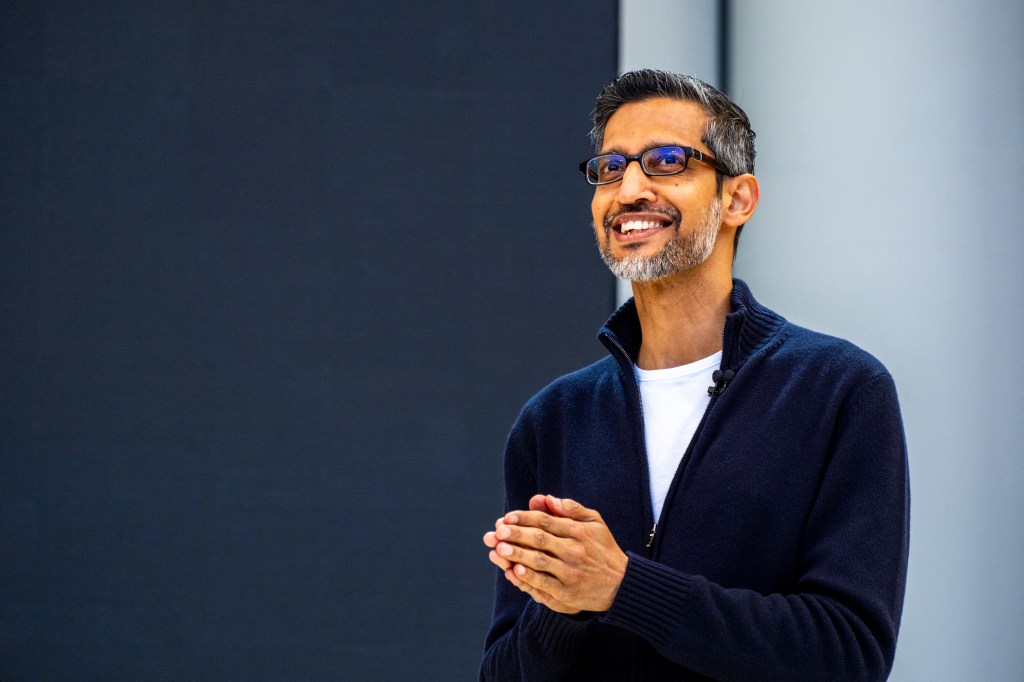
Google’s parent company, Alphabet Inc., has unveiled a new compensation plan for CEO Sundar Pichai, potentially elevating his earnings to $692 million over the next three years. This package, disclosed in a recent filing with the U.S. Securities and Exchange Commission (SEC), underscores Alphabet’s confidence in Pichai’s leadership and its commitment to ambitious growth initiatives.
Breakdown of the Compensation Package
Pichai’s annual base salary remains steady at $2 million, consistent since 2020. The substantial portion of his compensation is structured around equity incentives, aligning his financial interests with the company’s performance.
1. Performance Stock Units (PSUs): Valued at $126 million, these are divided into two equal tranches of $63 million each. The PSUs are contingent upon Alphabet’s total shareholder return relative to the S&P 100 index over two and three-year periods. Depending on performance, the payout can range from 0% to 200% of the target value, potentially reaching $252 million if Alphabet significantly outperforms its peers.
2. Restricted Stock Units (RSUs): Amounting to $84 million, these units vest monthly over three years, provided Pichai continues his tenure with the company.
3. Bet Performance Units (BPUs): A novel component of the package, BPUs are tied to the performance of Alphabet’s subsidiaries—Waymo and Wing Aviation. Pichai is allocated $130 million in Waymo BPUs and $45 million in Wing BPUs. These units vest after a three-year performance period and are based on the subsidiaries’ per-unit value growth, with potential payouts ranging from 0% to 200% of the target value.
If all performance metrics are met at their maximum thresholds, Pichai’s total compensation could reach the $692 million mark over the three-year period.
Strategic Implications
The inclusion of BPUs tied to Waymo and Wing signifies Alphabet’s strategic emphasis on its autonomous vehicle and drone delivery ventures. By linking a significant portion of Pichai’s compensation to these subsidiaries, Alphabet signals its commitment to transforming these units into substantial revenue generators.
Waymo, Alphabet’s self-driving car division, has been expanding its services, now offering over 400,000 rides weekly across multiple U.S. metropolitan areas. The recent $16 billion funding round, valuing Waymo at $126 billion, reflects investor confidence in its potential. Similarly, Wing Aviation, the drone delivery service, is scaling operations, indicating Alphabet’s broader vision for autonomous delivery solutions.
Comparative Executive Compensation
Pichai’s potential earnings position him among the highest-paid executives globally. For context, in 2025, Microsoft’s CEO Satya Nadella earned $96.5 million, including approximately $84 million in stock awards. Apple’s CEO Tim Cook received $74.3 million in the same period. Pichai’s compensation reflects Alphabet’s aggressive growth strategy and its reliance on his leadership to navigate the company’s future.
Market Performance and Investor Perspective
Since Pichai assumed the role of CEO in 2015, Alphabet’s market capitalization has surged from about $535 billion to approximately $3.6 trillion, briefly surpassing $4 trillion in January 2026. This growth trajectory underscores the market’s positive reception to Alphabet’s strategic initiatives under Pichai’s leadership.
However, the substantial compensation package has sparked discussions among investors and analysts. While it aligns Pichai’s interests with long-term company performance, it also raises questions about executive pay scales and the benchmarks set for performance-based incentives.
Conclusion
Alphabet’s decision to offer Sundar Pichai a compensation package potentially worth $692 million over three years highlights the company’s confidence in his leadership and its commitment to ambitious growth, particularly in autonomous technologies. By tying a significant portion of his compensation to the performance of subsidiaries like Waymo and Wing, Alphabet underscores its strategic focus on these ventures as future revenue streams. As the company continues to innovate and expand, stakeholders will closely monitor the outcomes of these performance-linked incentives and their impact on Alphabet’s trajectory.