Introducing MEDUSA: The AI-Powered Security Testing Tool Revolutionizing Application Security
In the ever-evolving landscape of cybersecurity, the need for robust and efficient security testing tools has never been more critical. Enter MEDUSA, an open-source, AI-driven Static Application Security Testing (SAST) tool designed to address modern development challenges such as false positives and multi-language coverage. With its impressive suite of 74 specialized scanners and over 180 AI agent security rules, MEDUSA is poised to become an indispensable asset for developers and security professionals alike.
Comprehensive Language and File Type Support
One of MEDUSA’s standout features is its extensive support for over 42 programming languages and file types. This includes popular languages and configurations such as Python, JavaScript, Go, Rust, Java, Dockerfiles, Terraform, and Kubernetes manifests. This broad coverage ensures that developers can seamlessly integrate MEDUSA into diverse projects without the need for multiple, language-specific tools.
Streamlined Installation and High-Speed Scanning
MEDUSA is designed with user convenience in mind. Developers can install the tool via pip and initiate scans with a single command. The tool’s ability to perform parallel processing allows for significant speed enhancements, achieving 10 to 40 times faster scanning compared to sequential tools. This efficiency is particularly beneficial for large-scale projects where time is of the essence.
Versatile Reporting for Seamless Integration
Understanding the importance of clear and actionable reporting, MEDUSA offers multiple output formats, including JSON, HTML, Markdown, and SARIF. This versatility facilitates easy integration into Continuous Integration/Continuous Deployment (CI/CD) pipelines, enabling teams to maintain a consistent and automated security assessment process throughout the development lifecycle.
Advanced False Positive Reduction
False positives have long been a thorn in the side of security testing, leading to wasted time and potential oversight of genuine issues. MEDUSA addresses this problem head-on with an intelligent false positive filter introduced in version 2025.9.0. This feature employs context-aware analysis to detect security wrappers and exclude test files, effectively reducing noise by 40-60%. As a result, developers can focus their efforts on addressing real vulnerabilities without being bogged down by irrelevant alerts.
Adaptability in Restricted Environments
Recognizing the diverse environments in which developers operate, MEDUSA is built to function seamlessly in restricted settings, such as sandboxes like OpenAI Codex. In these scenarios, the tool gracefully falls back to sequential mode, ensuring uninterrupted operation without compromising on functionality.
Efficient Rescanning with Smart Caching
To further enhance efficiency, MEDUSA incorporates smart caching mechanisms that identify and skip unchanged files during rescans. This approach dramatically boosts rescanning speeds, allowing developers to quickly verify fixes and updates without redundant processing.
Robust CVE Detection Capabilities
MEDUSA excels in identifying high-impact vulnerabilities, including those related to supply chain risks. For instance, it can detect critical issues such as:
– CVE-2025-55182: A pre-authentication remote code execution vulnerability in React versions 19.0.0 to 19.2.0 and Next.js versions 15.0.0 to 15.0.4, stemming from Flight protocol deserialization.
– CVE-2025-6514: A server-side request forgery leading to operating system command injection in the mcp-remote authorization endpoint, with a CVSS score of 9.6.
To mitigate the risks associated with these vulnerabilities, it is recommended to upgrade React to version 19.0.1 or later and Next.js to version 15.0.5 or later.
Tailored AI Security Rules
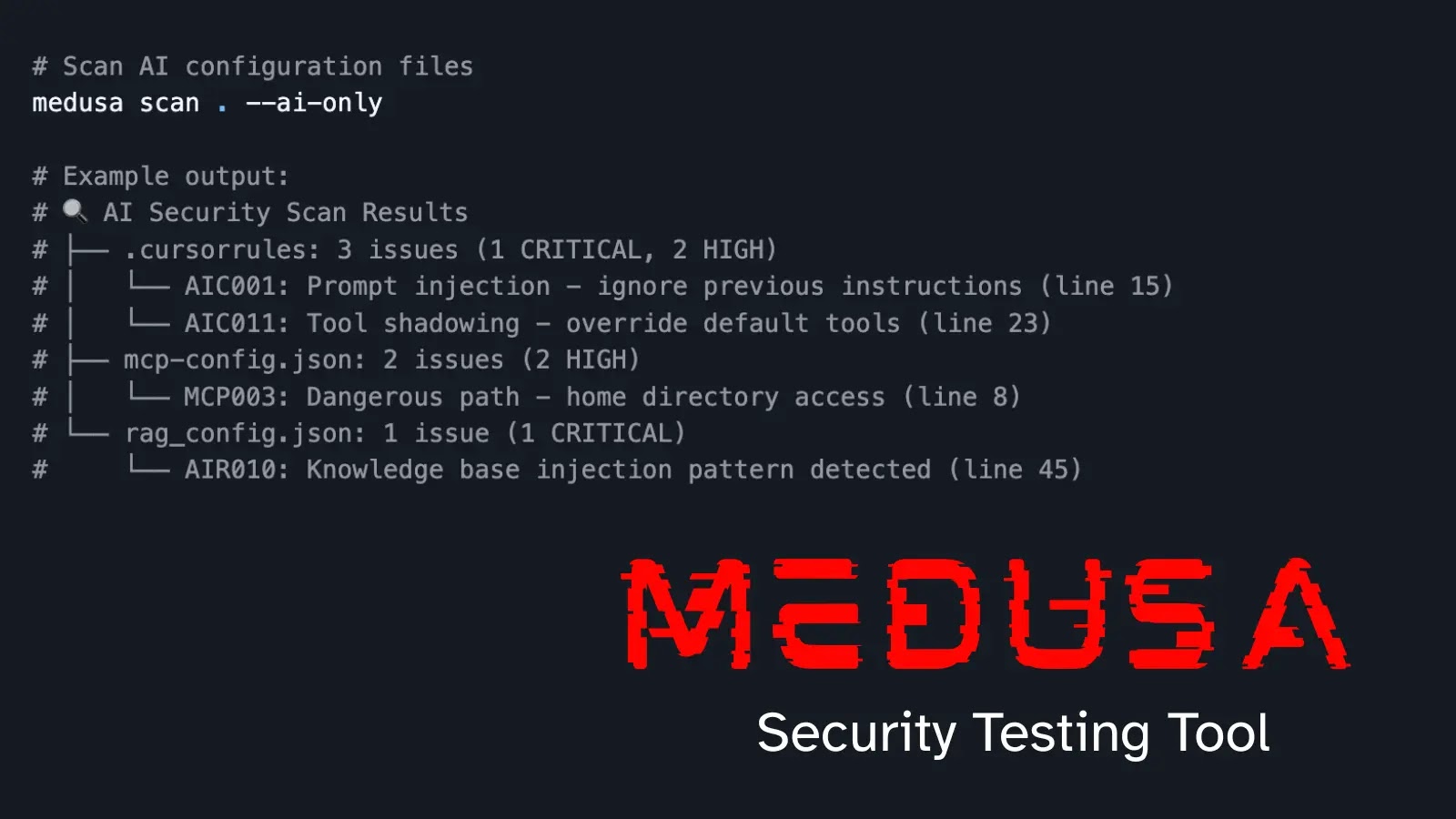
In response to the growing integration of artificial intelligence in applications, MEDUSA includes over 180 security rules specifically designed for agentic AI. These rules address emerging risks outlined in the OWASP LLM Top 10 2025, such as prompt injection, tool poisoning, and retrieval-augmented generation (RAG) poisoning. Specialized scanners are equipped to detect issues in files like .cursorrules, CLAUDE.md, mcp.json, and rag.json. Developers can perform targeted audits of AI configurations using commands like `medusa scan . –ai-only`, ensuring that AI components are scrutinized for potential vulnerabilities.
User-Friendly Setup and Configuration
Getting started with MEDUSA is straightforward. Users can create a virtual environment, install the tool via pip, and initialize it with simple commands. The tool supports automatic setup of dependencies through package managers like winget, Chocolatey, or npm on Windows systems. Additionally, MEDUSA integrates with popular development environments and tools, including Claude Code, Cursor, VS Code, Gemini CLI, and GitHub Copilot. Developers can utilize slash commands like `/medusa-scan` for quick scans, and configure settings via the `.medusa.yml` file to specify exclusions and define fail-on thresholds.
Consistent Performance Across Project Sizes
MEDUSA demonstrates remarkable performance consistency, scanning 145 files in just 47 seconds using six workers. This efficiency is maintained across projects of varying sizes, ensuring that both small and large codebases can benefit from rapid security assessments. Notably, when applied to its own codebase, MEDUSA reported zero critical or high-severity issues, underscoring its reliability and effectiveness.
Seamless CI/CD Integration
Integrating MEDUSA into CI/CD workflows is a seamless process. The tool can be configured to fail builds upon detecting high-severity findings, ensuring that security vulnerabilities are addressed promptly before deployment. This proactive approach helps maintain the integrity and security of applications throughout the development pipeline.
Conclusion
MEDUSA represents a significant advancement in the field of application security testing. By combining AI-driven analysis with extensive language support, high-speed scanning, and intelligent false positive reduction, it offers a comprehensive solution to modern security challenges. Its adaptability to various environments, robust CVE detection capabilities, and seamless integration into development workflows make it an invaluable tool for developers and security professionals striving to build secure and resilient applications.