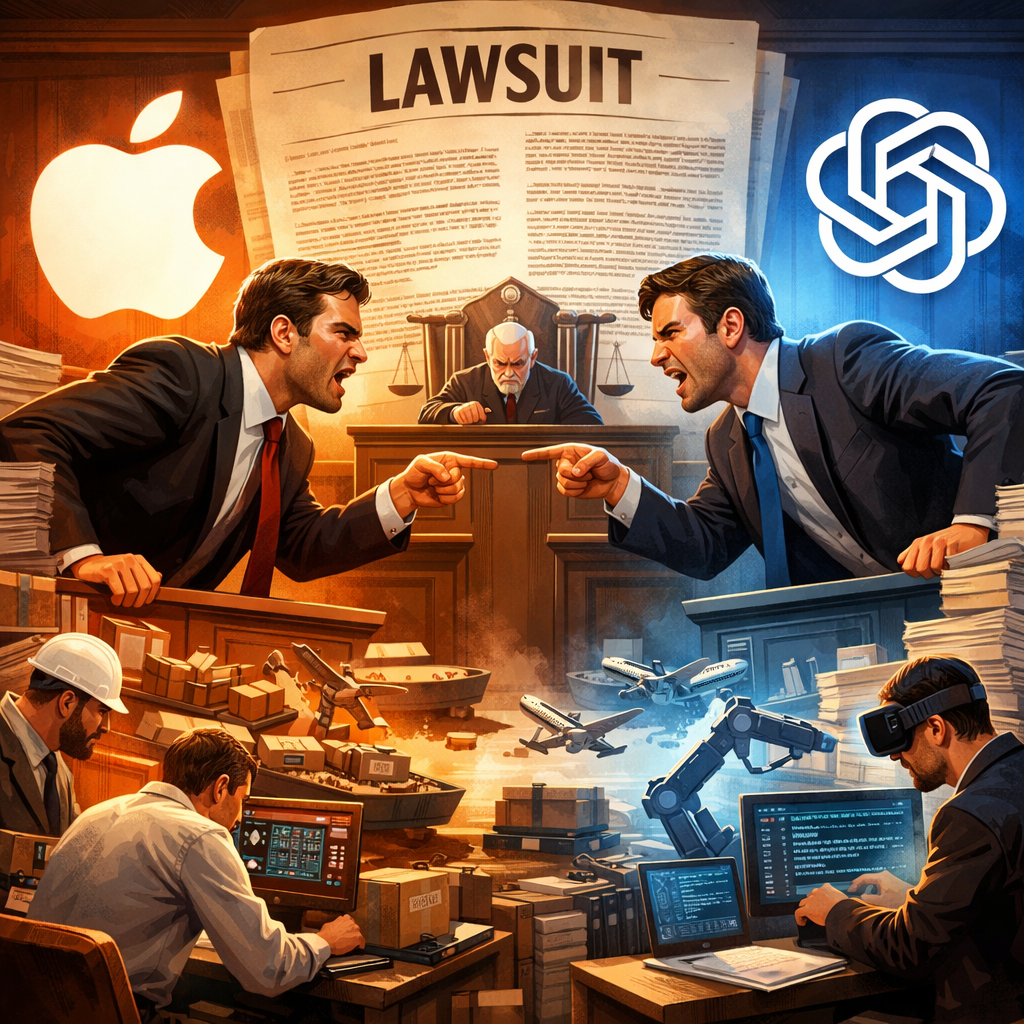
OpenAI has launched a countersuit against Apple, escalating a legal showdown rooted in competing claims of trade secret battles and what OpenAI labels as unfair business practices. These filings come in response to Apple’s lawsuit in July 2026, which alleged that OpenAI misused its confidential information while designing its own hardware offerings. OpenAI is now returning fire, accusing Apple of exerting unlawful pressure on suppliers and using employment agreements to lock down engineering talent.
What OpenAI Claims
OpenAI’s counterclaims focus on what it describes as anti-competitive conduct from Apple. One major allegation asserts that Apple has coerced suppliers who work with both companies to sever or avoid business with OpenAI. The filing argues Apple used ‘expansive employment restraints’—stringent clauses in contracts—to limit OpenAI’s access to experienced engineers.
Another contention from OpenAI targets Apple’s practices around employee departures, claiming that Apple encourages staff to store work-related files on personal cloud or messaging platforms. When those employees leave for rivals, Apple allegedly forces them out abruptly, leaving no opportunity to sort personal from confidential data—an approach OpenAI argues makes it easier for trade secret accusations to follow.
Where Apple Stands
Apple rejects the counterclaims entirely, framing them as a distraction from the substance of its original case. The company insists this is not about incidental file retention or vague employment terms, but about deliberate theft of secret information—misuse of unreleased specs, component designs, and confidential product material. Apple emphasizes that a court has already directed OpenAI to cease using its proprietary information.
In its own complaint filed July 2026, Apple charged two former employees—Tang Yew Tan and Chang Liu—with stealing trade secrets during their transition to OpenAI. The allegations include recruiting processes involving Apple hardware components, coaching candidates on evading security procedures, recruiting with knowledge of Apple’s proprietary project code names, and retaining access to Apple’s file storage and cloud services after leaving.
Legal Status & Broader Stakes
The legal response from OpenAI includes 12 counterclaims filed November 27, 2026, in the U.S. District Court for the Northern District of California. OpenAI and its hardware division io Products together with former Apple engineers bring claims under both federal and state law, including trade secret misappropriation and claims related to interference with supplier contracts.
The court has already granted Apple limited expedited discovery, requiring OpenAI to produce materials like forensic copies of devices and communications linked to the former Apple employees involved. Apple also seeks preliminary and permanent injunctions to stop OpenAI from using its alleged trade secrets. The case is set to be heard in July 2027.
The clash comes even though the two companies partnered in 2024 to embed OpenAI’s ChatGPT into Apple’s Siri—an alliance that now seems strained. Given Apple’s push into AI features and OpenAI’s drive toward hardware, the competitive tension is only going to grow.
This legal drama matters beyond just the courtroom. It sheds light on how power dynamics work in the tech supply chain, especially when suppliers are forced to pick sides. It also underscores the importance of employment agreements in the arms race over talent—and how companies try to create legal barriers to slow rivals. As the case advances, watch for how courts treat Apple’s contractual restraints, whether OpenAI can link supplier interference directly to damages, and how both sides navigate discovery over sensitive materials. What’s decided here could reshape norms for trade secret law and engineering mobility in the AI era.