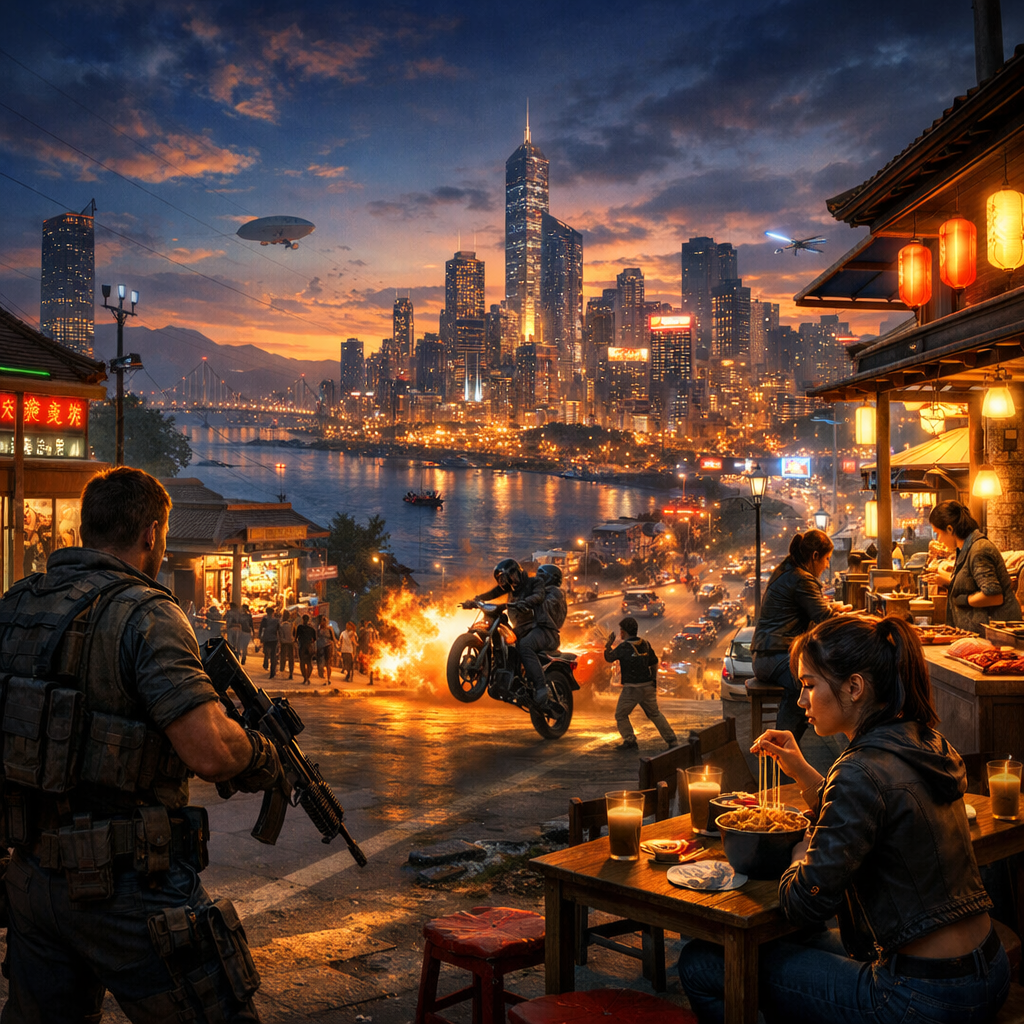
In a world glued to speed, metrics, and automation, two recent phenomena — the release of Grand Theft Auto VIand AI lab Anthropic’s $81.3 billion IPO — offer a compelling reminder that inefficiency, patience and chaos can still yield greatness. These aren’t failures of modern ambition, but proof that some of the most powerful creative work thrives outside the straight path.
The blockbuster no one expected
After a 13-year wait, Rockstar finally dropped GTA VI, a game that didn’t just beat fan hype — it shattered it. It launched as the highest-rated game ever on Metacritic and pulled in $3.79 billion on day one. That dwarf’s blockbusters like “Avengers: Endgame” and even the biggest music tours.
The production of this behemoth went in practically the opposite direction from what’s expected in today’s tech & entertainment landscape. Rather than leaning on generative AI or procedural shortcuts, the team built Grand Theft Auto VI by hand — crafting every detail, voice, character and corner of its open world. That meant over 5,000 people working for more than a decade. It meant unscripted changes, mistakes, rewrites. It meant inefficiency. And it paid off.
The IPO with a twist
Meanwhile, Anthropic stepped into the spotlight with what might be the largest IPO in AI so far. As the maker of Claude, the company now has an $81.3 billion valuation, inking its moment in public markets. But it stands in contrast not just to its IPO peers, but to GTA: an entity built on what many AI companies see as the virtue of maximum efficiency — scale, speed, automation, immediate outputs.
The paradox is clear: one organization bets on streamlining work and systems, the other invests in disordered labor, imperfection, and what many would call waste. Yet both are winning big.
Efficiency’s limits in creativity
Efficiency is baked into AI’s promise: faster code, instant content, sweeping automation. But that drive has real downsides. By taking shortcuts in development, relying on AI to generate textures, behaviors, or feel, companies risk trading away soul. In an age of algorithms that tailor entertainment to niche tastes, artistic works that force us to slow down stand out.
Rockstar’s approach recalls that the most memorable works often require trial and error. Over time, teams refine, delete, revise. Scenes that exist because some director or designer pushed through uncertainty. It is, in creative fields, a requirement — something automation alone cannot replace.
The broader implication for tech & culture
We’re witnessing a tension between two values: the relentless push for optimization (the kind of thing Anthropic stands for) and the messy, unpredictable work that builds timeless art. As AI continues to automate more parts of creative labor, there will be an inevitable conversation about what’s lost.
GTA VIis making waves not just because it’s a game, but because it feels human. It’s expansive, lived-in, and purposefully slow in moments. Waiting, driving, decorating — mundane tasks are part of its greatness. It demonstrates that art sometimes requires not scaling, but breathing.
Analysis:What these twin milestones show is that efficiency, though indispensable in many parts of tech, can’t be the end goal — especially in creative or cultural products. Anthropic’s IPO shows what investors crave; Rockstar’s game shows what audiences still deeply need. Moving forward, companies will have to reckon with inefficiency not as a weakness, but as a design choice. The real question isn’t whether we can streamline everything, but what we’re willing to lose — and whether the losses are worth saving time.