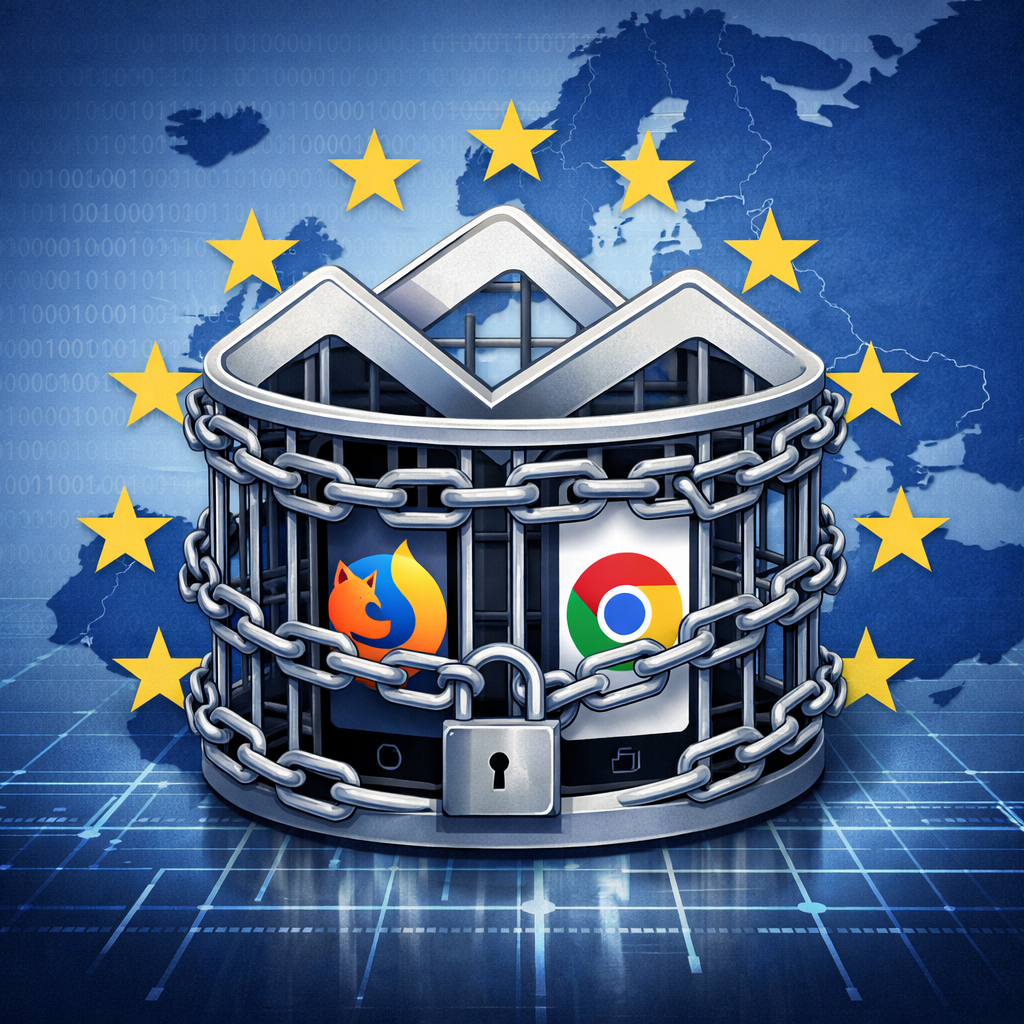
Google’s Chrome for Developers team has backed Mozilla’s complaint against Apple’s rules on alternative browser engines in the European Union, arguing that the changes required under the EU’s Digital Markets Act (DMA) deliver only “choice on paper,” not in reality. Although Apple introduced the possibility of allowing non-WebKit browser engines on iOS in early 2024, none of the major browser makers have been able to migrate their existing EU users from Apple’s WebKit engine to a truly alternative engine.
Why rival browsers say Apple’s rules are still restrictive
The heart of the issue lies in Apple’s conditions for using an alternative browser engine. Under current rules, companies like Mozilla can’t just update their existing iOS browser apps to run on their own engines. Instead, they must develop entirely separate apps solely for EU distribution. That means existing Firefox users would need to download a new Firefox app and manually transfer bookmarks, passwords, history, and then switch the app they regularly use. For many users, that barrier is enough to prevent adoption.
Additionally, Apple requires browser apps using non-WebKit engines to generally be distributed only in the EU, even if the developer’s other versions of the same app are global. Developers also can’t sync data such as cookies or other shared state between the EU-exclusive engine-enabled app and their other apps without user consent. These added restrictions are seen as making implementation impractical.
Regulatory pressure ramps up
Mozilla, Vivaldi, Brave, Shopify, Y Combinator, and other browser makers and organizations have joined forces in a coalition representing tens of thousands of businesses across the EU. In an open letter to European Commission President Ursula von der Leyen, they’re calling for formal enforcement action against Apple, asserting that its implementation of the DMA—even after the March 2024 deadline—has failed to enable meaningful browser competition.
The European Commission is said to be in discussions with Apple about these engine restrictions. Regulators are exploring how rival browsers could actually compete with Safari when all available iOS browsers in the EU continue to be built on WebKit.
Apple, for its part, frames its entitlements and requirements under the DMA as necessary for maintaining security and privacy. Its rules demand compliance with test benchmarks (like high scores on Web Platform Tests and Test262), fast turnaround on vulnerability fixes, and operations following strict disclosure and sandboxing protocols.
Notably, while Google’s Chrome developers have joined Mozilla in publicly criticizing the status quo, Google did not sign the open letter to the European Commission. Earlier experimentation by Google on running its Chromium engine (Blink) on iOS was only a prototype and not intended for release.
So, nearly three years after Apple began implementing EU requirements with iOS 17.4, no browser maker has moved its existing iOS app users away from WebKit. That includes Firefox, Chrome, and others who, despite the choice screen, are still bound by engine limitations.
For users, the visible difference since the DMA is that many have been prompted to select a default browser, and some usage of competitors like Firefox has increased. But underneath, WebKit remains the engine powering nearly every iOS browser in the EU—meaning the core rendering behavior, web platform compatibility, and underlying restrictions remain largely untouched.
This ongoing tension reflects a broader debate about what regulatory compliance should mean in practice, especially in tech ecosystems where platform control runs deep.