A newly identified cyber espionage collective tied to Iran has emerged, launching sophisticated attacks against targets in Cyprus and the broader Middle East under the name Volant Manticore. This group appears to be built from former members of MuddyWater, adapting legacy tools while developing original implants to pursue their own regional agenda.
Backdoor with a Twist: IPFS-Powered Control
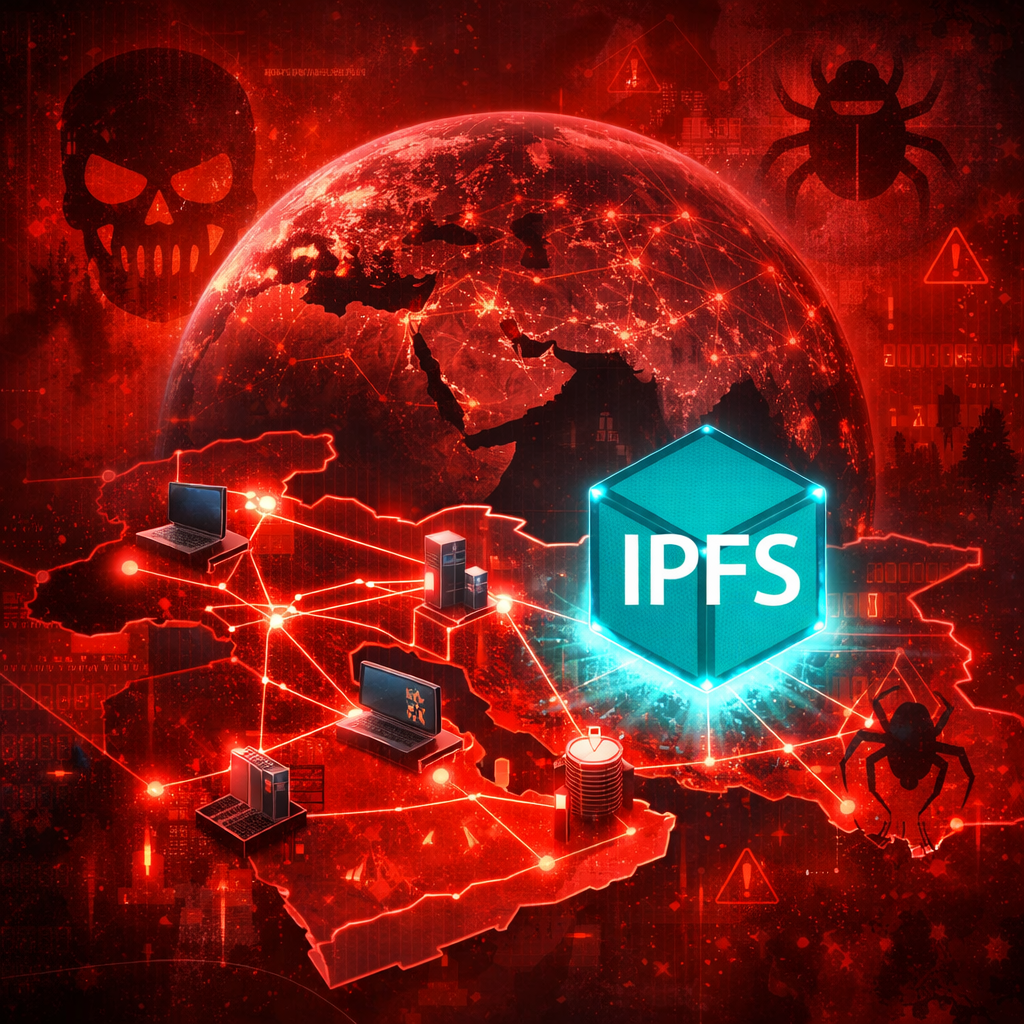
Volant Manticore’s signature tool is a Windows backdoor dubbed KuboShell. Instead of traditional command-and-control infrastructure, it leverages the InterPlanetary File System (IPFS) via the Pinata gateway to distribute commands. Each victim machine generates a signature based on its MAC address, uploads a “hi” marker file named <MAC>.log to a public folder, and polls for instructions in a corresponding <MAC>.txt file retrieved over IPFS. Commands are executed in the background via PowerShell, with results saved to C:\Users\Public\<MAC>re.txt and uploaded back—if the commands themselves write output.
Modular Attack Chain & Parallels with MuddyWater
The attack chain typically begins with a PowerShell stager that fetches a loader from a hard-coded IP, followed by a second stage that decodes and runs a JavaScript backdoor. That JavaScript backdoor maintains a persistent communication loop with the attacker’s servers, capable of executing PowerShell, SSH, or command line commands. Volant Manticore’s more advanced framework, Homa, mirrors MuddyWater’s MuddyC2Go toolset but signals new internal development rather than straight reuse.
Delivery methods include phishing emails featuring AI‐generated resumes, fake CVs, and healthcare themed ZIP files. Some lure victims in Cyprus and Saudi Arabia recently by impersonating medical seminars; others targeted government and defense sectors using macro-enabled Word documents.
Targets & Strategic Shifts
Initial victims include telecom operators, airlines, and critical infrastructure in Cyprus. Over time, focus expanded to Saudi Arabian healthcare organizations amid geopolitical tension involving Iranian-aligned groups. Analysts believe Volant Manticore branched off from MuddyWater sometime around 2023, when MuddyWater upgraded its tooling to DarkBeatC2, leaving space for this splinter group to adopt the previous generation tools and build outward.
Volant Manticore employs Remote Monitoring & Management (RMM) tools such as MeshCentral and NetLock to maintain access, alongside its own malware. These methods reflect MuddyWater’s long-standing techniques—but with distinct shifts in infrastructure, toolchains, and regional priorities.
KuboShell works as follows: on startup it checks for administrator rights and tries to elevate via User Account Control if not running high enough. It acquires the machine’s MAC address, registers this with the attacker’s server via Pinata, and periodically pulls commands from IPFS. Once instructions are received, execution is handled via PowerShell, and outputs, if generated, are saved and returned. Every 60 seconds the tool checks for new commands.
Once reconnaissance is done through KuboShell, the Homa framework can be deployed. This involves three stages: a stager, a JavaScript loader, and then a full-blown backdoor to run various types of commands. The Word document method, especially in government or defense targeting scenarios, acts as the initial vector to load this multi-stage payload.
Volant Manticore shows a blend of old and new: legacy MuddyWater approaches, AI-aided social engineering, and the use of peer-to-peer infrastructure like IPFS. Their targeting varies from aerospace in Cyprus to hospitals in Saudi Arabia, especially around escalated hostilities in the region.
This group has likely been active since at least late August 2025, steadily refining its methods and expanding its target set. Check Point researchers assess it’s a standalone cluster separate from MuddyWater, albeit with shared heritage—using familiar tools but for a realigned mission.
What this reveals is a cyber ecosystem in transition. Iran-aligned operators are not simply imitating older models—they are reconfiguring them. Volant Manticore’s combination of IPFS for resilient C2, legacy frameworks, socially engineered phishing crafted with AI, and strategic targeting signals a more agile, harder-to-track threat. Defenders should watch for increased use of decentralized or peer-to-peer infrastructures, AI-driven lures, and region-specific alignments in cyber-espionage campaigns.