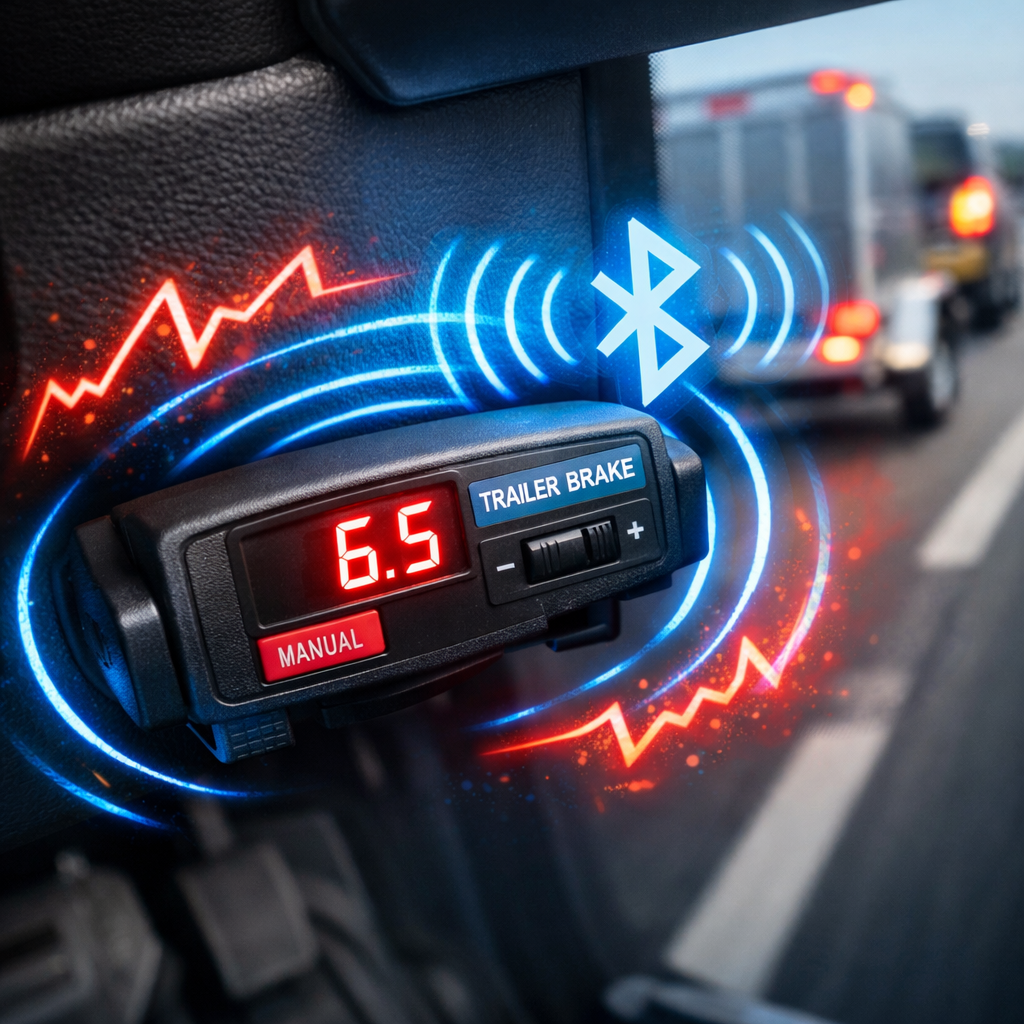
A newly uncovered Bluetooth vulnerability in Elecbrakes trailer brake controllers allows nearby attackers to remotely apply, change, or release a trailer’s brakes while it’s being towed—without driver approval. Identified as CVE-2026-96805 with a 9.6 severity rating, this flaw requires no Bluetooth pairing, PIN, or driver interaction. The U.S. CISA disclosed it on November 19, 2026. Firmware updates exist for the newer EB2 and VM1 models; the older ELBC 2000 remains unpatched.
How the Vulnerability Works
Elecbrakes uses Bluetooth Low Energy (BLE) to communicate between the controller and the Elecbrakes app or wireless remote. On affected firmware versions, there’s no verification to ensure that command signals originate from authorized devices. In practical driving tests, stronger unauthorized brake commands caused significant deceleration, enough to potentially destabilize a tow setup. This differs from prior automotive Bluetooth flaws that mainly affected infotainment systems rather than critical safety components like brakes. A second related vulnerability (CVE-2026-125273) lets attackers repeat previously sent authorized commands, while a third (CVE-2026-124281) exposes the firmware update process to modification.
Fixes, Recommendations & Risk Landscape
Elecbrakes released patches for the EB2 and VM1 models on July 6, 2026. Users must manually install the firmware: version 3.0.4.4.3 or later for EB2, and 1.3.4.2.1 or later for VM1. The updates enforce authenticated connections and require a physical brake-pedal press during initial pairing. Older wireless remotes are incompatible with the new pairing process; new remotes are being offered free to EB2 and VM1 users who need them.
The ELBC 2000 model is still vulnerable and lacks a fix. Owners are advised to contact the company for model-specific guidance and to keep checking the app for updates. As of late October, just over 60 percent of daily active EB2 and VM1 controllers had been updated to patched firmware—but those who rarely open the app likely remain at risk. Fleets and heavy users should audit firmware versions on all units rather than assume their equipment is current.
Researchers discovered the flaw after noticing one remote connected to another trailer without any pairing or prompt. Tests were conducted only on devices owned by the researchers, in closed or private setups—there’s no evidence yet of active exploitation on public roads.
Although this equipment is standalone—the trailer brake controller does not affect the tow vehicle’s own brake system—it still plays a critical role. When a trailer’s brakes engage unexpectedly, it can shift momentum, hitch tension, and potentially lead to jackknifing or loss of control. Bluetooth vulnerabilities that allow untrusted devices to issue commands to braking hardware cross from data risk into physical safety risk.
What you should do now:
- If you own an EB2 or VM1, open the Elecbrakes app and verify the installed firmware version. If it’s older than the patches listed above, update it manually.
- Check whether your wireless remote must be replaced under the compatibility changes and request a replacement if needed.
- If you use ELBC 2000, contact Elecbrakes for guidance and monitor official updates.
- For fleets or multiple units, inspect firmware on each device rather than assuming they’re updated based on aggregated statistics.
Longer view: Bluetooth and wireless protocols are recurring weak points in the automotive and trailer space. While infotainment hacks draw attention, vulnerabilities that let attackers take over braking systems present a much more severe safety concern. It’s not enough for manufacturers to patch; adoption of those patches and the redesign of pairing and authentication workflows are what will prevent dangerous misuse.