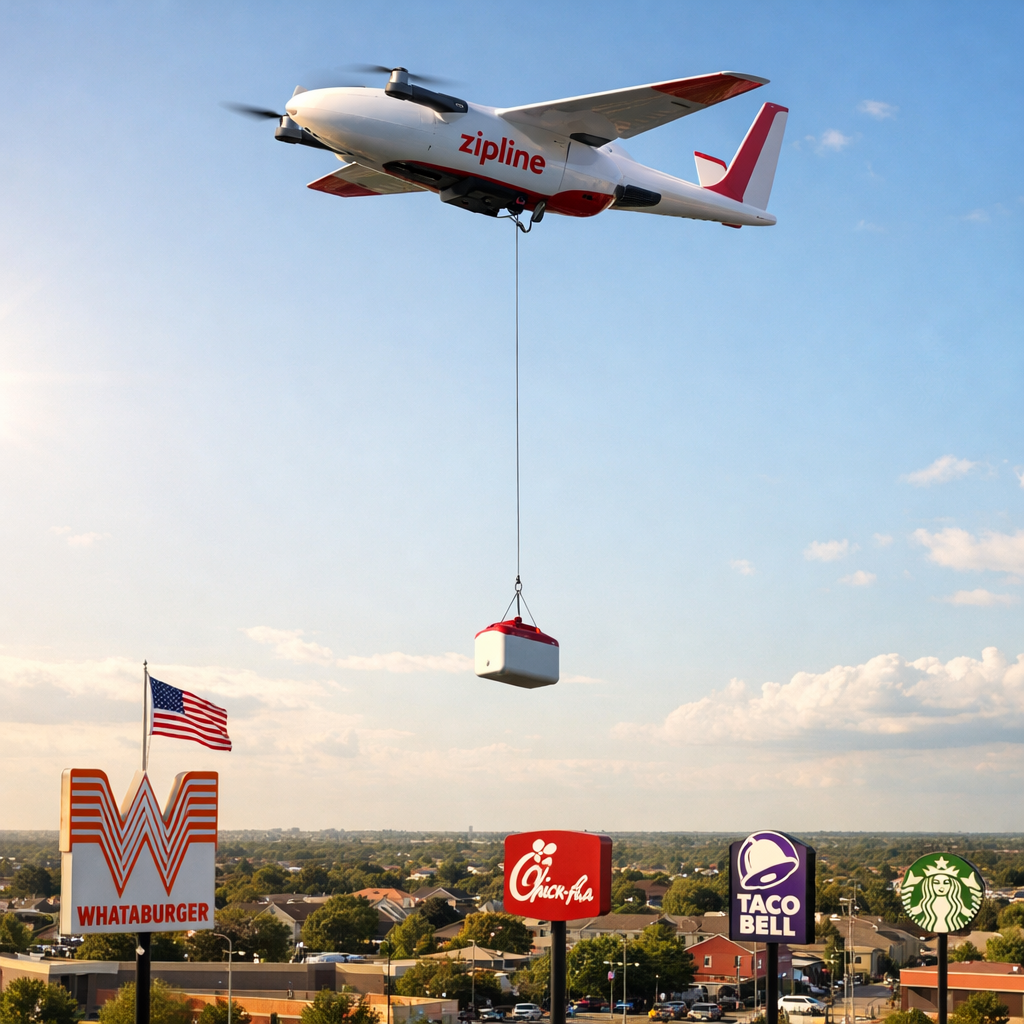
Uber Eats and drone delivery startup Zipline have officially launched their long-awaited partnership in Spring, Texas, marking their first live service under the deal announced earlier this year. Customers in this Houston suburb can now order restaurant meals via drone, with plans to expand to Dallas and many more U.S. cities soon.
How the service works
Zipline’s autonomous delivery drones carry Uber Eats orders weighing up to 8 pounds. They soar roughly 300 feet above ground at speeds reaching 70 mph. Rather than touching down, these drones lower a small protective pod via tether to deliver the meal to the customer’s location. Uber Eats users in the Spring area will be able to see which restaurants support drone delivery by tapping a new “drone” icon in the app. Participating vendors at launch include national chains such as Jersey Mike’s and Zaxby’s, alongside local favorites like Urban Bird and Abu Omar Halal.
Ambitious scale goals
Uber and Zipline aim to carry out one million drone deliveries per day in the U.S. by the end of 2029. The Texas rollout is just the beginning of that national push. Zipline, founded in 2014, developed its drone delivery system—including aircraft, launch/landing infrastructure, and logistics software—and received its Part 135 air carrier certification from the FAA in 2022, enabling long-range commercial drone operations in the U.S.
The financial commitment between the two companies runs deep: Uber has invested in Zipline, which recently raised $1.5 billion in a funding round led by Paradigm, WCM Investment Management, and Layer Global, with Uber among the backers. Financial details from Uber’s investment weren’t disclosed.
Challenges and broader context
This move lands in a larger field of drone delivery efforts—including Alphabet’s Wing and Amazon’s Prime Air—all of whom face pushback from communities over noise, wildlife impact, privacy concerns, and safety. Proponents of drone delivery argue that it could reduce traffic and pollution by cutting down on car trips for deliveries.
While the system is mature from a technical standpoint, with regulatory steps cleared, adoption remains nascent. Many communities are still evaluating how they’ll coexist with low-flying drones making regular flights above residential areas.
Zipline’s origins were in medical supply deliveries in Rwanda, before shifting into U.S. domestic operations. Its FAA certification in 2022 served as a major inflection point, opening wider opportunities in food, retail, and other fast-delivery categories.
Uber and Zipline’s drone delivery service in Texas represents a significant milestone in drone logistics. It blends speed, automation, and a bold scale target as industry competitors and regulatory stakeholders watch closely. This isn’t just about lifting packages—it’s about reshaping last-mile norms in delivery.
What this means: the Spring rollout is a proving ground. If Zipline and Uber can meet their one-million-deliveries-a-day goal by 2029, that could force regulators, cities, and competitors to fast-track rules around drone noise, flight paths, and privacy. Key observers will be how smooth the expansion to other cities is—and how communities respond when drone delivery becomes as common as car-based food delivery today.