In a newly documented malware campaign, attackers are sending ZIP archives themed around package shipments to deploy PureLogs and PureRAT malware. The unusual infection chain blends legitimate signed software, DLL side-loading, and concealed Python scripts to evade detection.
How the Attack Chain Works
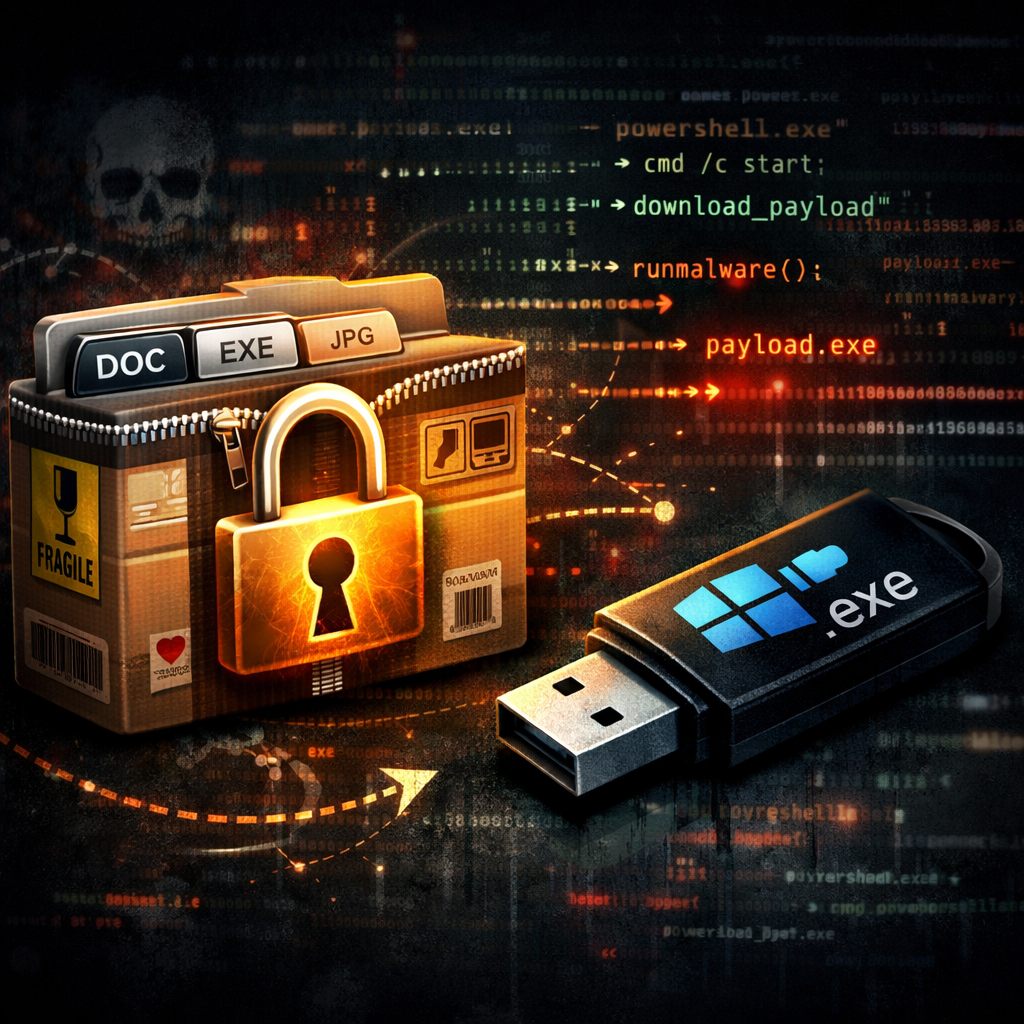
The ZIP file arrives masquerading as a shipment notice, complete with images, documents, and a “browser updater.” Hidden inside are two critical components: a genuine 32-bit Kingsoft PDF executable (legitimately signed) renamed to match the shipment scenario, and a malicious DLL placed alongside it. When the executable runs, Windows automatically loads the DLL in the same folder—giving attackers control without touching the signed program.
This DLL executes a command sequence, presenting a decoy PDF while triggering the next stage: a disguised WinRAR command-line tool, using a false image extension, extracts a password-protected archive. Inside this archive is a renamed Python interpreter, dressed up as the Edge updater, plus decoy files whose Korean names refer to chicken deliveries and refrigerator stock.
Obfuscated Python Payload
The renamed Python interpreter then reads an apparent PDF—which is actually encrypted script data—using a repeating XOR key, decodes it, and immediately executes it. That script in turn decodes a Base64 blob, applies another XOR sequence, yielding a Windows executable (with an “MZ” header) that becomes the final payload.
This payload connects via TLSv1 over port 443 to infrastructure linked with PureLogs or PureRAT campaigns. Though researchers couldn’t confirm both malware variants ran on the same compromised endpoint, many indicators tie the communication to both threat families.
For defenders, standout red flags include: running a signed application from the Downloads folder that loads a DLL from its same directory; hidden archive extraction and Python execution from public user directories; and a script masquerading as a document being read, decoded, and executed directly.
Key Indicators of Compromise
- SHA-256 of the malicious DLL:
7453f86a9b36a0067b37cf00627ae6195b9eeee9e64a58653a80069eae7bd6fa - SHA-256 of the decoded executable payload:
91ca4a96289fae34fb441a41d836e9a61ba8d2cfe6a12a8d345c521a4ddeebd3 - C2 domain:
tea.vexexo[.]com - C2 IP and port:
185.139.214[.]102:443using TLSv1 - Initial ZIP archive name:
Shipment_Condition_And_Check_mp4.zip - Renamed executable:
Shipment_Condition_And_Check_mp4.exe(originallywpspdf.exe) - Malicious DLL path:
...\Shipment_Condition_And_Check_mp4\...\krpt.dll - Disguised extractor: a WinRAR CLI binary renamed with a .png extension
- Password-protected archive inside named in Korean, containing the Python runtime
Researchers from Unit 42 observed this chain on October 21, 2026, after a user downloaded the shipment-themed archive. The findings were published around November 16, 2026. The exact vector delivering the ZIP file remains unverified. Whether victims are targeted specifically or hit at random is still unknown.
This case underlines why a proper digital signature doesn’t guarantee harmlessness: authenticated programs can be misused via side-loading attacks. True detection requires behavioral insight beyond signatures or hash matches alone.
This new attack’s sophistication—mixing trusted code with obfuscation, archive camouflage, and script-based payloads—makes it especially challenging for traditional defenses.
Why This Matters: These attacks show that modern malware campaigns are sidestepping signature-based protections by exploiting legitimate binaries. Organizations should bolster behavior-based detection, monitor DLL loads near signed apps in nonstandard directories, and scrutinize any script execution that masquerades with benign file extensions. The era of ‘‘trusted’’ software being beyond reproach is over—what looks secure can still be the Trojan horse.