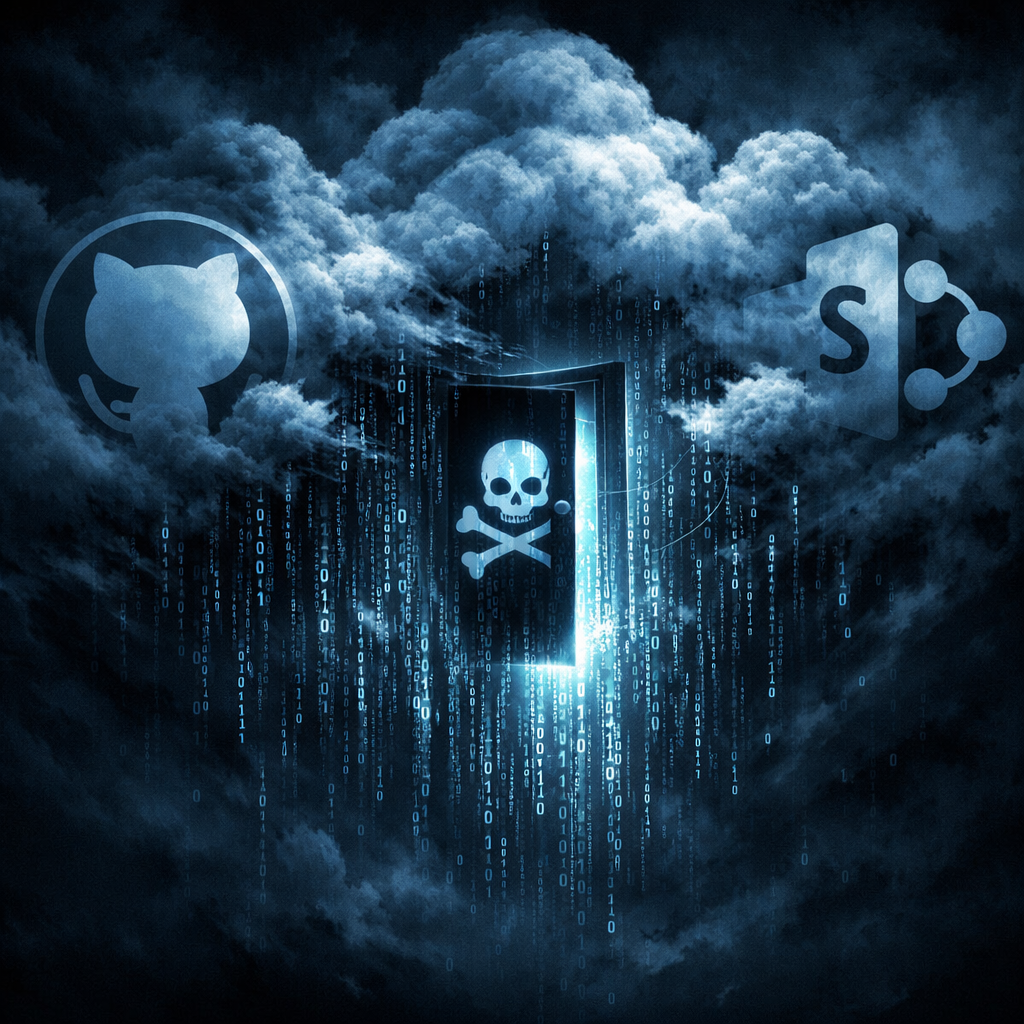
A newly uncovered espionage campaign dubbed Operation ShadowCloud is deploying previously unknown backdoors that abuse trusted platforms like GitHub, Microsoft SharePoint, and Ably to evade detection. Discovered by researchers earlier in 2026, the intrusion is currently targeting government entities across Asia and Africa. The adversary exploits legitimate remote management tools and encrypted communication channels to blend malicious activity into normal network traffic.
Infection & Loader Mechanisms
The attack begins with the deployment of MeshCentral’s legitimate remote access agent utility, which is already installed at a Taiwanese organization. While the installers remain unidentified, evidence suggests the agent is reused from earlier infections within the network. Once active, it connects to a hard-coded command-and-control (C2) server under the URL wss://27.102.66[.]162:443/agent.ashx to retrieve three staged payloads:
- A clean binary for DLL sideloading, using names like
start.exe,pythonw.exe, orzoomit.exe. - A malicious loader DLL—variants include
jli.dll,SbieDll.dll,python39.dll, among others—that unpacks the core payload. - An encrypted file containing the backdoor that will be injected into process memory at runtime.
Two loader types have been identified: one that decrypts using RC4 followed by an XOR mask, and a simpler one that uses XOR alone. The aim is to execute malicious code purely in memory, avoiding leaving easily detectable files on disk and complicating forensic analysis.
GraphDoor vs GitDoor: Dual Backdoor Architecture
The campaign deploys two modular backdoors distinguished by their C2 channels:
- GitDoor operates via GitHub. Public and private repositories—named “Havo” and “Trix”—are used for receiving commands and exfiltrating data. GitDoor supports over 25 commands, including file management, keystroke logging, shellcode execution, task scheduling, registry edits, process manipulation, screenshot capture, credential dumping using tools like Mimikatz, and even extracting WhatsApp decryption keys.
- GraphDoor leverages Microsoft SharePoint (via the Microsoft Graph API). It authenticates using Microsoft identity services, stages data on SharePoint drives, and runs a suite of plugins in parallel to handle screenshots, process listings, keylogging, and proxying through Ably. GraphDoor also introduces two additional commands: one for running executables (MZ-format) and another for launching commands via the Windows command prompt.
Why It’s Stealthy & Who Might Be Behind It
To blend in with legitimate enterprise workflows, this campaign tunnels its C2 traffic through popular cloud services like GitHub, SharePoint, and Ably. These services handle vast legitimate activity, making the illicit use harder to detect via network monitoring. Encryption, control-flow obfuscation, nested helper functions, and in-memory execution further complicate detection.
The threat actor remains unconfirmed, but clues point to a possible Chinese-speaking operation. Analysts observed overlap with known groups that regional cybersecurity firms track under names like Bronze Sandcastle, FamousSparrow, and CopperTurtle (also known as BlackTech). Though shared infrastructure or staging directories and synchronized deployment windows were noted, direct attribution has not been made.
What this means: organizations relying on tools like MeshCentral, Microsoft SharePoint, GitHub, or Ably must assume sophisticated adversaries can hide in plain sight. Monitoring cloud-service usage alone isn’t sufficient. Zero-Trust architecture, endpoint detection of in-memory threats, and strong identity authentication are essential defenses going forward. Watch closely for how defenders adapt to detect abused cloud APIs and in-memory shellcode techniques; this campaign could represent a new paradigm in persistent, stealthy malware.