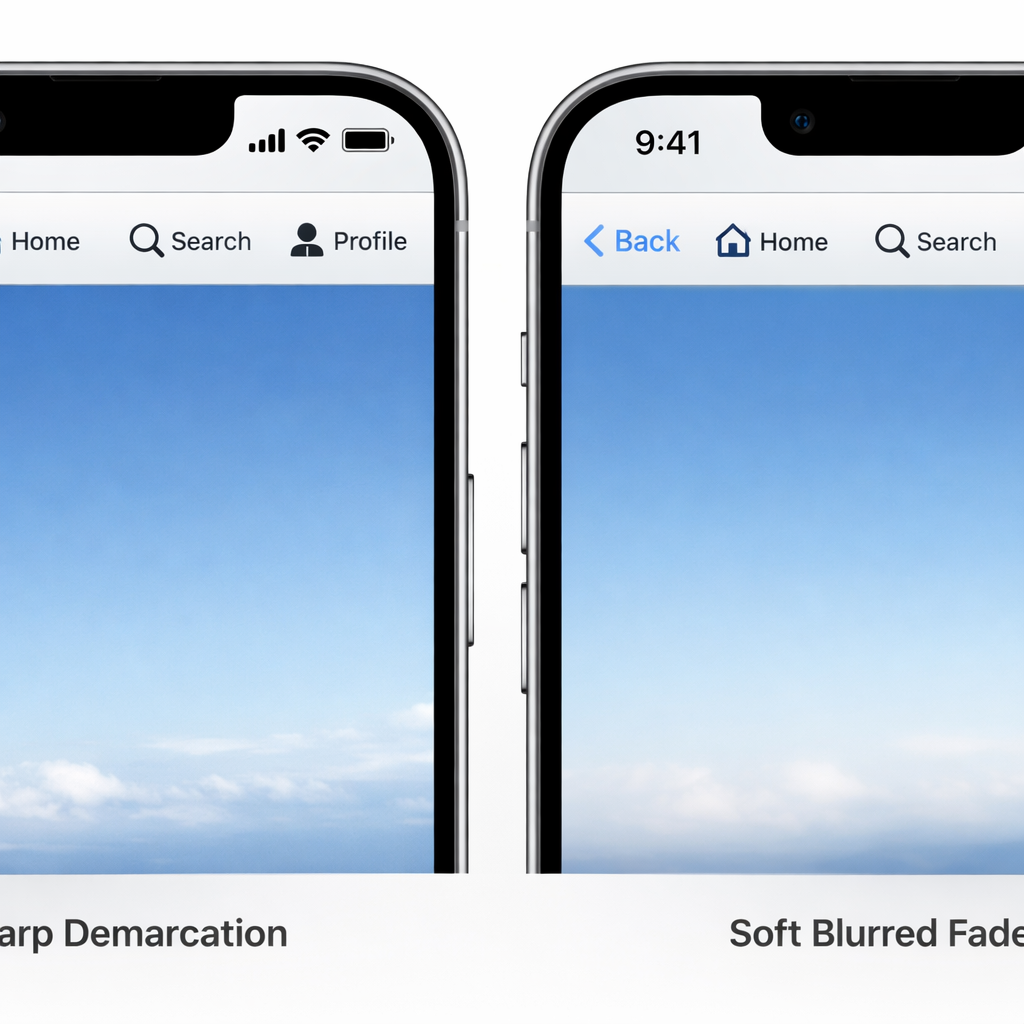
Apple is experimenting with a subtler navigation bar edge in iOS 27.3, restoring some of the softer visual transitions seen in iOS 26’s Liquid Glass design. Internal code changes indicate that app content scrolling under the top navigation bar will fade in more gently rather than ending at a sharply defined border. The change is currently hidden behind an internal feature flag. Users can’t yet activate it via Settings.
What’s Changing in Liquid Glass
Earlier this year, the company modernized Liquid Glass with updates aimed at improving legibility and control. Among those tweaks was replacing separate Clear and Tinted presets with a continuous transparency slider, which gives users finer control over how transparent the navigation bar appears.
The softer fade-out effect Apple is testing only applies when Liquid Glass tint is set at 25% or lower and only to navigation bars set to the default style. When enabled, it causes the content underneath the bar to gradually blur and fade instead of being clipped by a defined edge. This is reminiscent of how navigation bars behaved in iOS 26.
Where Things Stand
The soft fade effect is disabled by default in the latest iOS 27.3 developer beta. It’s unclear whether Apple will make it broadly available, require a toggle in Settings, or leave it as an engineer-facing experiment. But sources suggest the company is seriously exploring bringing back this more subtle design touch.
Apple first introduced Liquід Glass to offer a modern translucent feel across its UI, but over time users and designers pushed back against navigation bars that obscured text or content. Earlier opacity options were often criticized as appearing overly harsh. The continuous transparency slider launched in iOS 27 was meant to address that by letting users fine-tune how bold or subtle translucent elements appear.
Why this matters: navigation bars are a key part of interaction design. They influence readability, app discoverability, and overall aesthetic. Subtle design changes like this can improve accessibility, user comfort (especially during scrolling), and visual consistency across devices.
What to watch: whether this soft fade becomes a user-facing toggle, and whether it’s limited to certain opacity thresholds or styles. Also important: whether Apple tests this widely or limits it to internal betas. If enabled, we could see this change in an upcoming public iOS 27.3 release—or maybe even later, depending on feedback and performance.