Threat actors linked to Mustang Panda have launched a campaign using LOTUSLITE V2 malware, distributing it through public Zoho WorkDrive downloads. The operation, concentrated in Thailand, leverages an Indo-Pacific assessment theme to trick users into executing malicious files. Target machines are Windows systems, where persistent backdoor access is being established through several stealth techniques.
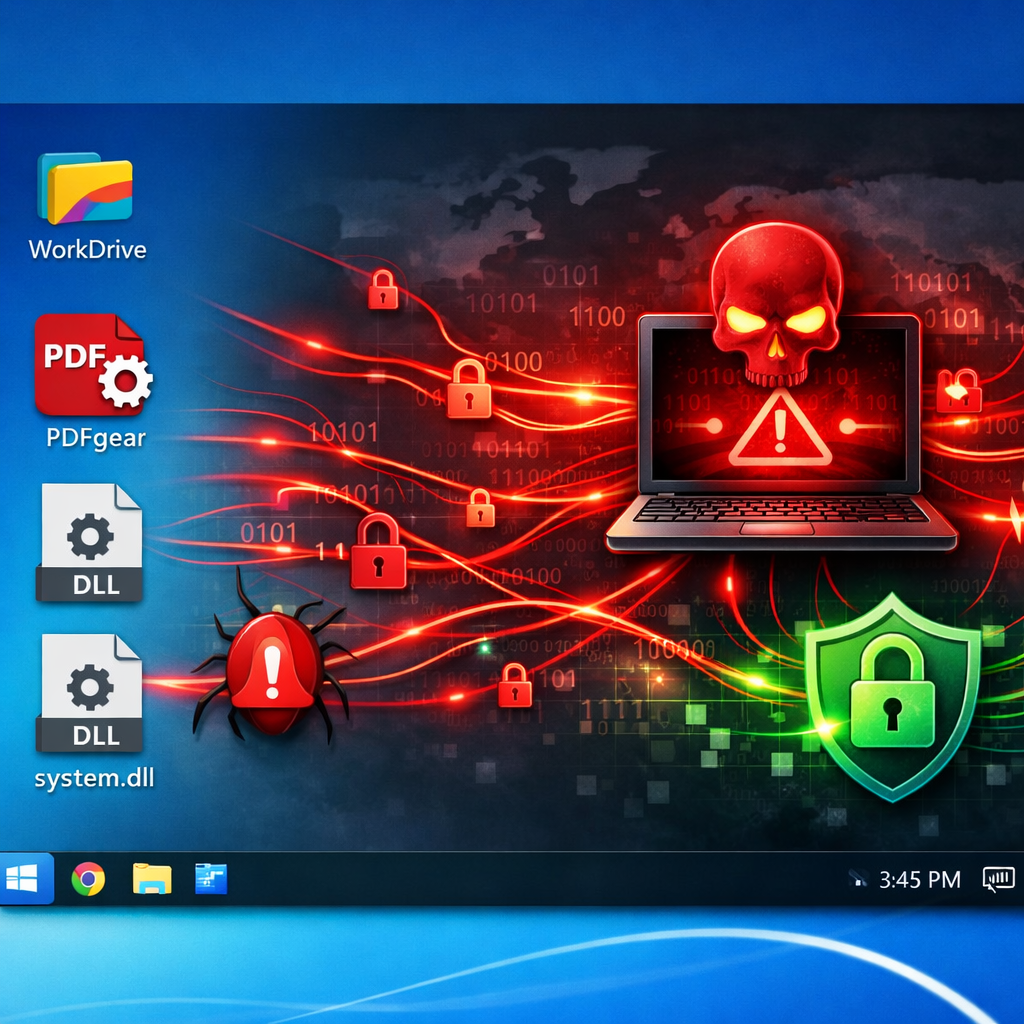
Financial industry software named PDFgear is central to the attack, acting as a trusted executable that sideloads a malicious DLL when run. To maintain persistence, the malware also manipulates Windows registry entries and alters file association settings. All communications with the command-and-control (C2) servers are encrypted, and multiple techniques are in place to avoid detection.
LOTUSLITE V2: Next-Level of an Existing Threat
Security researchers identify LOTUSLITE V2 as a modern rewrite in managed C# of the earlier LOTUSLITE family. While past campaigns used a Microsoft-signed launcher, this latest variant disguises itself alongside PDFgear, sidestepping signature-based filters. Shared traits—including protocol design, execution chains, persistence, and geographic focus—strongly tie this campaign to Mustang Panda.
The malware is delivered via ZIP files hosted on public Zoho WorkDrive links. Once clicked, the archive downloads an executable that resembles an assessment document and a malicious library. When the executable is run, it stages payloads into a Microsoft-themed directory in ProgramData. The PDFgear executable then loads the malicious library using DLL sideloading.
Operational Mechanics & Network Behavior
Upon launch, the backdoor modifies the Windows registry. If running with SYSTEM privileges, it adds a system-wide Run key; otherwise, it updates the current user’s run-on-startup path. It also rewrites PDFgear’s file-opening handler so that documents trigger a launcher under attacker control.
The malware communicates using multiple network options—UDP and secure WebSocket (WSS) across ports like 443, 80, 22, 21, 8080, and 1080. Configuration data, including hardcoded C2 addresses, is stored obfuscated, decoding byte arrays using a simple XOR key at runtime. The protocol incorporates version markers and AES-256-GCM for payload encryption, with compatibility wrappers to support older Windows versions without relying solely on higher-level .NET cryptography.
Indicators of compromise include download hosts like files-accl.zohoexternal.com, executables staged in C:\ProgramData\Microsoft\DeviceSync, and artifacts such as PDFLauncher.exe and the mutex PDFgear_DeviceSync_Mutex. Specific SHA-256 hashes are associated with the original archive, the staged executable, and the malicious DLL.
Detection Tips & Risk Mitigation
Security operations teams are being advised to monitor abnormal PDFgear launches, unexpected DLL loading, registry changes tied to persistence, and out-of-band network traffic, particularly to known C2 addresses. Recognizing updated protocol markers is also critical, as signature-based detection relying on older LOTUSLITE identifiers won’t flag this variant.
This campaign shows how attackers evolve while reusing trusted tools. PDFgear provides cover but does not immunize the process against inspection. Distinguishing threat behavior—even when the software appears signed or legitimate—is more crucial than ever.
As defenders respond, the key will be identifying these changes in execution, encryption, and delivery. Threat intelligence updates, including all known IoCs, will be essential for organizations at risk of India-Pacific region targeting. This isn’t just a refresh of LOTUSLITE—it’s a refinement.
Analysis: This attack illustrates a maturation in Mustang Panda’s tactics, blending social engineering with evolving technical sophistication. By abusing a legitimate business platform like Zoho WorkDrive, the group improves stealth. Transitioning to C# and integrating strong encryption steps up the difficulty for defenders. Watch for whether there are spillovers beyond Thailand, adaptations to evade behavior-based detection, or misused trusted applications in other sectors. Enterprises should treat any signed executable as potentially weaponized.