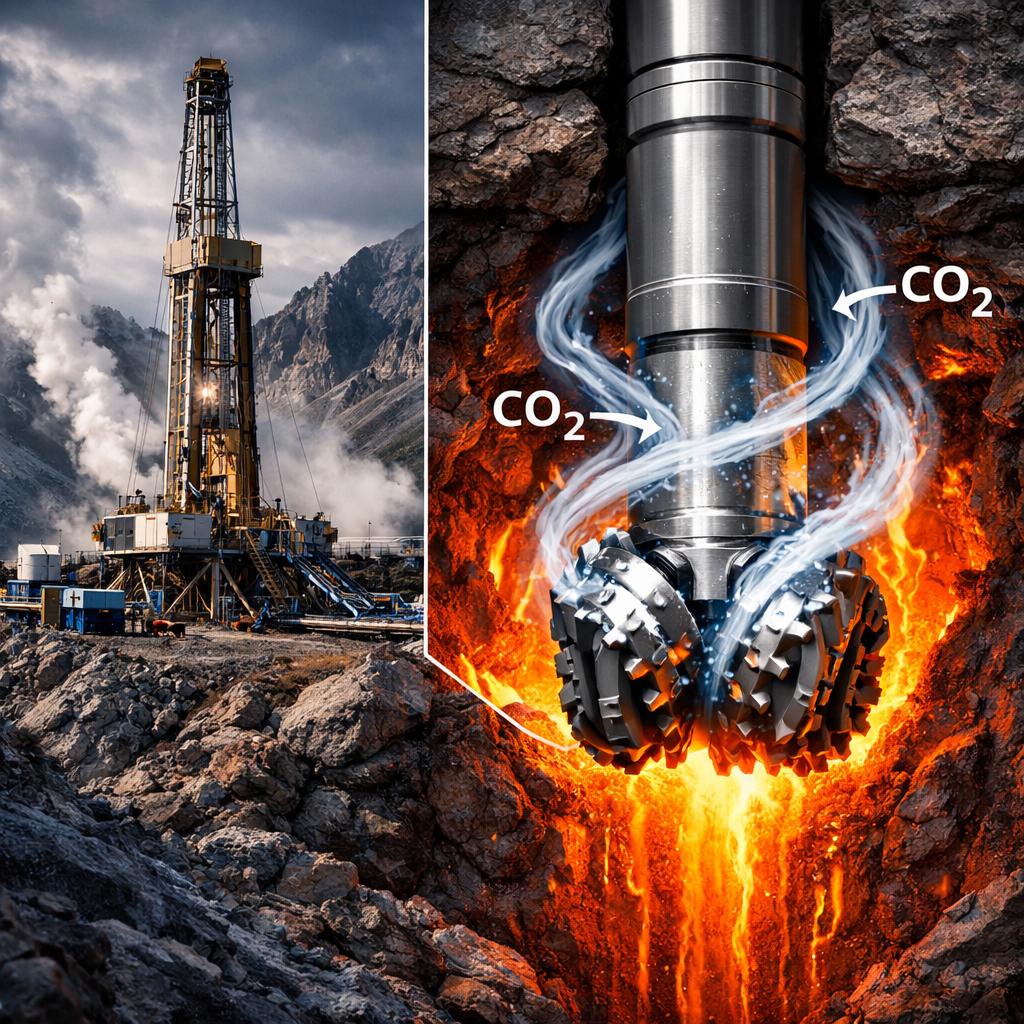
Geothermal energy startups are locked in a race to drill both deep and quickly—the deeper the well, the hotter the rock, and the hotter the rock, the harder it is on equipment. One company, Mazama Energy, has unveiled a novel approach called Carbon Chill that uses liquid carbon dioxide instead of conventional drilling mud to solve the extreme heat problem at the bit, enabling safer, faster penetration through super-hot rock.
Why heat is geothermal’s biggest obstacle
Traditional geothermal wells rely on drilling mud—a water-based mixture that cools the drill bit and flushes out rock cuttings. But when the surrounding rock heats beyond a certain threshold, the mud alone can’t keep things cool, and the electronics that steer the drill start to fail. This hits productivity and pushes up the cost: drilling usually makes up about 25% to 30% of a geothermal plant’s total cost.
How Carbon Chill works
Mazama’s approach begins by pumping liquid CO₂ down through the drill string. As it descends, the CO₂ picks up heat from the rock until it becomes supercritical—a state where it behaves like both gas and liquid. Right before it reaches the drill head, the CO₂ passes through a nozzle resembling those used on rockets. When it expands, it rapidly cools the bit and electronics—cooling that would be impossible with mud alone.
Results so far and what’s next
In field tests at extremely high temperatures, Mazama has already reached wells exceeding 629°F (331°C), and more recent ones have surpassed 700°C. Thanks to Carbon Chill, penetration rates climbed roughly 20% over already high baselines. Armed with a fresh $135 million funding round led by Centaurus Capital and Doerr Capital, the company’s next goal is to deliver a single well capable of generating up to 15 megawatts of electricity with this super-hot-rock geothermal approach.
The broader view: why this matters
Helming geothermal toward greater depths and higher temperatures promises more energy from each well. When rock surpasses ~752°F (400°C), water reaches a supercritical state—retaining density while behaving like a gas—and carries 5 to 10 times more energy than in conventional wells. Experts estimate the U.S. alone has the potential to generate between 26.5 to 57 terawatts from geothermal energy. Even developing 10% of that lower end would more than double peak U.S. electricity capacity.
This latest innovation is a potential tipping point. It addresses one of the biggest bottlenecks in geothermal: keeping drill bits and electronics intact in super-hot conditions. Reducing drilling costs via faster speeds—or needing fewer wells per project—could make geothermal a much more competitive player.
Still, major challenges remain. Scaling the Carbon Chill technology from pilot to industrial scale will require careful validation of reliability, safety, and overall economics. Will CO₂ supply, infrastructure, and handling costs undermine the gains? Can drill components withstand repeated exposure to supercritical fluids and thermal cycling? What regulatory and environmental hurdles will emerge?
What’s clear is that if Mazama’s approach succeeds, it has potential not just to shift geothermal economics, but to reshape energy infrastructure in the 2030s. For the dream of commercial super-hot rock geothermal, this is no longer a question of “if” but “when.”