A recent investigation revealed that the BlackNevas ransomware group demolished a VMware ESXi environment—including all virtual machines, vCenter Servers, and backups—not by exploiting any hypervisor vulnerabilities, but by leveraging stolen administrative credentials. Over a ten-day period, attackers targeted four ESXi hosts, every hosted VM, two vCenter Server Appliances, and connected backup infrastructure. This incident serves as a sharp reminder that having secure virtualization tools doesn’t protect you if access controls fail.
How Attackers Took Control Without Technical Exploits
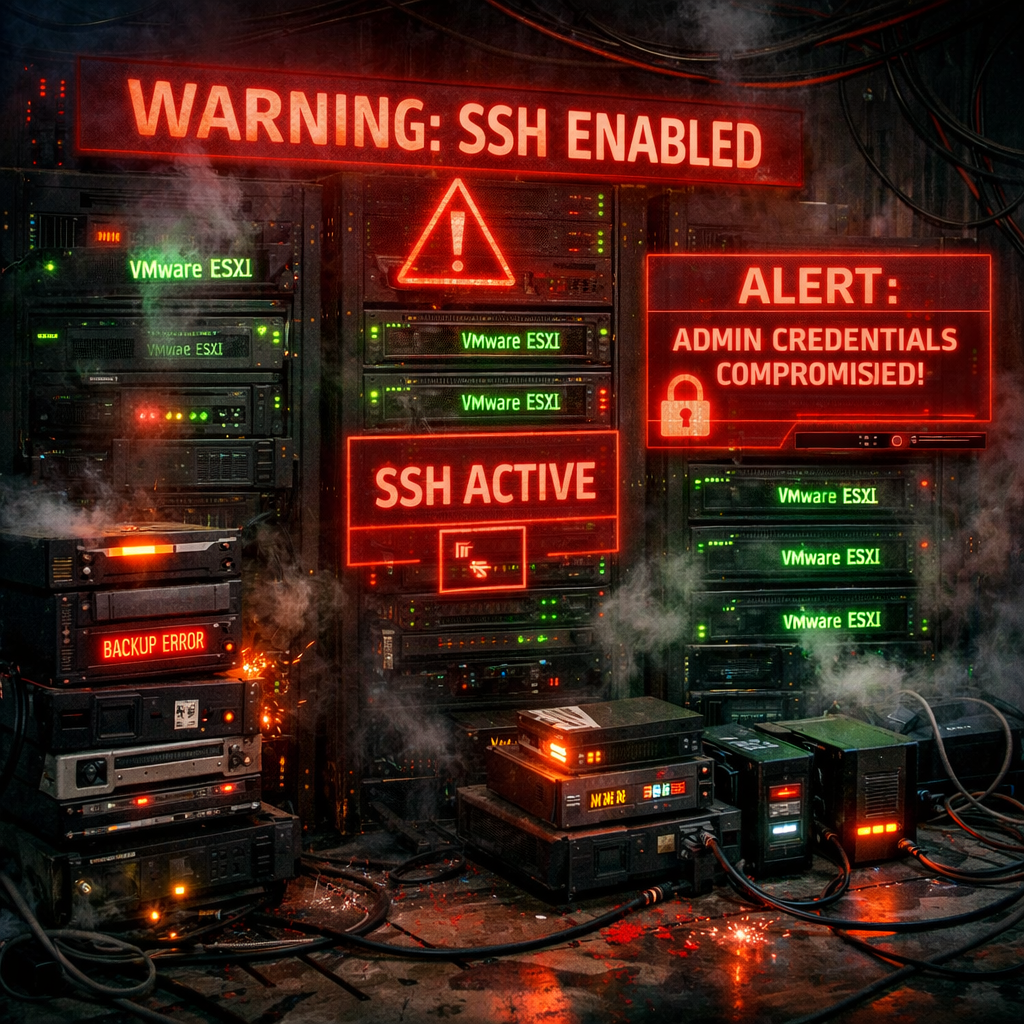
Rather than leveraging technical flaws in the ESXi hypervisor or its components, the attackers gained login credentials from outside the virtualization layer—most likely through compromised systems tied to backups. With those credentials, they accessed the vCenter server appliances, obtained root-level SSH access, and introduced a persistent reverse tunnel via Ligolo-ng. From there, they changed host configurations to enable SSH access directly on ESXi hosts using VMware’s Host Profiles feature, essentially turning legitimate administrative tools into attack vectors.
The breach unfolded over hours. After obtaining access to a disaster-recovery vCenter appliance, the attackers authenticated and planted a backdoor (MeshAgent) within seconds. Multiple hours later, they returned to establish the reverse tunnel and then made configuration changes to weaken defense. Eventually, they delivered a destructive payload via SFTP that wiped parts of virtual disk files—particularly the first 2 KB of each virtual disk—rendering the VMs unbootable in many cases. Backup services were also disabled days earlier, cutting off recovery options before the damage was irreversible.
What Went Wrong and What to Monitor
This case illustrates four major failures. First: backups were not just attacked—they were used as a launchpad. Attackers disabled security protection, halted backup operations, and encrypted recovery infrastructure, preventing any restoration once the destructive ESXi payload struck. Second: administrative tools and features like SSH and Host Profiles, designed for legitimate operations, were misused once the attacker was in. Third: visibility was severely limited—agents inside VMs can’t see changes at the hypervisor level, which meant these changes went unnoticed until it was too late.
Indicators of compromise include unexpected Host Profile changes, enabling SSH on ESXi hosts, new connections originating from vCenter, executable staging, and mass shutdown of virtual machines. Authentication logs, host-management logs, shell access, and vCenter task logs were key to understanding the attack. To protect against similar scenarios, organizations should implement separate admin identities for production, virtualization, and backup environments; restrict management access; ensure recovery procedures are tested; and forward critical logs outside the same environment that could be wiped or controlled by attackers.
IOCs tied to this attack include domain names, IP addresses, and file indicators, including specific services like `vmware-vdma` for VCSA persistence and `vspbind` for remote-management services, as well as SHA-256 hashes of agents and executables used during the breach. These intelligence points are crucial for SOC teams focused on detecting similar threats.
Administrators should also bear in mind that immutable storage—while vital—is not enough if attackers already hold credentials or can reach critical servers or systems involved in restoration. To rely solely on unchangeable backups without protecting how those backups and recovery paths are accessed can still leave an entire system vulnerable.
This breach underscores a broader trend: attackers are increasingly abusing legitimate management paths and admin tools rather than seeking zero-day vulnerabilities. As organizations lock down code exploits, credential theft and the abuse of trust continue to offer powerful footholds. Moving forward, tighter separation of duties, more aggressive monitoring of management actions, and resilient disaster-recovery architectures will be essential to avoid total collapse of infrastructure when defensive assumptions are breached.