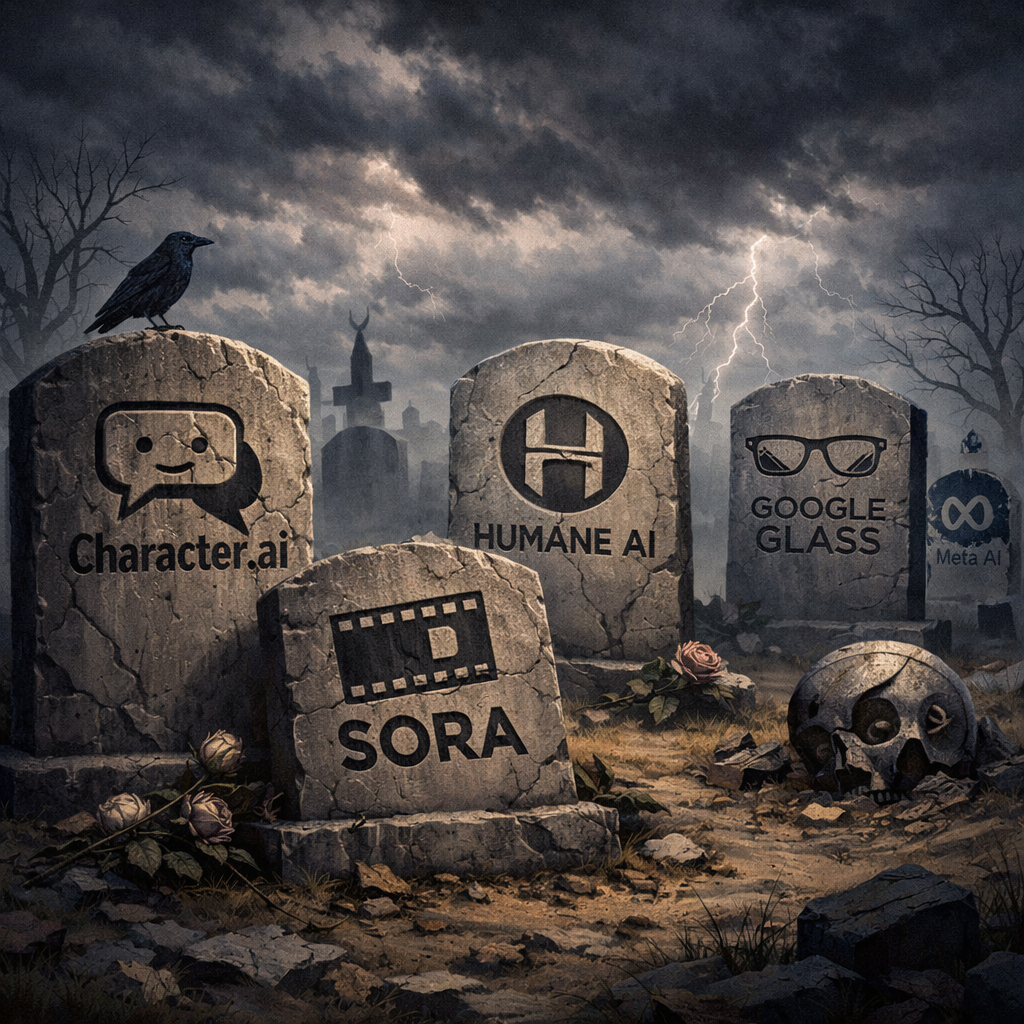
It’s become increasingly clear that AI isn’t immune to failure. An estimated 42 percent of corporate AI initiatives get dropped before reaching maturity, often under pressure from technical roadblocks, weak demand, or stiff competition. These misfires are stacking up, and a recent survey of fallen AI startups, tools, and products lays bare their strategies, stumbles, and what the industry can learn.
What Big Players Got Wrong
Even OpenAI, a pioneer in generative AI, has had its share of false starts. In mid-2024 it tried to morph ChatGPT into a “super app”—combining several functions like Codex and “Work” modes alongside the classic chat interface. But users found the update confusing, and the experiment was quickly reversed. A number of specialized apps—ChatGPT Atlas (a browser), Operator (a task-performing agent), plus dedicated image generator DALL-E—were folded back into ChatGPT, making those standalone tools obsolete. And Sora, a social video sharing spin-off, was shuttered in March 2026 following struggles with user retention and high cost.
Apple’s AI ambitions—including a contextual Siri meant to understand cross-app behavior—were delayed multiple times due to engineering and bug issues. These delays fed into a $250 million settlement over how Apple marketed its AI capabilities. Siri AI finally surfaced in beta as part of iOS 27 in July, with an English rollout beginning in November and support for more languages promised.
Startups & Tools That Fizzled Out
Character.ai, launched in 2021 to let users chat with customizable bots, ran into legal and ethical storms—lawsuits, misuse of IP, teen safety issues. It declared bankruptcy in October 2026. Disney is among bidders to license its character rights, with final sale expected by late November or early December.
Relay, which set out to be an AI-powered rival to Zapier, shut down in August 2026. As big platforms baked workflow automation into their own tools, Relay couldn’t justify its place as a separate product.
Ollie, a family-oriented agent launched in June 2026, struggled to distinguish itself and secure funding. It pulled the plug on November 6, thanking competition and insufficient growth.
Hardware and Niche Darlings That Didn’t Catch On
The Humane AI Pin—aimed at delivering AI via a wearable instead of a phone—raised eyebrows and $230 million in funding. But performance issues and even battery-case safety hazards forced its business to shutter in early 2025. Most of its assets were picked up by HP for $116 million.
Rabbit R1, another hardware hopeful introduced in early 2024 that promised gesture-based control and AI companionship, sold well initially. Yet reviews called it rough, unreliable, and limited. The company is pivoting, continuing updates and working on a new “Project Cyberdeck,” a portable device for “vibe-coding.”
Apps like **Huxe**, which transformed text into podcast-style audio; **Yupp**, a platform comparing AI model responses with crypto incentives; and **Figgs AI**, a role-playing character platform, all closed shop between 2024-2026. They struggled as incumbents began offering overlapping features to much larger audiences.
What These Failures Tell Us
These cases share recurring patterns: rivals with more reach absorbing niche competitors, inability to scale without serious funding, and the difficulty of building new products when larger platforms keep adding overlapping capabilities. Privacy missteps and ethical incidents have also triggered results that go beyond lost sales—character licensing issues, user safety, and claims about claims alone cost some startups their futures.
The uneasy truth: launching an AI product isn’t enough. Getting traction—and maintaining trust—matters even more. The AI graveyard isn’t a hall of shame; it’s a warning. Investors and entrepreneurs must demand honest product–market fit, prioritize reliability from day one, and not assume novelty alone guarantees success. What we watch next: which of the many current AI bets escape this fate, and how survivors build differently.