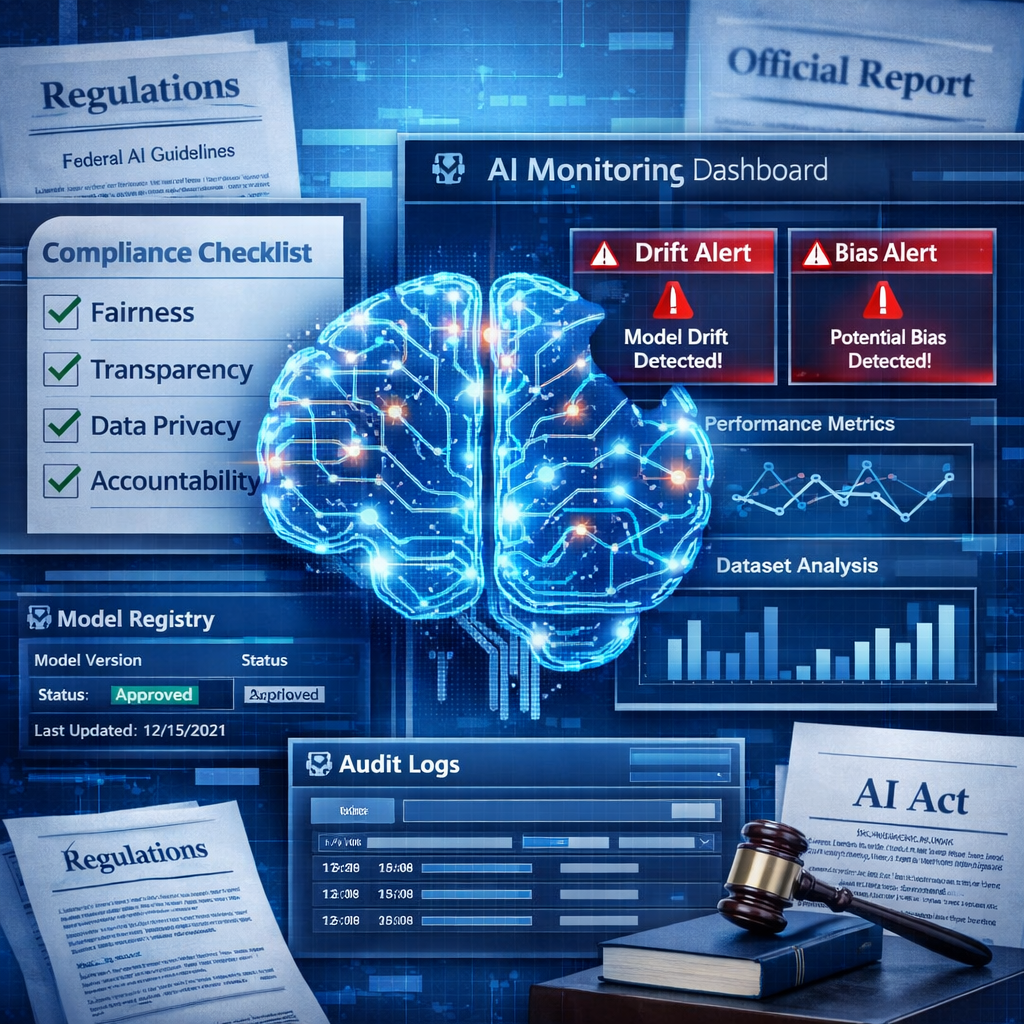
As EU AI Act obligations take hold and corporate boards demand transparency about deployed models, organizations are rushing to select AI governance platforms—also known as AI TRiSM tools—that can deliver both compliance and runtime truth. In 2026, platforms fall into three camps: registry-heavy policy suites, observability-first monitors, and hybrid security/assessment tools. Here are the top 10 across those lanes, and how buyers should evaluate them.
Leading Platforms in Policy, Registry & Governance
Credo AI tops the list as the most policy-to-evidence governance tool. It excels at mapping AI use-cases, aligning policy packs with frameworks like the EU AI Act and NIST, and generating evidence for auditors. It also provides vendor-AI assessments for purchased models. Its shortfall: runtime monitoring depth is only partial. Overall score: 8.7.
IBM watsonx.governance closely follows in second place. It embeds governance throughout the model lifecycle, with automated documentation, bias and drift monitoring, workflow approvals, and regulatory mapping. Integrates with IBM’s OpenPages for strong adoption in regulated industries. Score: 8.6.
Microsoft Purview ranks third by addressing the “shadow AI” problem across large estates. Its inventory discovery spans the Microsoft 365/Azure environment, tracing both data flow and prompt-level usage. Regulative mapping and monitoring are only partial, but it’s highly effective for organizations heavily invested in Microsoft tech. Score: 8.4.
OneTrust stands out for extending existing privacy suites into AI governance. It ties AI registries to data maps, leverages existing assessment workflows, and tracks regulations as they evolve. Monitoring like model drift or bias is not yet deeply embedded. Score: 8.2.
Holistic AI builds its reputation as a specialist in regulation-mapped assessments. Audit-grade evaluations tied to jurisdictional rules—such as New York City’s bias law—and registry workflows are its strong suit, though its scale of integrations trails larger suites. Score: 8.1.
Runtime Monitoring, Observability & Enforcement Tools
Fiddler AI shines in model observability. It tracks drift, performance, bias, and adds explainability, including LLM-specific safety signals like hallucination metrics. But it doesn’t offer a full policy or registry workflow. Score: 8.0.
Cisco (Robust Intelligence) brings an attack-surface mindset: red-team-style testing, adversarial validation, runtime guardrails. It’s ideal for security-focused governance; its registry and policy layers are partial. Score: 7.9.
Arthur targets performance monitoring, with accurate bias and drift detection and LLM evaluation metrics—especially suited for engineering teams. Broader governance and regulatory mapping are weaker. Score: 7.7.
ModelOp is built for enforcing governance at scale. It supports inventory across diverse platforms, enforces lifecycle gates (preventing deployment without checks), and is trusted in model risk management (MRM) regimes especially in financial services. Policy pack breadth is narrower than others. Score: 7.6.
Monitaur excels in audited, regulated-industry settings. It delivers decision-level audit trails, full model documentation and workflows shaped for insurance and other sectors under strict regulation. Its scale outside those sectors is more limited. Score: 7.5.
How These Tools Were Scored
Rankings use five criteria: depth of registry and inventory, regulation-framework mapping (notably EU AI Act), assessment workflows, runtime monitoring, and quality of evidence output. Weights: registry (25%), regulation mapping (20%), assessment workflow (20%), runtime monitoring (20%), evidence generation (15%). All tools evaluated via independent research—no sponsored placements.
What Buyers Should Prioritize
First task: build an accurate registry or census of all AI in your organization—both internal models and third-party/SaaS-embedded AI. Without knowing what you have, nothing downstream can be trusted. Tools like Microsoft Purview help discover “shadow AI,” while Credo AI builds the registry and maps policy packs to regulation.
Next: enforce conformity. That means pairing a strong registry with runtime monitoring—drift, bias, adversarial stress testing. Having dashboards is good, but what matters is what the model does in production.
Also demand audit-ready evidence: documentation, decision trails, vendor-AI evaluation, assessment reports auditors will accept. For regulated sectors, focus on platforms like Monitaur or ModelOp.
Finally, align tool choice to your estate: if mostly Microsoft, Purview gives strong discovery; enterprises with mature programs may lean toward IBM’s lifecycle strength; others require specialist tools where privacy or audit primes matter.
What this means: AI governance is no longer optional—it’s central to risk management. The difference between mere dashboards and audit-grade evidence is becoming the dividing line between readiness and exposure. As AI regulations spread globally, organizations without strong registry foundations or runtime truth will struggle when examiners or stakeholders demand proof, not promises. The platforms that win will be those that stitch policy, observability and compliance into a single, verifiable thread.