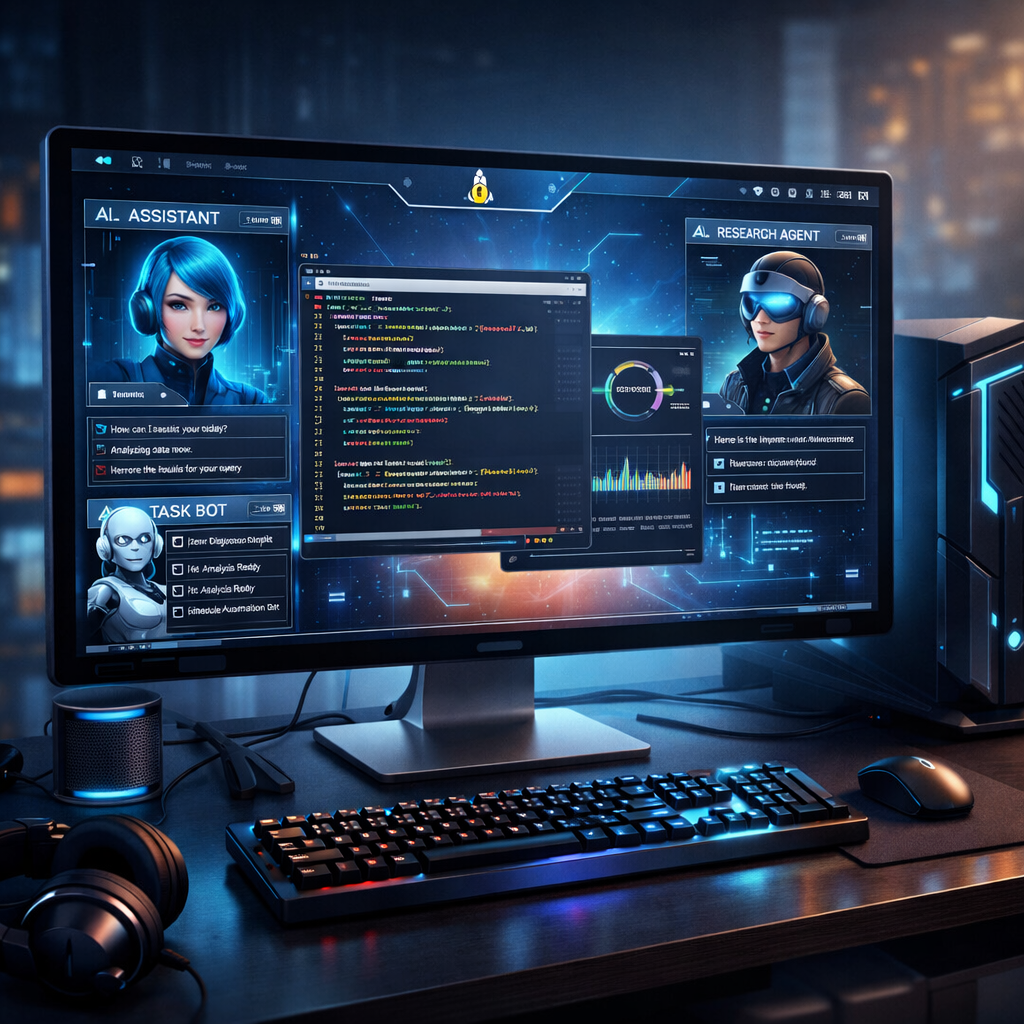
More than a decade after his first bid to compete with Google’s Android via Cyanogen, co-founder Kirt McMaster is now turning his attention to challenging Microsoft. His latest venture, Kora Systems, has revealed a Linux-based desktop operating system aimed squarely at users dependent on artificial intelligence in their daily workflows.
The OS — simply named Kora — is intended to reshape how AI tools integrate with the desktop. It promises autonomous agents and models that span across applications, access files directly, and hold context between tasks. It’s built for devices using Intel, AMD, and even Qualcomm’s Snapdragon chips. A release is expected in 2027, and the OS will be free to users.
Kora’s Foundations & What Sets It Apart
The team behind Kora has around 50 engineers, and McMaster says they’ve leaned heavily on external tools — specifically OpenAI’s Codex and Anthropic’s Claude — to speed up development. He estimates that these tools have improved productivity by at least five times, particularly over the past six months.
Kora’s design philosophy reflects lessons learned during McMaster’s time at Cyanogen. Back then, the venture tried to offer something beyond Google’s Android but remained heavily reliant on Google Mobile Services — a dependence he believes prevented it from ever fully decentralizing the operating system experience.
Features, Partnerships & Business Model
Already, Kora is born from years of work under McMaster’s earlier company, initially called Playtron, which focused on creating a gaming OS called GameOS based on Linux. The shift toward AI happened in mid-2025 when roles broadened to meet emerging demand in AI-powered browsers and agents.
Kora will employ the Nix package manager on top of a Linux base, replacing GameOS’s previous Fedora Silverblue foundation. The core OS, desktop interface, and the Cortex AI engine will remain closed-source, even as the system supports external AI models and services. Users will get secure workspaces to control agents and file access.
Gaming remains part of the roadmap, including tools for developers and Android app support. Meanwhile, Qualcomm is working closely with Kora to optimize for Snapdragon-powered PCs, especially its Snapdragon X2 Elite chips. There’s also a planned enterprise version called Humain OS, developed in partnership with AI firm Humain, targeting Snapdragon laptops and expected to debut in 2027.
On the business side, Kora plans to monetize via subscriptions focusing on access to AI models and agent-driven services. When possible, workloads will run locally via the Cortex engine; else, cloud-based solutions will take over. Current investors include Samsung Next, Square Enix, Alumni Ventures, Polychain, VanEck, and Circle. Though McMaster hasn’t shared exact financing details, he claims the company has enough funding to last for years.
Microsoft continues to dominate the desktop OS market, holding about 77 percent of share globally in October. Apple’s macOS trails at nearly 10 percent. But McMaster isn’t aiming to topple this dominance entirely. Instead, he’s zeroing in on advanced users — roughly 45 to 50 million now, a group he predicts will grow to over 200 million by 2033 — who demand deep AI integration and are willing to pay for it.
This move could put pressure on Microsoft’s long-held control over desktop environments, especially as AI becomes a crucial differentiator not just in cloud or mobile computing, but right at the OS level.
What this means: Kora’s approach signals a potential shift in OS competition. Instead of mass-market wins, the key battleground may move toward AI-first feature sets, deeply integrated agents, and flexibility around third-party models. If Kora can deliver stable performance, consistent updates, and compelling agent experiences, traditional players like Microsoft may find their dominance challenged — not by low-end rivals, but by a focused AI-native alternative. What to watch next: partner announcements for hardware, details on privacy and security of local vs cloud-based AI, and how the AI agents deal with user data and cross-app workflows.