New startup Osaurus is challenging the cloud-first AI model dominance in enterprise. Founded by Terence Pae (also a co-founder of Dinoki), Osaurus offers an open-source “AI harness” designed to let businesses run tools like memory, agents, code execution and identity directly on Apple Silicon Macs instead of relying on remote servers. The product is emerging as a compelling option for organizations with sensitivity to privacy, data resourcing, or infrastructure dependency.
What Osaurus Offers
Osaurus is a native macOS app (built in Swift) that runs on Macs with Apple Silicon (M1 chip or newer) and requires macOS 15.5 or newer. The core product is free, open-source (MIT licensed), and allows local inference—so all models, agents, memory and tools live on the user’s own machine. You decide whether to use cloud providers like OpenAI or Anthropic; but unless you explicitly choose to send tasks off-device, data remains local. The app supports both local models—some lightweight, others heavier—and cloud models when needed.
For teams, Osaurus offers “Workspaces”—paid access to shared agents, credit pools for cloud use, collaboration features, and optional managed cloud resources—while preserving local-first functionality. Enterprises can negotiate contracts for scale, security, compliance, single sign-on, and audit controls.
Why Local AI Matters for Businesses
Pae discovered demand for local-first AI particularly from enterprise users in sectors like legal, research, and healthcare—fields where privacy, control, and avoiding third-party data access are critical. Running AI tasks on Mac hardware promises tighter data security, reduced dependency on cloud infrastructure, and potential cost savings over large-scale cloud compute and token bills.
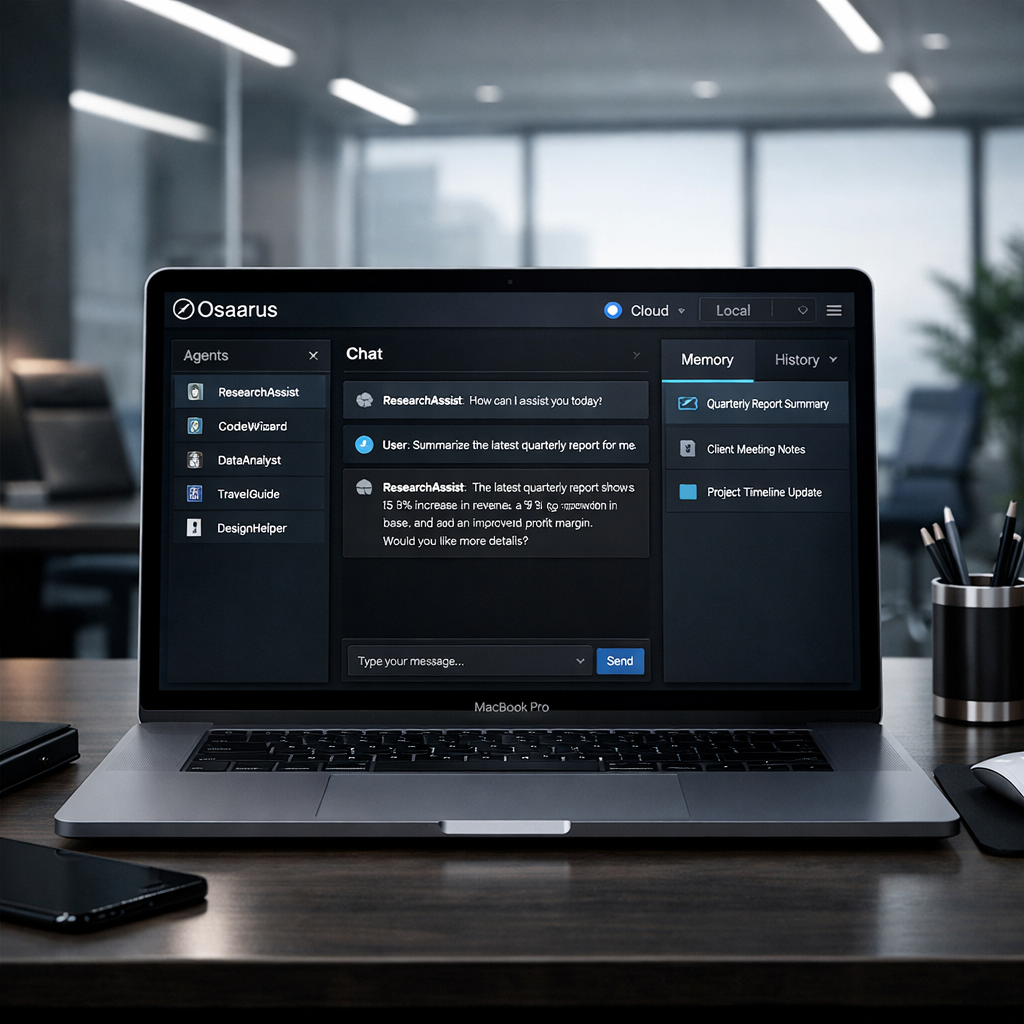
Technically, Osaurus acts as both a client and server on the local machine and includes a memory system, ability to run code in isolated sandboxes, shared agents, schedule-triggered workflows, and connectors to cloud or local runtimes. All this is wrapped in a unified toolset so that switching underlying AI “brains” (i.e. models) doesn’t disrupt your agents or retained context.
Importantly, when using purely local models, none of your data—prompts, files, tools, memory—leaves your Mac. Privacy safeguards extend to optional cloud use, where users review what is being sent, and the company explicitly states it doesn’t store user content from shared agents or cloud inference beyond what is required for billing and usage records.
Challenges & Reach
While Osaurus works on many Macs, hardware capability matters: handling large models smoothly demands enough RAM and processing headroom. Macs with more limited resources may be tipped toward lighter local models or rely more on cloud models for performance.
The user base is growing steadily. Osaurus has seen over 100,000 downloads since launch; enterprise interest is rising, especially among teams that currently worry about data residency, compliance and the hidden costs of cloud vendor lock-in.
Pricing for individuals remains free—no subscription, no usage cap on local mode. Cloud inference is pay-as-you-go. Teams using Workspaces pay a flat monthly fee for shared agents, credit allotments, and collaborative controls. For larger organizations, custom enterprise plans are available.
Osaurus positions itself as an AI infrastructure alternative: its harnessing layer—the persistent memory, agent tools, identity—is what stays with you even as models evolve or swap. This matters for enterprises worried about sudden policy or pricing changes from cloud providers, or needing transparency over how data or AI operations happen.
What this means is that AI deployment doesn’t have to mean giving up control. Businesses can build customized, private assistants, automation, research tools, or security-sensitive workflows without having to send everything through a third-party server. As local models grow more capable and efficient, this model could reshape how AI is integrated into business operations. Now, whether Osaurus can deliver enterprise-grade stability, scale, and support will determine how far this local-AI, Mac-first vision stretches.