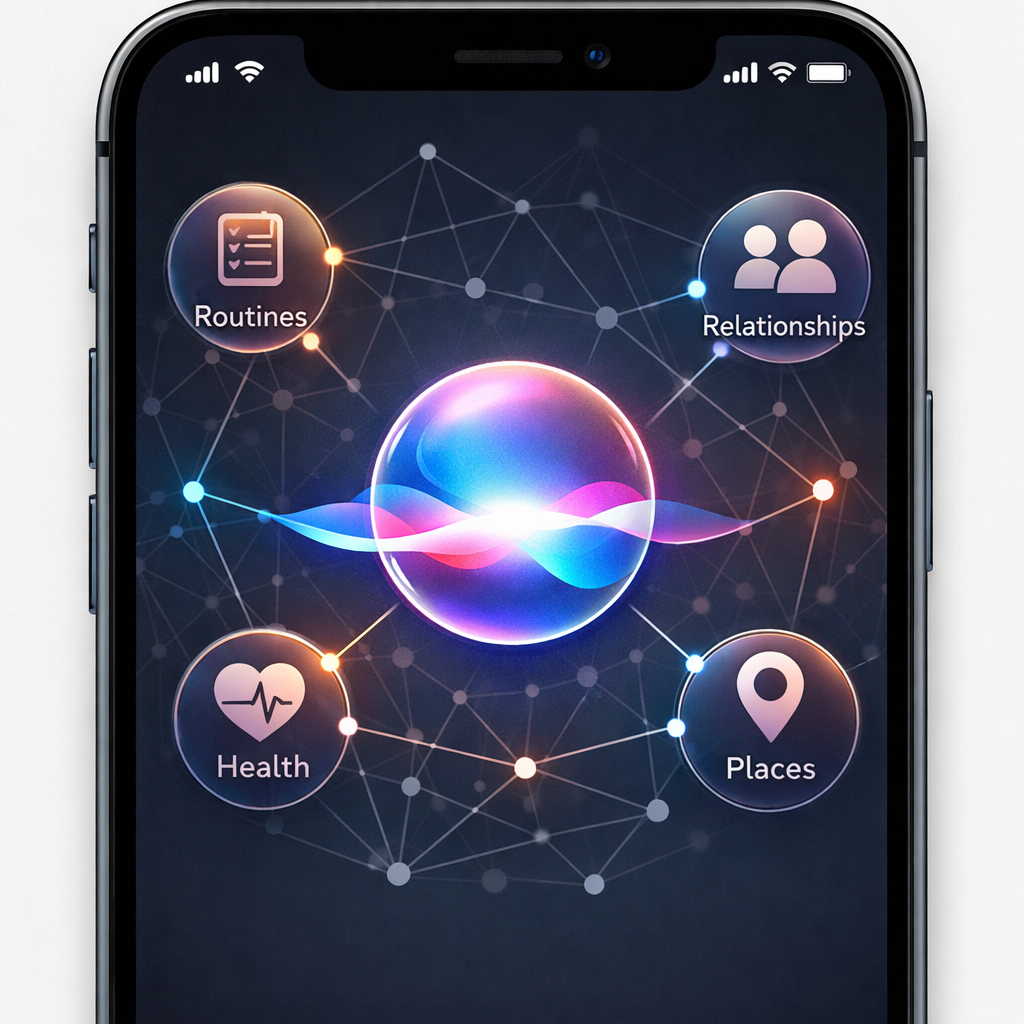
Apple is quietly laying the groundwork for a more aware and personally tailored Siri in the iOS 27.3 beta. Under review of well-known code explorer findings, the update introduces a concept called a “memory graph”—a system designed to record and organize details about the user’s life, from relationships and routines to health metrics and core motivations.
Memory Graph: The Backbone of Siri’s Personal Recall
The memory graph is built around “memory atoms,” which are small data points capturing facts, opinions, intentions, and events, with metadata like people, times, places, and topics attached. These atoms are tagged under one of 21 topics—food, travel, finance, services, and more—so every insight about what motivates or challenges a user is categorized. Over time, those atoms group into broader structures called molecules, which Siri could draw from when remembering something more complex.
To populate this graph, iOS 27.3 beta includes two mechanisms. First, there are “Fastpass” recipes that mine already-structured information—such as contact details in the user’s Me card. Then there are “agent” recipes: AI-powered routines running on-device or via Private Cloud Compute. The only agent identified so far is called “MotivatorBarrierResource,” which prompts users with about 60 built-in questions. One example asks whether long solo media use in the evenings affects the time available for rest.
Where Things Still Need Building
This system is very much a work in progress. As things stand, no part of the code yet generates memory atoms—those crucial building blocks are defined but not instantiated. Separately, a planned “explicit-memory” store, intended to hold records that can be retrieved via searches, also exists only as infrastructure, with no populated entries so far.
Both the memory graph and this memory store are underpinned by Apple’s custom fork of the Kùzu graph database, which the company acquired in 2025. The database files have been spotted by developers—on macOS, for example, there’s a memorygraph.db file in a CorePersonalization folder. But without active processes populating the system, these databases remain mostly empty shells at this stage.
Aside from this memory system, iOS 27.3 beta also advances Siri AI in broader ways: expanding language support, opening developer preview access so more apps can integrate directly with Siri AI through App Intents, and enhancing what Siri AI can do inside apps like Mail, Maps, Photos, and Files. Still, Apple hasn’t said when the memory graph or explicit-memory store will ship to the public, or what control users will have over how their data is collected or used.
Why this matters: The move toward a memory graph represents a shift toward a more human-centered assistant—one that doesn’t just execute commands, but remembers. It hints at Siri evolving toward a system that understands user habits, motivations, and context deeply. But the gaps—no atom creation yet, data store infrastructure not populated—show that Apple is taking care in building, likely testing privacy, security, and data control too. What will make or break this experience when it arrives is not just how well Siri “remembers,” but how users can manage, opt in or out, and see what’s stored.


