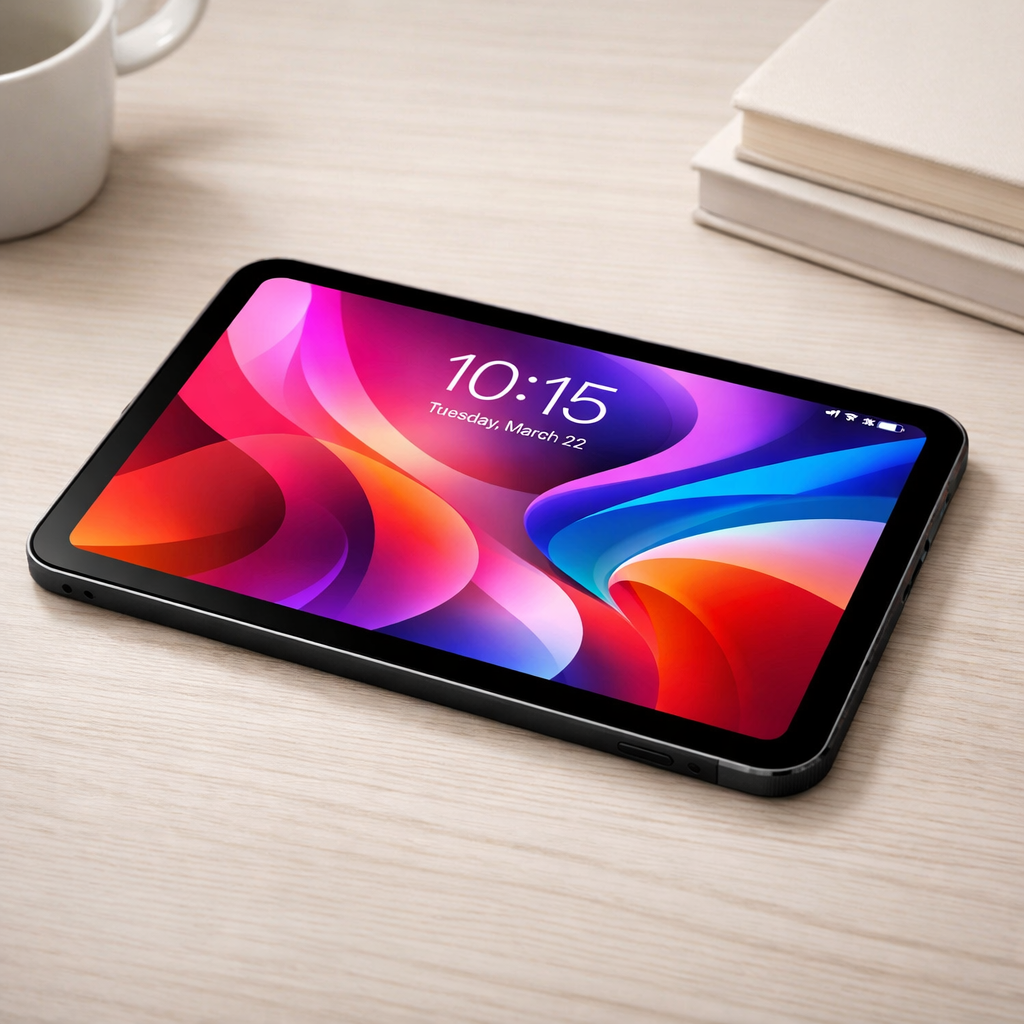
Apple’s eighth-generation iPad mini upgrades what was already a compact powerhouse into something sharper and more premium—especially for reading—even if it still doesn’t cross into Pro territory.
What’s really new
The iPad mini 8 keeps the same overall design as its predecessor, but trims the thickness and width. The device is now thinner (0.21″ vs 0.25″) and slightly less wide, making many existing cases incompatible. Color options have been pared down to Starlight and Midnight—no more vibrant hues like blue or purple.
A major milestone: the mini gets OLED for the first time. The 8.5-inch Super Retina XDR panel replaces its LCD. With vertical edges trimmed, screen size increases slightly. OLED’s advantages—true blacks, superior contrast—are evident here, along with brightness of 600 nits in regular use and peaks of 1,200 nits for HDR content. However, it remains at 60 Hz refresh; ProMotion (120 Hz) still belongs to higher-end models.
Performance, cameras, and features
Under the hood sits Apple’s A20 Pro chip—a leap forward from the A17 Pro. Entry models (128GB and 256GB) ship with a five-core CPU. The 512GB version adds an extra efficiency core. All variants include a seven-core GPU with hardware-accelerated ray tracing and a beefed-up Neural Engine, setting the mini well ahead of the previous gen in both CPU and GPU performance metrics.
Camera setup is mostly carried over. There’s a 12MP wide rear lens with ƒ/1.8 aperture, 4K video at up to 60 fps, and a 12MP Ultra Wide front camera now placed along the long edge so it works better when holding the device in landscape. Face ID is still absent. The audio shifts to an Acoustic Display—a panel vibration system—and though it adds depth, it doesn’t match high-end models.
Other updates: The new mini boasts an IP67 rating for water resistance. Connectivity improves too, with Wi-Fi 7, Bluetooth 6, USB-C at up to 10 Gbps (though not Thunderbolt), and 5G cellular (sub-6GHz only). Battery life remains about ten hours for video streaming, despite a slight drop in battery capacity.
Price and trade-offs
Pricing starts at $699 for 128GB, rising to $999 for a 512GB configuration. Add another $100 if you want Nano-texture glass to cut glare—though the standard finish suffices for most. These prices edge the mini into iPad Air territory, especially as the Pro features—LiDAR, Face ID, or ProMotion—are not included.
What the mini does brilliantly: it’s extremely portable, fast for day-to-day tasks, and its OLED screen pushes it past earlier models for reading, media, and light creative work. Where it falls short: those looking for Pro-level speed, display smoothness, or photorealistic selfies might still prefer a higher-end model.
The iPad mini 8 earns four out of five—its OLED display, compact sealed shell, and generational chip jump are big wins. But like its predecessors, it remains more e-reader than Pro workstation, and its steep price leaves room to pause before upgrading.
Bottom line: This is the best e-reader Apple has made—vibrant display, sharp performance, great for carrying everywhere. If you’re after a full Pro experience, though, keep watching the line above.
Why it matters: The mini’s move to OLED shows where Apple is going with its non-Pro lines. With rising expectations for displays and new capabilities across all tiers, this sets a benchmark for future iPads. Watch for display tech and refresh rates trickling down in the next generations.