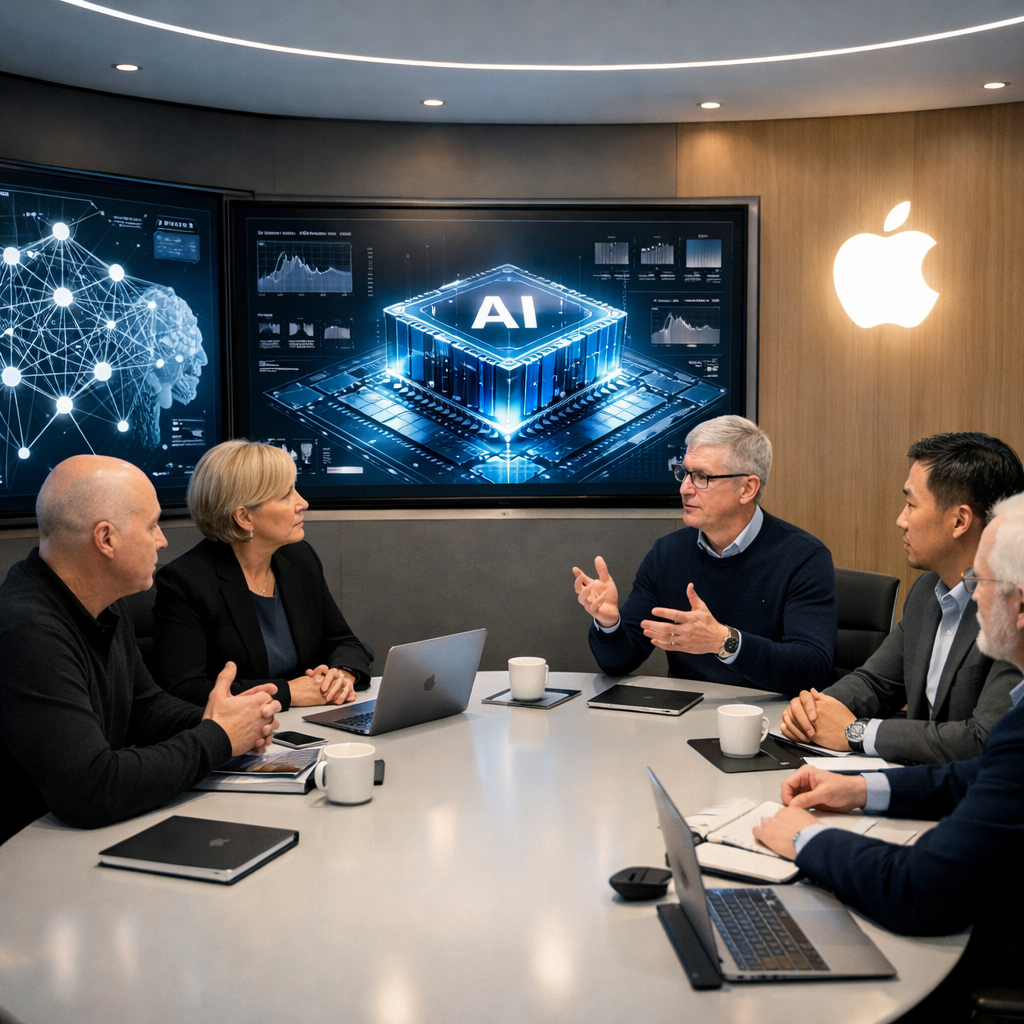
New reports suggest that Apple is currently experiencing internal tension over how aggressively to pursue artificial intelligence initiatives, particularly as competitors and investors push for rapid advances. While some executives are apparently urging quicker rollout of AI features, the company appears to be maintaining a consistent strategy set by John Giannandrea—a focus on powerful hardware, local models, and privacy.
More than half a decade ago, Apple hired John Giannandrea from Google to lead its AI and machine learning (ML) efforts. His approach centered on designing hardware capable of running smaller, private models locally—rather than chasing after massive “frontier” models that depend on massive cloud infrastructure and endless data trains.
Still, tensions seem to be emerging at the top. Current CEO John Ternus is reportedly pressuring Craig Federighi to accelerate development of AI features. Meanwhile, voices both inside and outside the company warn that these faster timelines might be unrealistic. Nonetheless, Apple has so far held firm to Giannandrea’s original vision.
A turbulent path toward AI launches
One concrete example of the pressure to show results came in 2024, when Apple’s annual developer conference raised expectations with ambitious AI promises. Many of those features weren’t ready to ship, which forced Apple to recalibrate in the following years.
Siri, for instance, underwent a phased rebuild that ultimately led to a 2026 relaunch built around the Gemini frontier model. In parallel, Apple has been refining its “foundation models”—smaller, local-first tools that offer solid AI-powered capabilities without sacrificing privacy or relying on giant cloud models.
Why staying true to the local-first play matters
Apple’s architecture for AI places a heavy emphasis on privacy, local processing, and on-device intelligence. Its hardware is widely regarded as some of the strongest for running ML workloads natively on iPhones and Macs. Meanwhile, its foundation models are already powering secure, private AI tasks that meet many users’ daily needs.
On Wall Street and in regulatory circles, support for large-scale, cloud-reliant AI is beginning to fray. Many tech giants have overextended themselves with data centers and ambitious frontier models, attracting political scrutiny and exposing themselves to inflated cost structures. Apple’s restrained AI investment path has so far shielded it from the risks others are now facing.
The current drama—executives pushing for acceleration, fears of overpromising, timing mismatches—frames the question that many tech firms are confronting: build fast and large, or build steady and secure?
What this means: The tension between urgency and caution in AI rollout reflects larger industry currents. Apple’s steadfast commitment to Giannandrea’s local-first, privacy-heavy strategy may be slow, but it could pay off as global regulation tightens and users demand control over data. The biggest watch-outs will be whether Apple can deliver on its current AI roadmap without repeating the overreach it saw around WWDC 2024 and whether its foundation models can keep pace with customer expectations without compromising its core values.