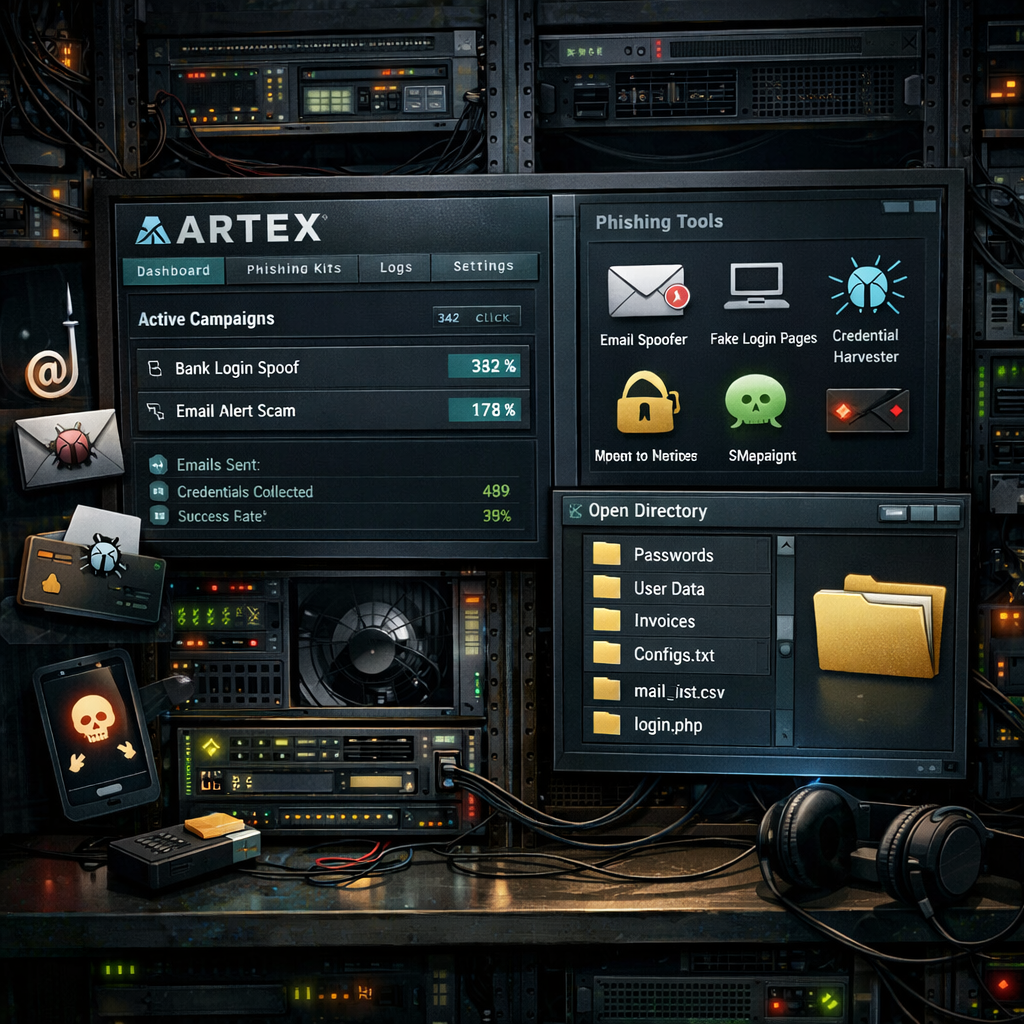
Security analysts have uncovered widespread exposure of ARTEX, an AI‐driven penetration testing framework, across 1,465 internet‐facing servers. Several of those hosts didn’t just run ARTEX—they also stored command-and-control (C2) services, phishing platforms, and exploit tooling. The discovery underlines growing concerns that security testing tools are being deployed in ways that blur the line with malicious infrastructure.
What is ARTEX and how it’s being misused
Launched on July 26, 2026, ARTEX is built with a Go backend, a Next.js console, and a PostgreSQL database. It can integrate with ScopeSentry, an asset-discovery system, to import target data such as domains, IPs, ports, and endpoints. Users tell it a target, testing scope, and objective, and then AI agents break down tasks, execute tools like nmap, map assets, explore the environment, and record the results.
This setup includes worker agents for executing tools, while separate components build an asset graph of discovered systems and an exploration graph of what has been probed. ARTEX supports various AI model providers—including Anthropic and OpenAI—making workflows portable regardless of backend choice.
Magnitude of exposure and possible abuse
Though 1,465 hosts were spotted running publicly exposed ARTEX consoles, roughly 650 shared duplicate configurations tied to two specific hosting providers. After filtering out these clusters, about 815 deployments appeared distinct. Not every exposed console implies wrongdoing—some may belong to legitimate pentesters or organizations using ARTEX for internal security, rather than offensive activity.
Yet, more concerning signals emerged. Researchers detected threat activity signatures on about 155 hosts (10.6% of the total), and found that 32 machines had open directories with tools including phishing kits, Windows lateral-movement utilities, Linux implants, reverse shell scripts, and compiled stage loaders. In one revealing case, a server exposed an operator’s home directory, complete with historical shell sessions and SSH keys.
Links to broader threats
ARTEX wasn’t discovered in isolation. On around 70 hosts, it was co-hosted with other offensive tools and frameworks like CyberStrikeAI, PentAGI, HexStrike AI, RedAmon, Vshell, Cobalt Strike, Adaptix C2, FRP, and Gophish. These pairings matter: reconnaissance, phishing, remote access, and AI-assisted automation working together significantly raise threat potential.
Investigators also connected some ARTEX servers to real-world malicious campaigns. One server cited by Microsoft was linked to “Storm-0940” operations targeting Microsoft 365 tenants. Another connected ARTEX activity to attacks on financial entities in South Korea. However, experts stress that users should correlate infrastructure data with logs and network behavior—seeing an ARTEX console doesn’t inherently confirm a breach.
Detection tips and indicators
Researchers recommend organizations scan for ARTEX and similar exposed endpoints by looking for traits like ports 8787/tcp, 8790, 443; console/UI titles beginning with “ARTEX”; and use of “_next/static” assets—common in Next.js applications. Open directories, unexpected LLM gateway endpoints, tunnel or proxy domains, and short-lived directories are red flags. Between November 3 and November 5, for instance, analysts saw some of these directories vanish from one place and reappear elsewhere.
Specific indicators of compromise (IoCs) were published: these include IP addresses tied to hosting providers, exposed ARTEX consoles, proxy nodes, Microsoft infrastructure linked to Storm-0940, and domains functioning as LLM API resellers. The directories holding sensitive operator files or exploit tools are especially concerning.
Even when ARTEX deployments are known, determining intent—malicious or sanctioned—typical requires examining authentication records, endpoint logs, and network traffic. Public exposure is a risk even if tools are used ethically, because attackers may repurpose the exposed infrastructure.