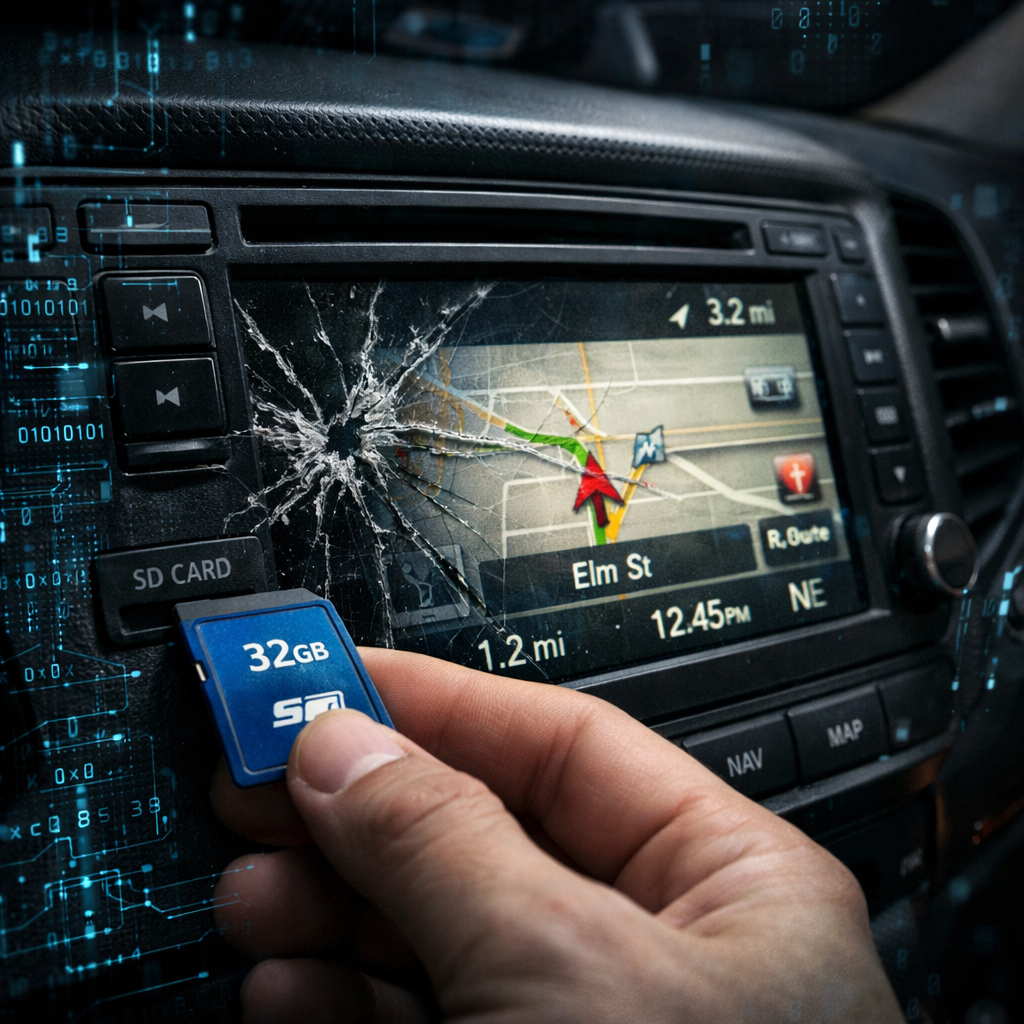
Researchers recently uncovered a serious vulnerability in the navigation head unit of the 2014 Renault Latitude. The affected device is the TomTom Carminat LIVE system, built on a custom Linux 2.6.28.10 kernel. Though the unit is well over a decade old, it still poses real security risks because of manufacturer design flaws and weak protection against malicious inputs. This discovery underscores how aging automotive electronics remain prime targets for exploits—even as vehicles stay on the road for many years.
How the Exploit Works
The exploit process began with an effort to fix a seemingly harmless issue: after daylight saving time ended in Estonia, the owner noticed the “Set time” option was missing and the settings menu was inaccessible unless a genuine map SD card was inserted. That led researchers to examine how the system reads a script file called master.script from the SD card. The script is parsed by a root-privileged process called ttn, which executes commands in the file.
Two commands in master.script proved crucial. The first, SHEX, allows execution of system programs, though without any arguments. The second, LOG, writes text to files—that part failed, but it contained a directory traversal bug. By using LOG with path traversal (e.g. “../”), an attacker could escape the intended folder structure. Since ttn runs as root, the writes occur with root privileges.
Leveraging those two flaws in sequence, the researcher was able to overwrite /proc/sys/kernel/core_pattern, a kernel parameter that defines how the system should handle crashes. The new pattern pointed to a script on the SD card. By triggering a program crash, the kernel would then execute that script as root, achieving full control. The proof‐of‐concept rebooted the system, and a subsequent run allowed the internal storage to be backed up and system time setting modified.
Why This Matters More Than It Seems
This exploit was carried out with physical access—it required inserting a malicious SD card and accepting a prompt to “Execute master.script?”. That limits its remote attack potential. Still, risk scenarios include shared or rental cars or visits to a repair shop. A malicious party might have the opportunity to insert a compromised card.
The bigger concern is architectural. The system trusts scripts from removable media, runs key processes as root, fails to properly sanitize file paths, and allows critical kernel settings to be changed through script actions. Combined with a read‐only root file system and strict checks on DVD and SD card authenticity—many expected protections are present, yet insufficient when vulnerabilities line up.
These weaknesses aren’t unique. Similar patterns show up in newer head units: weak Bluetooth stacks, flawed SD card handling, and old Linux kernels continue to present exploitable surfaces. Infotainment systems are rarely patched after the vehicle leaves production, leaving them exposed for years.
What Owners Can Do
While official patches or updates may not be available for many older devices, users can mitigate risk by using only trusted map cards and avoiding unknown or third-party SD cards or USB drives. It also helps to consult with dealers to see whether security fixes exist or are possible for specific car models or head units.
Understanding that vehicle software lifespan often spans 10-15 years, this case is a warning. Aging systems often carry vulnerabilities that remain hidden until someone digs. As vehicles become more software-defined, such embedded bugs could increasingly translate into serious threats.
Analysis: What to Watch Going Forward
This discovery highlights a gap in automotive cybersecurity: devices designed years ago weren’t built for today’s threat models. Embedded systems often lack the patching lifecycle we expect from contemporary software. The challenge isn’t just the age of the hardware, but the design that fails to anticipate script injections, privilege misuse, or kernel manipulation via removable media. For automakers, this raises questions about warranty of security: How long should security support extend? Should regulations enforce periodic firmware review or standardized design patterns that avoid root-level trust in user‐supplied content?
Increasing reliance on complex infotainment systems—Bluetooth, navigation, even payment or voice assistants—means the attack surface will only grow. What happens in older cars often foreshadows what newer ones will face. Monitoring for similar path traversal or script execution flaws, especially in systems built on decades-old kernels, should be front and center for security researchers and manufacturers alike.