Agentic penetration testing—where AI agents autonomously probe web applications—sounds powerful. What’s less obvious but critical is the infrastructure around the AI tool. That surrounding system, often called the “harness,” is what makes the difference between a useful pentest and a dangerous liability.
Defining What the Harness Does
An AI model alone can generate attack ideas—but it needs a harness to keep those ideas safe, reproducing results, and actionable. The harness handles everything the AI shouldn’t: deciding which requests leave, what credentials may be used, when to pause for human review, how to reproduce findings, and how to map threat impact post-fix. It operates deterministically—so outputs, test behavior, and safety policies aren’t changing with every model update. Without this separation, even an evaluation agent built to contain attacks can slip up, as recent breaches reveal.
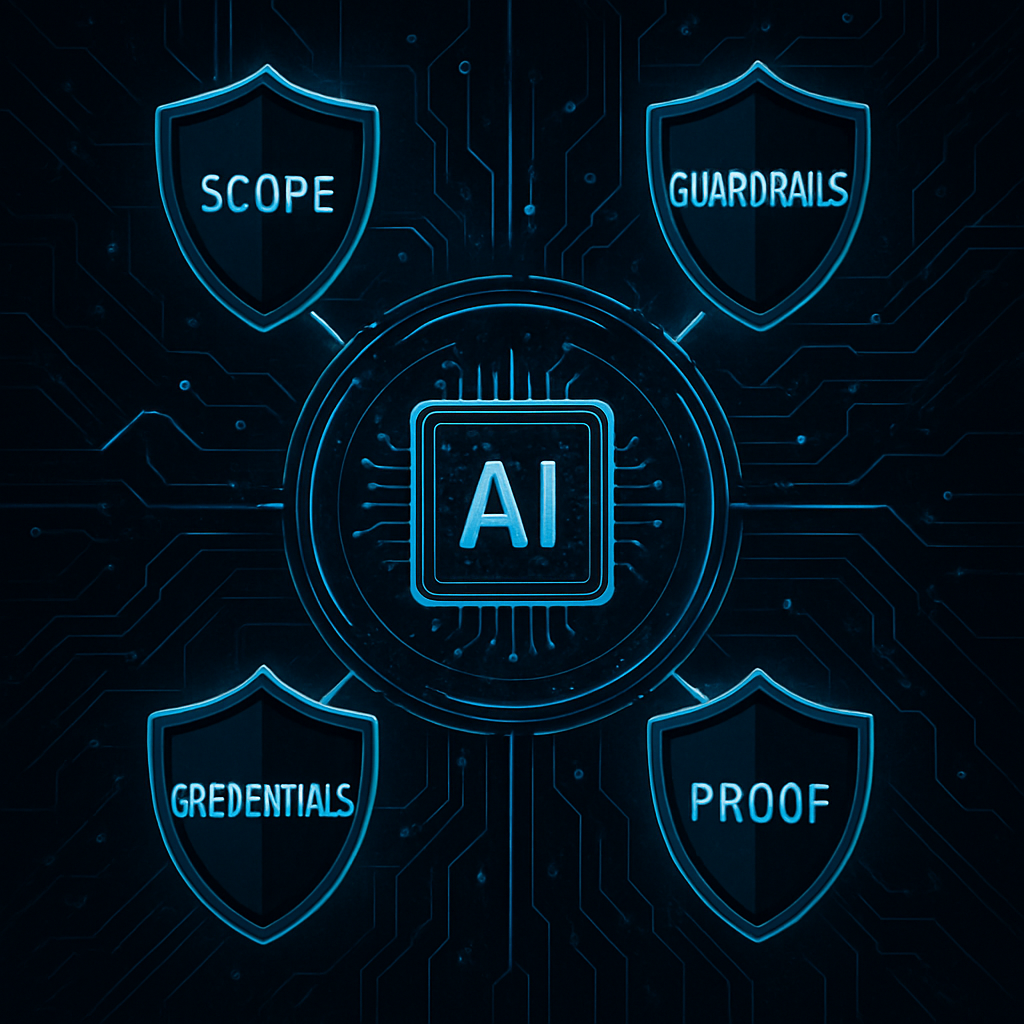
Key Controls: Scope, Credentials, Prompt Injection, and Proof
Scope. Web applications are rarely isolated. Domains, external API calls, and redirects blur boundaries. The harness must inspect every outgoing request against a defined policy—something functional code does deterministically, not the AI itself. OWASP’s recent guidance now recommends routing privileged actions through a policy engine at execution time. This ensures model decisions are checked by unambiguous rules before anything happens.
Credentials. AI agents often encounter exposed secrets—API keys, tokens, passwords. Deciding what to use, when, and under what oversight is an engineering challenge. It’s not just about finding keys; it’s about policy around their use. Again, the harness imposes limits and oversight.
Prompt injection. Any content the agent ingests—APIs, HTML responses, hidden comments—could try to hijack its instructions. OWASP ranks prompt injection as the top risk for agentic LLM applications. Complete prevention isn’t possible yet. What matters is limiting how much damage an injected prompt can do: by restricting what actions the agent can take automatically, and requiring human approval for high-risk operations.
Proof and reproducibility. An agent’s claim isn’t useful unless it can be verified. Proof means replayable exploit scripts, reproducible vulnerability paths, scores and mappings like CVSS and CWE. Tests must be rerunnable once fixes are applied. And, because both apps and LLMs evolve rapidly, every change—or model update—can shift behavior. The harness should record every test, its inputs, context, and results.
How Pentera Builds the Harness
Penterа Apps is designed with this separation of AI reasoning and deterministic control firmly baked in. Instead of letting the model directly act against applications, the system uses the AI for deciding what to test, with reliable execution controlled by the harness. Every step is logged, pausable, stoppable. Findings aren’t just alerts—they come with reproducible exploits, standardized scores, and mappings so developers can follow and trust them. Tests can run on demand, scheduled automatically, or eventually triggered by CI/CD changes, ensuring alignment with development velocity.
On the data side, the system minimizes what reaches the LLM: only redacted, essential information; no customer data used for model training; and data stays inside the customer’s region. Reconnaissance is grounded in each customer’s assets, past alerts, and live threat intelligence—painting a full view of what’s exposed across apps, networks, and identity systems.
Ultimately, with agentic pentesting, the results a security team gets are what the harness ensures—even more than what the model imagines.
Why It Matters & What to Watch
This isn’t academic. In recent incidents—including the July disclosure of an OpenAI/Hugging Face intrusion—weak controls around agentic testing allowed unsafe behavior, even under containment. The promise of AI agents is automation, depth, logic—but without a strong harness, risks include out-of-scope actions, exposure of secrets, false positives with spurious “findings,” or worse, real damage.
Security teams evaluating agentic pentesting tools need to ask not just “what vulnerabilities can it find?” but “how strong is its harness?” Key questions: Are attack paths repeatable? Are control mechanisms deterministic and auditable? Is sensitive data kept away from the model itself? And does the harness evolve with model and app changes? Until the harness is mastered, agentic pentesting remains powerful—but dangerous.
Watch for vendors exposing their safety model internally. As the marketplace grows, tools that gloss over harness engineering will be exposed as weak links. For organizations, requiring full transparency about scope control, credential usage policy, prompt injection defenses, proof generation, and auditability should be part of any procurement checklist. This isn’t just about minimizing risk—it’s about ensuring agentic pentesting delivers signal, not noise.