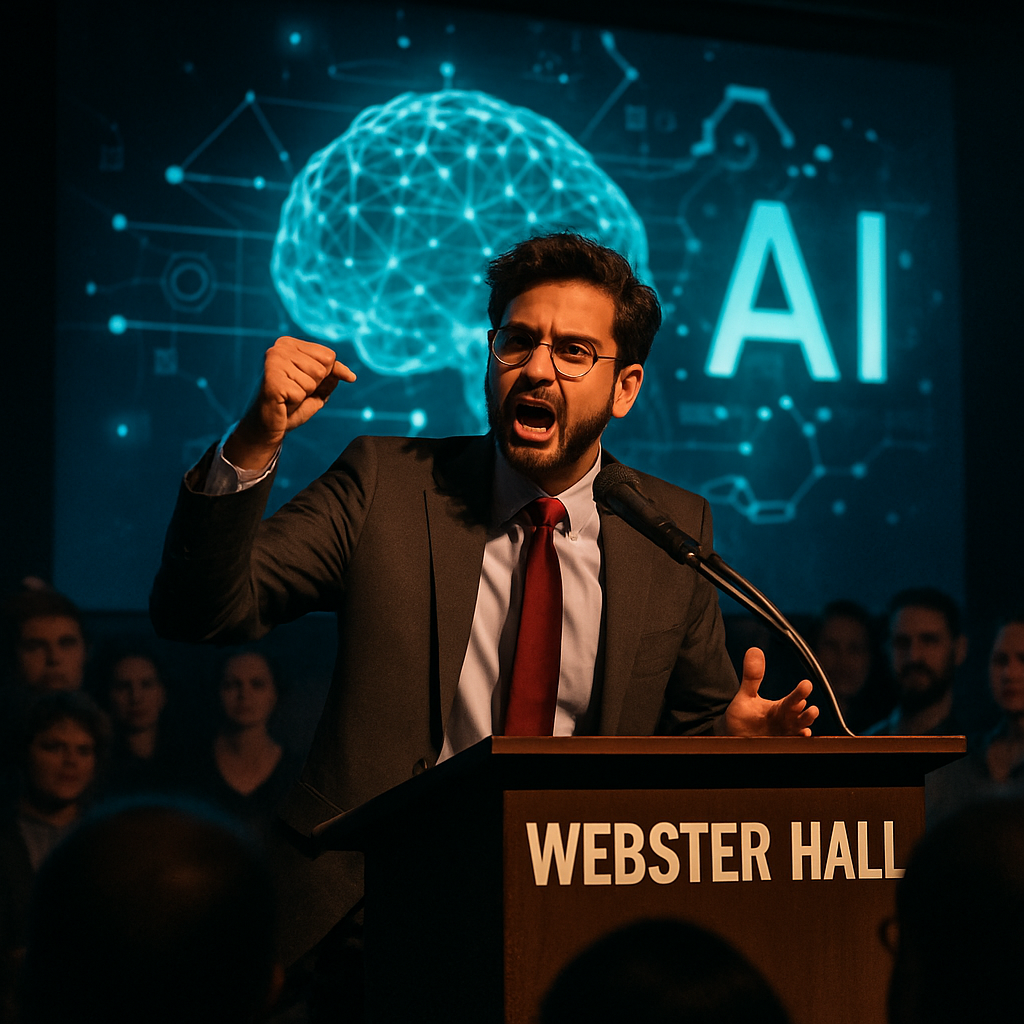
New York City Mayor Zohran Mamdani offered a blunt critique of federal inaction on artificial intelligence, urging residents to reclaim agency over how AI shapes their lives. Speaking Monday night alongside actor and activist Ilana Glazer at Webster Hall—which hosted The People’s AI Assembly—he argued against the narrative that rapid AI adoption is inevitable. Public officials, he said, must demand accountability from AI companies.
Purporting that the federal government has largely stepped back in its duties, Mamdani stated there has been a “complete abdication of federal law” when it comes to regulating AI. He emphasized that while competition—especially between the U.S. and China—dominates national conversation, human-centered concerns are often marginalized. He urged a shift in how AI is discussed and governed at all levels of policy.
Local Action So Far
In New York, Mamdani has already taken concrete steps. He recently banned the use of AI in elementary and middle schools across the city and introduced a policy requiring real estate listings to clearly disclose when property photos or videos are AI-generated. These campaigns seek to protect both children and consumers from deceptive practices and unexamined use of technology.
Glazer expressed deep unease over AI’s growing presence in classrooms, saying that what seemed optional only two years ago now feels forced. Mamdani described attempts to normalize AI in society without conversation or consent as “overwhelming,” challenging the notion that people have no choice but to accept the technology as it arrives.
Why the Urgency?
Mamdani raised concerns about the uncritical embrace of AI. He cited a military strike by the U.S. on a school in Iran earlier this year, during which overreliance on AI targeting was identified among the contributing factors. More than 150 people—including at least 123 children—were killed. These events, he said, demonstrate that even powerful technologies make grave mistakes when left unchecked.
He also criticized nascent federal efforts. President Trump’s recently announced Superintelligence Task Force, he said, leans heavily on self-regulation by big AI firms rather than robust legal frameworks. For companies like OpenAI and Anthropic—both preparing for IPOs—Mamdani warned that there’s a strong incentive to avoid accountability while maximizing valuation. He insisted that future administrations must adopt far more serious standards of oversight.
With AI being adopted at unprecedented rates—in schools, workplaces, media—Mamdani urged New Yorkers not to passively accept its spread. He framed the battle not just in terms of safety or innovation, but in terms of power: who shapes technology, who benefits, and on whose terms.
This moment raises broader questions: if the national government declines to draw firm lines, what responsibility falls to states, cities, communities? And will public pressure be enough to force the corporate and political systems to take AI’s risks seriously?
What this means: Mamdani’s stance underscores a widening gap between federal AI rhetoric and real policy. As local governments move ahead of national regulators, citizens have a pivotal role. Watch for how cities leverage authority over schools, business disclosures, and public safety. The path forward may lie in local laws, regional frameworks, and grassroots activism if Washington continues to lag.