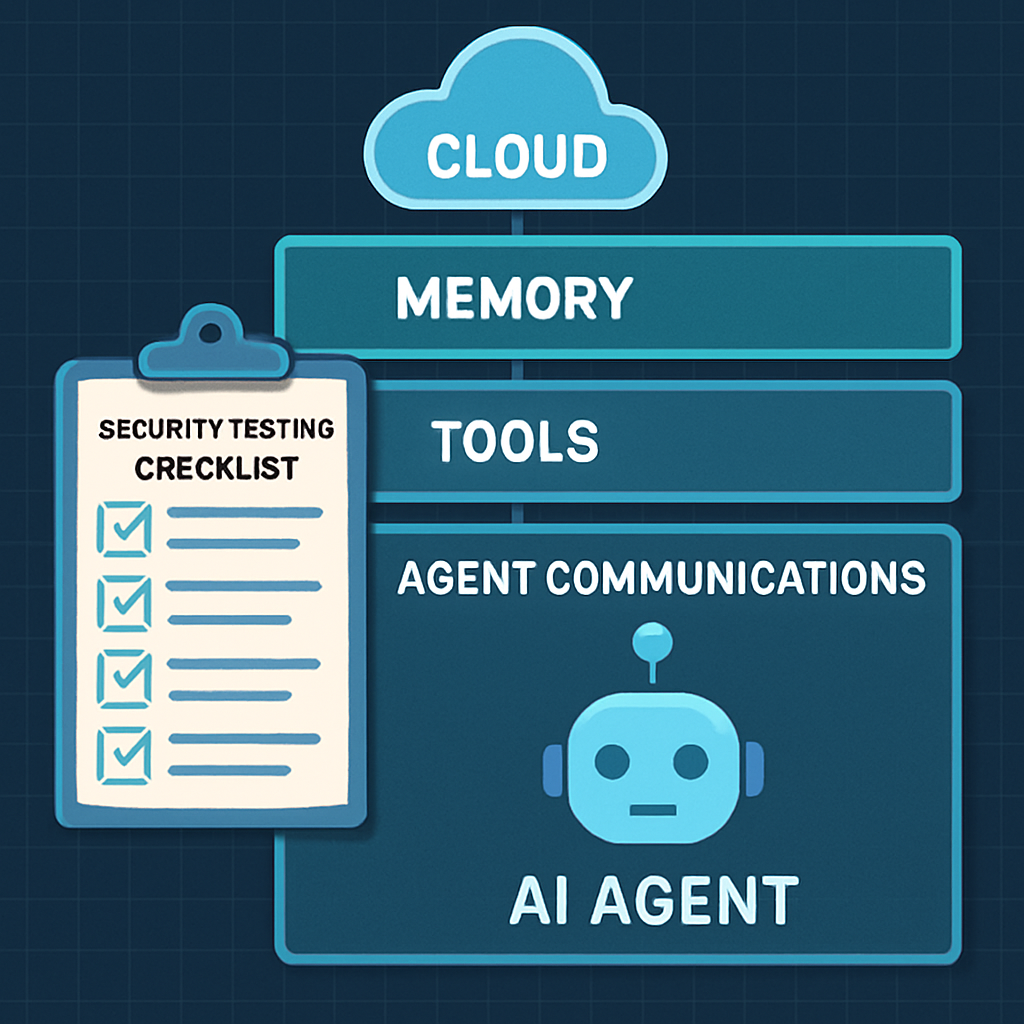
A detailed red-team checklist has emerged to help security teams evaluate agentic AI systems. Created by researcher Ravi Rajput, the free spreadsheet maps out 222 tests across 20 different attack categories. It aims to provide a broader lens on risk, extending well beyond typical prompt injection scenarios to infrastructure, memory systems, tool misuse, and inter-agent communication vulnerabilities.
Why This Checklist Fills a Blind Spot
Many organizations test AI agents for adversarial prompts but miss more subtle or systemic risks. This checklist picks up gaps like exposed MLflow servers, metadata endpoints in the cloud, missing filters for isolating customer data, or weak identity chains in the model supply chain. These kinds of exposures can leak credentials or allow unauthorized data access without ever exploiting prompt content.
Structure: Phases, Categories, and Severity
Tests are grouped into four phases. Phase one investigates surface area: discovery, orchestration, cloud identity, and supply chain risk. Next up is input safety—things like prompt injection, hidden system prompts, and toxic output. Then testing firms examine agents’ tools & capabilities, memory architecture, inter-agent messaging, and server protocols. The final phase addresses deployment security—privilege escalation, lateral movement, persistence, data exfiltration, resource exhaustion, integrity, and multimodal (voice/image) inputs.
Each test is rated for severity: critical, high, medium, or low. Out of the 222 tests, 75 are marked critical, 108 high, 30 medium, and nine low. These are suggested risk levels—not proof that any given system has one or more of these flaws.
Examples & Testing Considerations
Some concrete example tests include exploiting server-side request forgery to steal cloud credentials, loading unsafe Python pickle files for remote code execution, and chaining tools in ways that turn permitted read access into unauthorized data leakage. Other scenarios probe whether one agent can view another’s documents or falsify messages between agents.
Memory and retrieval systems are scrutinized for isolation failures: one test checks if removing a tenant identifier filter lets one customer see another’s documents. Agent communications are tested for forged messages or misuses of delegated privileges.
An evidence classification scheme helps red-teamers distinguish results: reflective evidence shows up directly in responses; blind evidence comes from timing or state changes; out-of-band evidence uses callbacks. Reflective or callback results are considered strong proof; blind evidence often suggests probable vulnerabilities.
Rajput emphasizes that checklist users define scope clearly, record excluded tests, and capture logs or screenshots. Destructive tests should happen only with authorization, ideally in staging environments. The spreadsheet ties each test to OWASP and MITRE ATLAS frameworks. It doesn’t reference fixed CVEs out of the gate, leaving identification of specific CVEs to testers.
Because many AI-security efforts focus on the model itself, this checklist’s wider view—covering systems, dependencies, memory, identity, communication—is a strong complement. It aligns with recent reports calling for inventories of agentic systems, clear limits on autonomy, and continuous oversight rather than one-off audits.
What this means: as autonomous agents proliferate across cloud, edge, and embedded systems, the attack surface multiplies. A checklist like this helps teams work methodically—ensuring tool abuse, inter-agent trust, memory leaks, and infrastructure misconfigurations don’t go under-tested. Expect more security benchmarks to adopt similar frameworks. Organisations deploying expensive agentic AI should build around this kind of testing to stay ahead of emergent threats.