At a16z partner Olivia Moore is pushing back on the notion that consumer AI is hitting a wall. In a new report featuring the top 100 consumer AI apps, she shows that while dominant players like ChatGPT still tower over the field, smaller innovators like Suno and ElevenLabs are proving resilient—and hints that the real opportunity in the space hasn’t taken shape fully yet due to gaps in both monetization and product coverage.
Subscription doesn’t cut it
Moore points out that the bulk of revenue in consumer AI has so far come from subscriptions and API usage—streams heavily dependent on more technical, prosumer, or enterprise users. Only about 2.2% of U.S. households currently pay for an AI service. That leaves most of the market unserved or untapped. What’s needed, Moore argues, is for companies to find ways to reach mainstream users—offering free or low-cost tiers subsidized by advertising or other models—rather than placing everything behind a paywall.
Another major hurdle is cost. AI’s infrastructure, especially models with top-tier accuracy, carry high marginal expenses. Moore believes that we’ll start seeing more lightweight models and open source foundations play a larger role. She points to ChatGPT’s newly launched Go plan—priced around $8/month—as a signal that not every application requires bleeding-edge AI to deliver value.
Prosumer first, consumer potential still unrealized
The most active spending in consumer AI today comes from prosumers—people using AI tools for coding, content creation, marketing, or workflow productivity. Startups like Replit, Fireflies AI, and Hugging Face-derived tools are capturing that demand. In many cases, products that launch with a consumer-first focus are quickly adopting enterprise models to scale their revenue, blurring traditional lines between business and consumer AI.
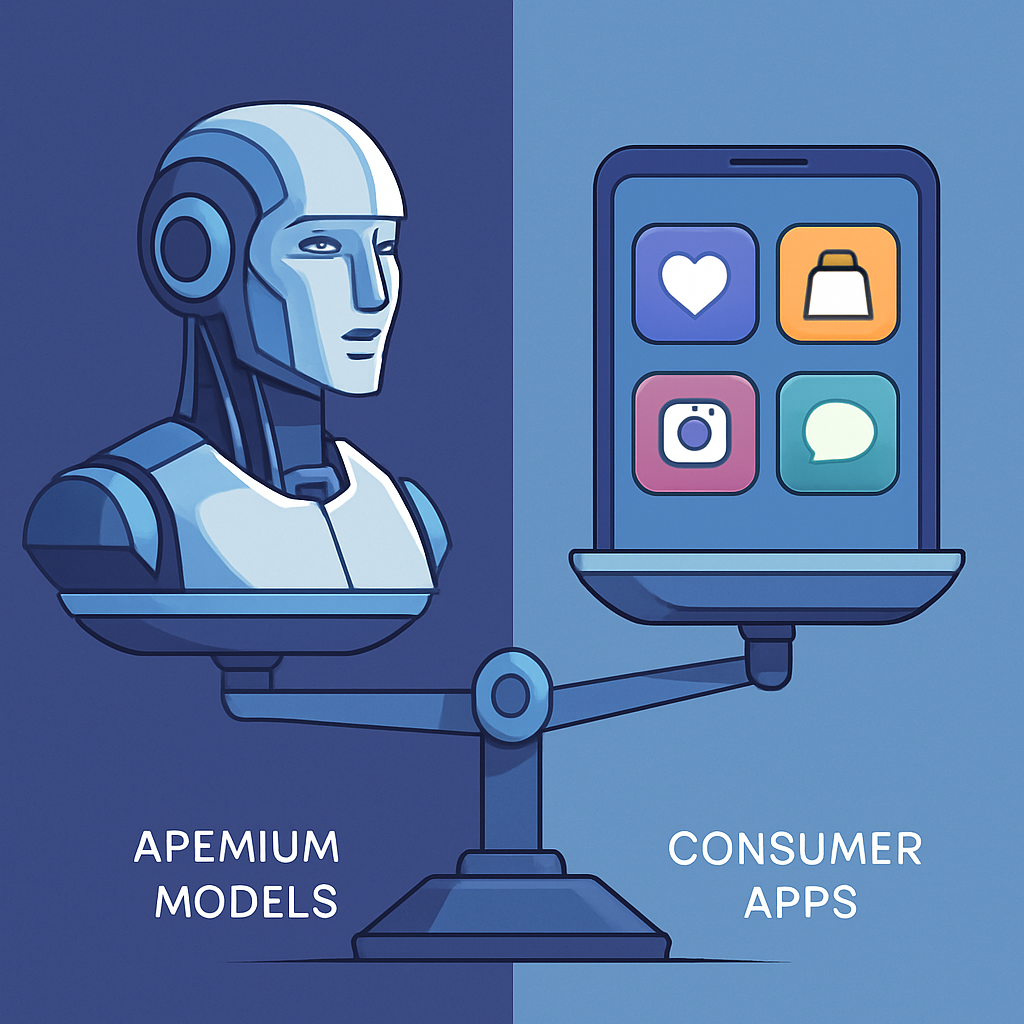
Yet, even within this dynamic mix, there are vast categories where no major AI-enabled entries have broken through. Moore’s analysis finds that major consumer domains like social networking, dating, marketplaces, travel, health, finance, and retail are barely represented among top AI apps. That absence suggests that consumer AI still has its biggest ground to cover.
Why this moment matters
This is not simply about incremental growth—it’s about defining the next decade of AI’s integration into everyday life. If the space can unlock models where consumers don’t pay directly—via ad support, freemium upsells, or experiences where AI augments existing behaviors—the financial base of AI will expand in ways subscriptions alone can’t sustain. Leveraging lightweight models and open-source infrastructure will be essential for managing cost without sacrificing accessibility.
It’s clear consumer AI as we envisioned it—ubiquitous, affordable, deeply integrated—is still forming. The current powerhouses are essential, but they’re just stepping stones. The truly transformative products will come from where the gaps are widest—in social, commerce, health, finance, travel—and will succeed when they find sustainable ways to reach everyday users without asking for a big up-front payment.
Why this matters: We’re at a crossroads where AI could either entrench itself behind paywalls oriented around power users or break into the mainstream—and only one path builds a foundation for broad societal impact. What to watch: which startups begin filling the under-penetrated categories, how advertising models evolve in AI, and whether cost-cutting via open-source and lean architectures becomes a competitive necessity.