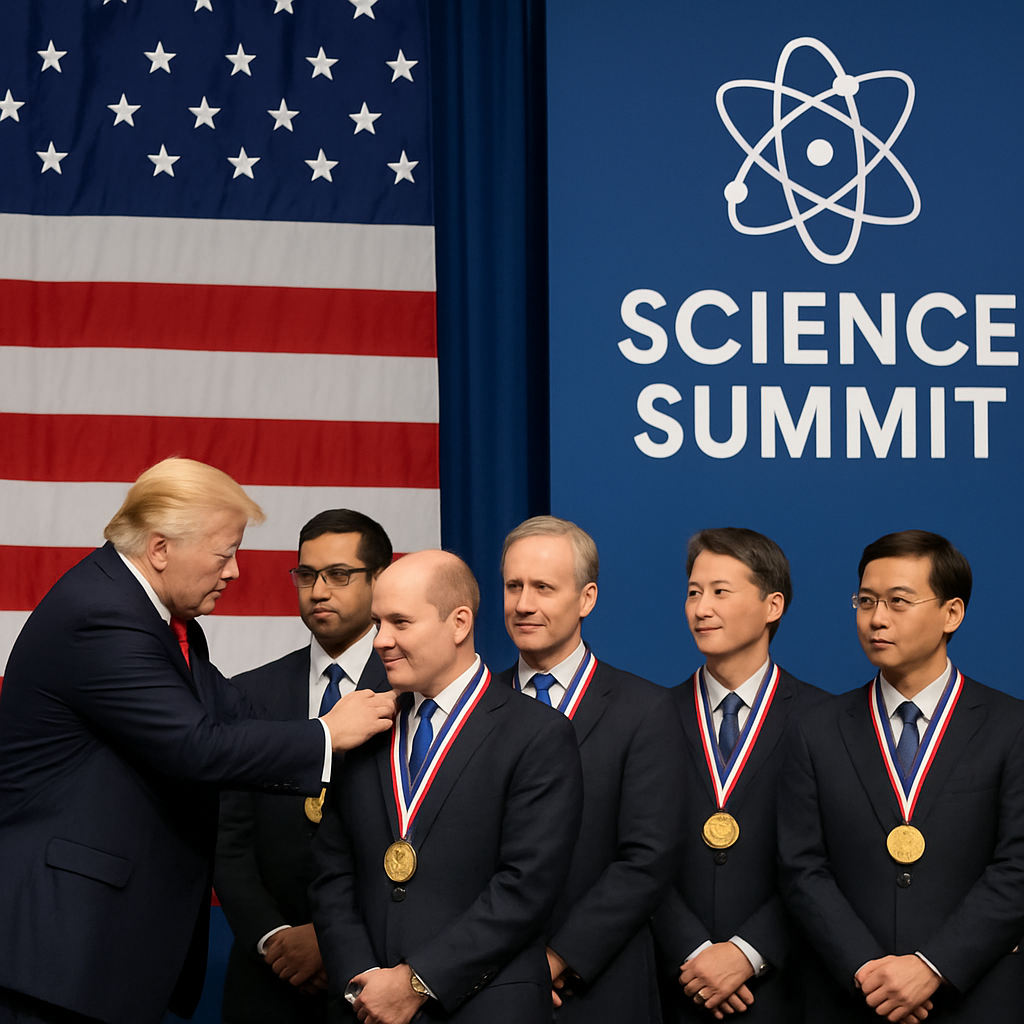
During the Science: A New Golden Age Summit on October 8, 2026, President Donald J. Trump presented six leading tech figures with the United States’ top honors in science and innovation: the National Medal of Science and the National Medal of Technology and Innovation. The ceremony underscored the administration’s goal of asserting America’s leadership in tomorrow’s science and engineering breakthroughs.
Four visionaries—Elon Musk of SpaceX, Google co-founder Sergey Brin, Nvidia’s Jensen Huang, and AMD’s Lisa Su—received the National Medal of Science, awarded since 1963 to individuals recognized for outstanding scientific contributions to the nation. Meanwhile, Michael Dell of Dell Technologies and Microsoft CEO Satya Nadella were honored with the National Medal of Technology and Innovation, first awarded in 1985 for those whose innovations have strengthened the U.S. economy and quality of life.
Recipients of the National Medal of Science were honored for pushing boundaries in space exploration, intelligent systems, chip design, scalable computing, and leading semiconductor engineering that enabled global advances in high-performance and exascale computing. Meanwhile, the Technology and Innovation honorees were recognized for their leadership in enterprise computing, cloud infrastructure, transformative business management, and enabling global deployments of superintelligence.
Big Donations, Political Ties, and Timing
The honors come amid criticism over political contributions: together, the six recipients are reported to have donated nearly $6 billion to pro-Trump causes, including his campaign, inauguration fund, and the White House ballroom. One recipient pair also contributed to the administration’s “Trump Accounts,” a savings program for children.
The timing drew attention. Just before Satya Nadella was awarded the Technology and Innovation medal, Trump’s administration suspended Microsoft (along with several other tech and outsourcing firms) from participating in a federal green card program for H-1B visa workers. Vice President JD Vance accused Microsoft of abusing visa programs and replacing laid-off American workers with foreign employees. Labor Secretary Keith Sonderling announced that no new or pending permanent labor certification applications would be accepted for Microsoft, Adobe, Capgemini, Cognizant, HCL, Infosys, and Wipro.
White House’s New Science Strategy
The Summit also served to unveil the administration’s sweeping science agenda, based on the “Science: A New Golden Age” report by White House science officials. These plans involve over $6 billion in combined investment from government, academic, industry, and philanthropic sources. Key goals include accelerating biomedical innovation, building metascience infrastructure, supporting early-career scientists, and using superintelligence and quantum computing to drive scientific discovery.
President Trump, during his remarks, emphasized American dominance in science and technology, declaring these honorees central to maintaining that edge. He also pointed to federal initiatives designed to deliver a quantum computer by 2028 and to launch the Genesis Mission—an effort to solve some of science’s most pressing challenges using intelligence augmentation.
What This Means and What to Watch For: While the awards celebrate clear technological achievement, the overlapped donations and political associations raise questions about where merit ends and influence begins. The administration’s suspension of Microsoft from US residency programs for tech workers, right before one of its top executives accepts a national medal, highlights tensions between recognizing corporate leaders and holding them accountable. Moving forward, how the White House defines “innovation” in science policy—and who it rewards—will shape not just public perception but the actual direction of U.S. science and immigration policy.