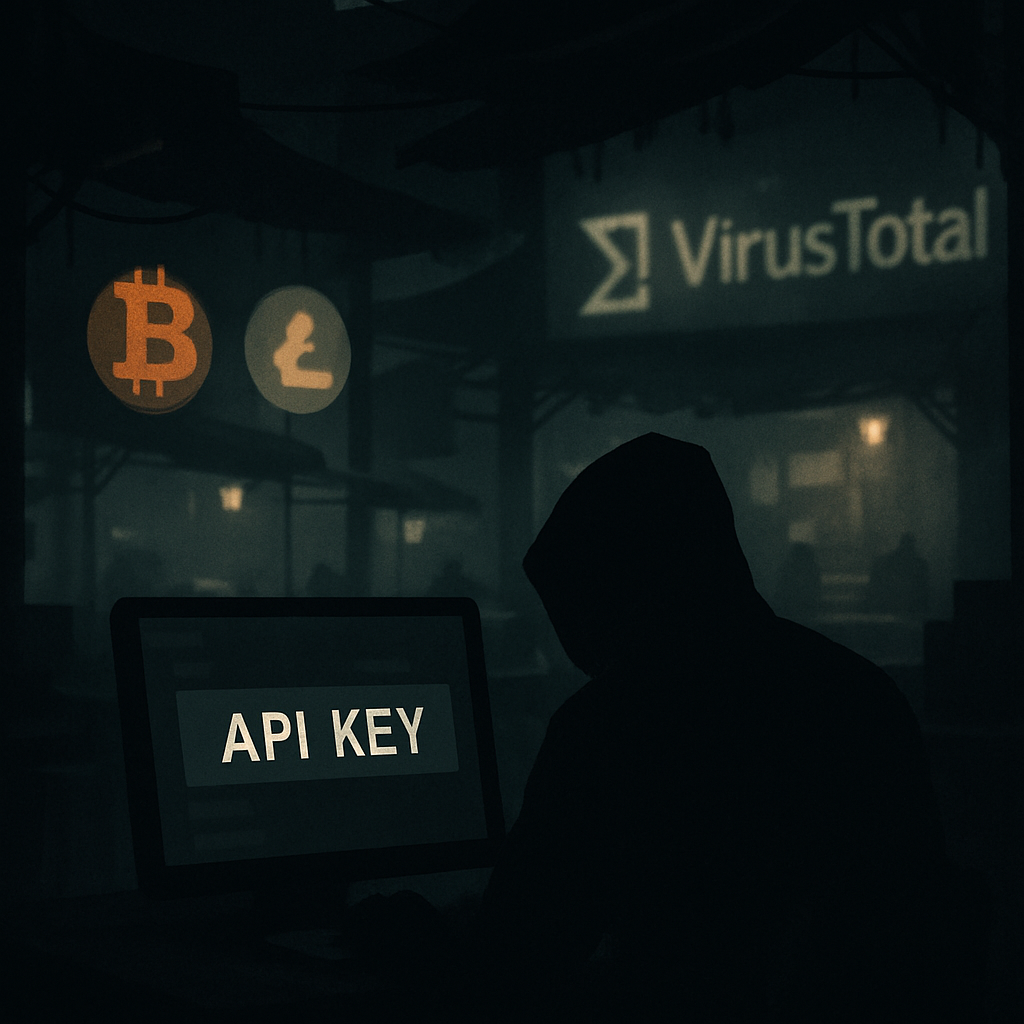
Hackers are advertising what they say is a VirusTotal Enterprise API key for sale on the Dark Web, priced at $350, with alleged quotas of 5,000 requests per day, 300,000 per hour, and 1 billion per month. However, there’s no proof yet that the key is real, active, or stolen—and the advertised quotas may be misleading. 🕵️♂️
In a Dark Web Informer post dated October 7, a seller claims to accept Bitcoin or Litecoin, offers escrow, and promises the aforementioned limits. Yet these figures clash internally: a key limited to 5,000 requests per day couldn’t also support 300,000 per hour—unless the quotas refer to different accounts, services, or are outright false. It’s unclear which scenario applies.
Understanding VirusTotal APIs and Abuse Risks
VirusTotal’s service separates public and paid API access. Public-level users are allowed up to 500 requests per day and just four per minute. Enterprise or premium access unlocks broader functionality under higher quotas—though “Enterprise” labels seen in illicit listings don’t always reflect true feature sets. Whether the key on offer meets genuine enterprise standards, or is just a mislabel, is unknown.
API keys serve as credentials for automated access—enabling users to query file reports, scan domains, gather threat intelligence, and integrate directly into security systems. VirusTotal warns that sharing a personal key grants its full privileges to anyone who possesses it, which can include costly licensed features for those paying customers.
Claims vs. Reality—and What Organizations Should Do
The listing fails to provide proof of ownership or demonstrate how the key was obtained. No credible evidence establishes the key works in real-time or is tied to a particular account. Even claims posted on social media should be treated as speculation unless backed by verifiable detail.
To guard against misuse, organizations using VirusTotal—or relying on any API key—should regularly audit their usage logs, revoke any keys showing unusual behavior, and ensure credentials are not improperly shared or exposed. Monitoring request patterns and checking for anomalies in quotas or endpoints used can help spot theft or abuse early.
As of now, this is merely an allegation with unconfirmed claims—not proof of a breach of VirusTotal’s systems or verification of enterprise-level access.
Why this matters: API keys are often the unsung gatekeepers of a company’s cybersecurity posture. If attackers gain access to licensed tools or high-volume APIs, the downstream risks range from infrastructure abuse to exposure of threat intelligence pipelines. We’re watching whether this purported key works—and whether VirusTotal or affected organizations issue any response or disclosure.