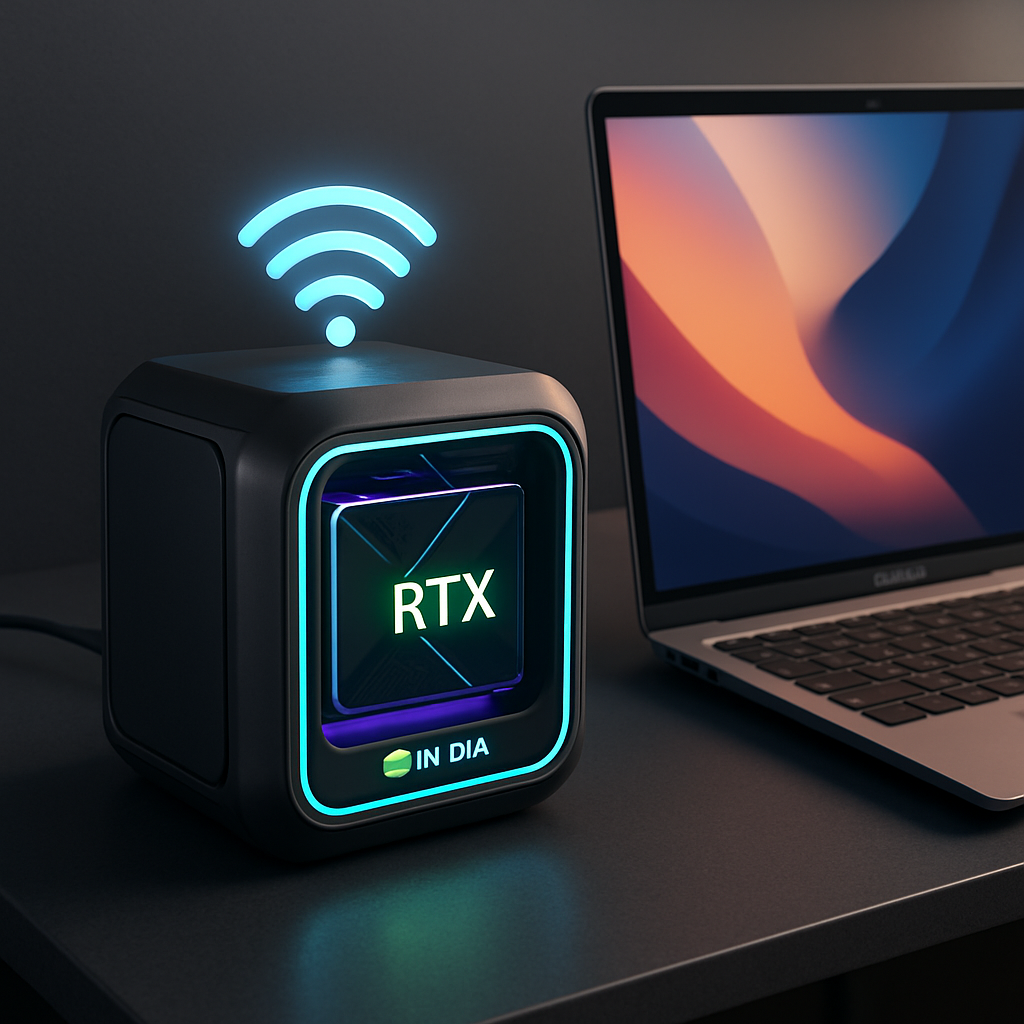
WiCi’s latest concept, the WiCi One, promises to revolutionize graphics performance by moving the eGPU over Wi-Fi, not Thunderbolt. Designed to let Macs and PCs tap into serious GPU horsepower remotely, it intends to handle everything from generative AI workloads to high-end gaming. Though the idea sounds compelling, its reality comes with serious caveats—starting with the price.
What is WiCi One?
The WiCi One is a wireless external GPU enclosure that connects to devices via your Wi-Fi network. It’s built as a standalone unit packed with both GPU and CPU, aiming to boost graphics, AI model inference, rendering, and more—without the need to attach anything heavy to your laptop or desktop. Macs, PCs, and other devices could offload rendering tasks to the unit, whether it’s in video editing or gaming.
WiCi offers two configurations. The entry-level model includes an NVIDIA RTX 5060 Ti with 16 GB of GDDR7, paired with an Intel Core 3 100U processor and 1 TB NVMe 4 storage. The higher-end version features an NVIDIA RTX 5090 with 32 GB of GDDR7, an Intel Core Ultra 7 255H CPU, and 4 TB NVMe 5 storage. Despite housing its own CPU, the device is meant to operate mostly as a remote GPU rather than a full server itself.
Performance: Big Claims, Heavy Expectations
The company claims impressive numbers: the high-end model delivers around 420 FP16 TFLOPS of compute power, while the base model delivers about 95 FP16 TFLOPS. By comparison, Apple’s Mac Studio with M5 Max silicon is said to reach about 70 TFLOPS. The WiCi One also allows for paging via NVMe SSD (using a tech called TurboStream) to support large models—and purportedly it can host models with trillions of parameters that far exceed what typical Mac hardware can handle.
For connectivity, WiCi bills the WiCi One as using Wi-Fi 7 (4×4 MIMO, 320 MHz channels, twin antennas), operating under what it calls “Router-grade AirLink Multi-Link transport.” In ideal conditions, Wi-Fi 7 can hit up to 48 Gbps, which—on paper—makes it viable for eGPU tasks. However, real-world conditions rarely match wireless theory: interference, latency, and signal degradation could all eat into performance severely.
Pricing and Competition
The WiCi One starts at **US$2,599** for the RTX 5060 Ti version, rising to **US$9,999** for the 5090 model. Early buyers can subtract about US$600 from both, dropping them to roughly **US$1,999** and **US$9,399** respectively. For context, a Mac Studio powered by the M5 Max starts at about **US$2,499**, while the M5 Ultra version runs around **US$5,499**.
That means the WiCi One sits in a premium bracket—especially for what remains a niche idea with as yet uncertain wireless performance. For those willing to invest heavily in local AI computation or high-end visual production, it could appeal. But it also invites tough comparisons: for less money, a local Mac with Apple silicon already provides excellent GPU and AI performance, without worrying about Wi-Fi signal integrity.
The Trade-Offs and Unanswered Questions
WiCi’s idea depends heavily on wireless conditions behaving perfectly, which rarely happens. Factors such as distance, obstructions, and interference will influence whether graphics, AI inference, or gaming remain usable. Latency, in particular, may be a challenge for interactive work and high-frame-rate gaming.
Additionally, while the unit includes strong internal hardware, its utility depends on software compatibility—especially on Mac. NVIDIA drivers have long been absent from Apple hardware, and Thunderbolt eGPU support is effectively dead in modern macOS. The WiCi One claims to bypass this by acting as a “local GPU over Wi-Fi,” but how seamless that integration will be remains to be seen.
Thermals and noise are also in the spotlight. The enclosure is said to offer a quiet cooling solution and compact design, intended for shelf-placement rather than cluttering a desk. And while press materials hint at additional ports—Ethernet, maybe USB-C or Thunderbolt—WiCi’s marketing focuses almost entirely on the wireless angle.
Why It Matters—and What to Watch
The WiCi One represents a bold rethinking of how eGPUs are used, particularly in the era of heavy AI workloads and distant cloud costs. If wireless eGPU becomes practical, it could reshape expectations about device portability, workflows, and hardware design. It might also force Apple and others to revisit eGPU drivers, network-based compute, and optimized wireless protocols.
But in its current form, the WiCi One feels more concept than consumer-ready product. Its success depends on delivering low latency, consistent Wi-Fi throughput, and solid software support—all for a high price. Early buyers might get value in specific use cases, but widespread adoption will depend on real-world reviews.
Start paying attention to how well the device performs under imperfect Wi-Fi conditions, how seamless the macOS integration is (including driver and app support), and whether WiCi can deliver strong value compared to compact but powerful Apple silicon machines. We’re looking forward to testing it rigorously.