Robotics is entering a new era where robots are increasingly driven by generative AI rather than just programmed behavior. That shift brings unpredictability. A startup called Safeworld is launching today to tackle precisely that challenge: how to ensure these robots are safe enough to deploy around everyday people.
What’s Safeworld Doing?
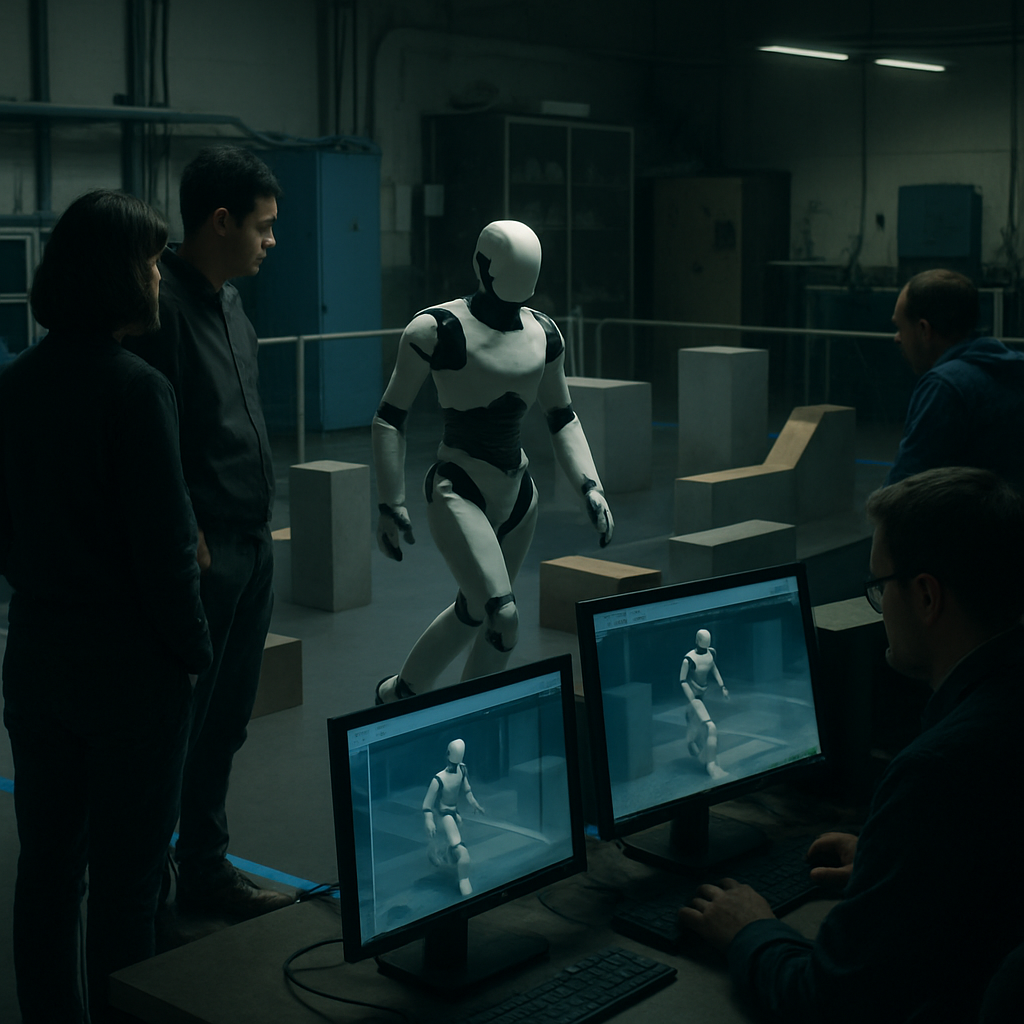
Safeworld was founded by Dr. Ding Zhao, Kyle Wong, and engineer Simo Rachidi. Zhao, who leads Safe AI Lab at Carnegie Mellon University, highlights two core issues: first, how to assess risk in probabilistic systems, and second, how to build public trust in robots with generative AI. Safeworld’s solution is to simulate robots acting in human environments using realistic human models. The idea is to stress-test robotic systems in many edge-case situations before they ever interact with real people.
For example, Safeworld will recreate scenarios like a blind corner in a factory, or a worker carrying boxes. They’ll use physics engines like MuJoCo or Genesis to model how a robot might respond when a person suddenly trips or appears in its path. The goal: thousands of simulated scenarios where the robot’s decision-making software—and its safety features—are thoroughly tested. The company aims to help robot makers understand stopping distance, detection of human shapes, and responsiveness to unpredictable human behavior.
Why This Matters
The startup just emerged from stealth with over $12 million in seed funding, led by Shine Capital and a16z Speedrun, with investments from Box Group, the Carnegie Mellon Endowment, Innovation Endeavors, and SV Angel. Investors are particularly concerned about creating safety benchmarks early, before robots are widespread and safety incidents begin. Creating these standards now, they argue, is far safer than reacting once incidents involving kids or homes begin emerging.
Safeworld believes that though many robotics firms already run internal safety simulations, companies deploying robots will want third-party validation—someone independent doing safety tests and sharing data about safety cases between competitors. One of Safeworld’s first partners is Gritt Robotics, which builds robot systems for industrial-scale solar farms. The CTO of Gritt Robotics emphasizes how human appearance and behavior—whether someone is running, falling, kneeling, or wearing bulky clothing—can greatly change how a robot should perceive and respond.
Safeworld is still deciding whether their product will be a platform robot-makers subscribe to, or a services-based model where Safeworld performs the evaluations. The team is confident this problem is urgent—and the business opportunity is significant. As Zhao puts it, any robot deployment will need safety assessment, meaning that Safeworld expects strong demand for its validation services.
Safety in robotics hasn’t been a fashion checkbox—it’s a critical requirement. For decades, robots in structured environments like factories or assembly lines were constrained and predictable. Generative AI changes that: robots now need to act in open settings, with humans who behave unpredictably.
Safeworld’s work sits at the intersection of engineering, ethics, and regulation. If it succeeds, it could prevent accidents before they happen—and save robot-building companies from recalls or lawsuits. But to realize that, simulations must reflect real-world complexity, and industry needs to agree on what “safe enough” means. Watch for Safeworld’s first demo of its platform, how its metrics compare to what regulators expect, and whether this approach becomes the standard others follow.
This matters because the reputation of AI-driven robots hinges on their safety. Once people feel unsafe around these machines, trust is lost—and adoption slows. If Safeworld can show that rigorous simulation-based testing can prevent accidents before robots reach people, it won’t just be good for safety—it could be the foundation for wider acceptance of generative AI robotics in homes, factories, and cities.